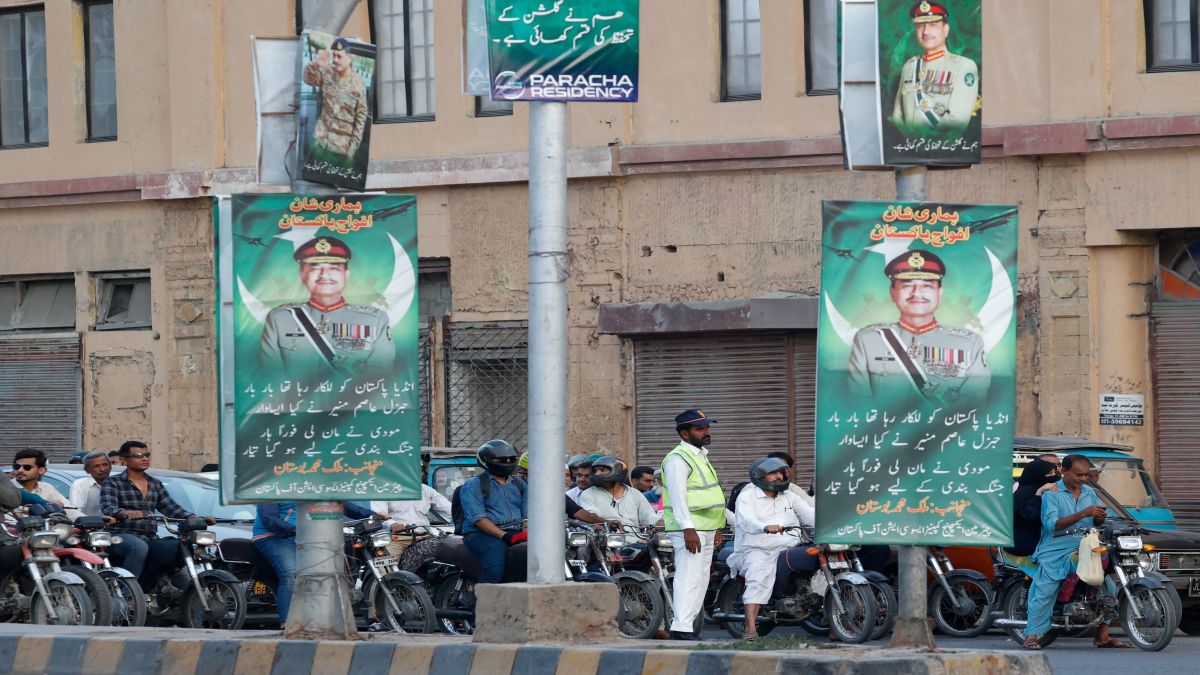
 "A police officer stands in front of the traffic, next to posters of the Chief of Army Staff of Pakistan Asim Munir, in Karachi. File image/Reuters")
In 2026, Pakistan enters a new year, but the shadow of 2025—the country’s deadliest year—still lingers. In the previous year, the debate inside Islamabad was no longer whether the country was facing a security crisis, but whether it still had the strategic bandwidth to manage more than one at a time.
The numbers, compiled by the South Asia Terrorism Portal (SATP), tell the story with a bluntness that political statements cannot soften. Between January 1 and December 27, 2025, Pakistan recorded 1,070 incidents of killing, resulting in 3,967 deaths. Among them were 1,212 security personnel, 655 civilians, and 2,099 insurgents. In a single year, Pakistan nearly doubled the total fatalities it recorded in 2024.
This was not simply the deadliest year in recent memory. It was the year Pakistan’s internal security crisis stopped being containable and began to bleed visibly into its foreign policy, military posture, and diplomatic choices. Yet even these figures may significantly understate the true scale of loss.
Pakistan has historically maintained strict opacity around military and paramilitary casualties, rarely releasing comprehensive or disaggregated data on security personnel killed or injured during attacks and counterterror operations. Official figures are drawn largely from media reporting, selective ISPR briefings, and episodic acknowledgements that are widely believed by analysts to represent only a fraction of actual losses. What is missing most conspicuously from official tallies is the full impact of IED-driven attrition.
Across Khyber Pakhtunkhwa, the former tribal districts, and large swathes of Baluchistan, improvised explosive devices have emerged as the primary killing mechanism in 2025, accounting for over 40 per cent of security force fatalities. Patrol vehicles, logistics convoys, checkposts, and even routine troop movements have increasingly become targets of low-visibility, high-lethality IED attacks. These incidents rarely produce dramatic visuals that can depict easily marketable claims of tactical success and are therefore the easiest to downplay, aggregate vaguely, or omit altogether.
Quick Reads
View AllThis creates a structural distortion in datasets such as SATP’s. While methodologically rigorous, SATP relies heavily on open-source media reporting and official confirmations. When the state or its affiliated media sources choose not to acknowledge IED-caused fatalities as insurgent attacks or collapse them into euphemisms such as “vehicle blast”, “operational incident”, or “roadside explosion”, those deaths often fail to enter the formal count.
Also glaringly missing are the casualty figures from the October 2025 Jaffar Express hijacking and its associated casualties. Most of the mainstream media and credible OSINT sources had put the casualty numbers between eighty-eight and a hundred and twenty-five, yet this data is critically missing from SATP’s data sheet on Baluchistan for the month of October 2025.
The consequence is not a marginal discrepancy but a systemic undercounting of losses in precisely the form of warfare insurgents now prioritise.
Credible open-source intelligence (OSINT) accounts, aggregating battlefield reports, funeral notices, local-language media, hospital admissions, graveyard data, and district-level incident tracking, paint a far grimmer picture. When this data is collated and the fatalities are fully incorporated, Pakistan’s security force losses in 2025 plausibly fall in the range of 2,700 to 3,000 killed, with around 3,500 more injured.
Strikingly, these OSINT estimates converge closely with operational claims made by the Tehreek-e-Taliban Pakistan. While insurgent statements are routinely dismissed as propaganda, they are often far more granular when it comes to IED operations by listing locations, routes, timings, and unit types that can be cross-verified independently. In an environment of state opacity, insurgent transparency about inflicted losses becomes, paradoxically, a more reliable signal.
If these higher estimates are even partially accurate, 2025 was not merely Pakistan’s deadliest year by acknowledged metrics, but it was one of the most punishing periods for its security forces since the peak of the internal war a decade earlier.
When escalation becomes routine, not exceptional
For years, Pakistan’s counterterror doctrine has rested on a familiar assumption, that intensified operations would eventually suppress insurgent capacity. In 2025, that assumption has completely collapsed under the weight of reality.
Data from domestic security trackers showed that violence did not recede despite sustained kinetic action. Insurgents were killed in large numbers, yet the attacks continued with a frequency that suggested regeneration and not exhaustion. Security force fatalities were higher than the insurgent deaths, a pattern that bears the characteristic not of victory, but of an attritional conflict.
This is the uncomfortable truth the numbers expose, especially once IED casualties are fully accounted for. Pakistan is not absent from its internal battlefield, but it is deeply engaged, and the engagement alone is no longer shaping outcomes. Instead, it is bleeding manpower steadily, quietly, and without strategic inflection.
Balochistan: The cost of deferred political settlement
Nowhere is this clearer than in Balochistan. The province accounted for hundreds of attacks in 2025, with civilian and security force casualties reaching levels that, in quieter years, would have triggered national emergencies.
Here too, IED warfare has been decisive. Long-range ambushes, infrastructure sabotage, and convoy-targeted explosives have turned the province into a slow-burn insurgency theatre. Infrastructure projects, transport routes, migrant labour, and state installations were targeted with increasing confidence. The state responded with force, but without a parallel political strategy capable of addressing alienation, representation, and resource grievances. The result is a province that drains military resources continuously, at a time when Pakistan can least afford strategic leakage.
The western frontier: Strategic depth turns into strategic death
If Balochistan reflects Pakistan’s internal contradictions, the western frontier exposes its external miscalculations.
The relationship with the Afghan Taliban that was once framed in Islamabad as a post-2021 strategic advantage has hardened into a liability. The persistence of attacks linked to the TTP, many of them executed through cross-border planning and IED networks, has turned the Afghan border into a zone of strategic bleed.
Pakistan bears the costs of violence inside its territory while possessing limited leverage over Kabul’s internal calculus. Military operations can disrupt cells, but they cannot neutralise an ecosystem whose rear areas lie beyond Pakistan’s control.
The eastern frontier: Escalation risk without internal insulation
Against this backdrop, Pakistan’s eastern frontier with India has re-emerged as a destabilising variable rather than a managed rivalry.
The pattern in 2025 was familiar. After ISI orchestrated a terror attack in Jammu and Kashmir that was followed by the launch of Operation Sindoor, striking at the heart of Pakistan, the context of managed rivalry changed into a full hostile threat.
A state losing not just a thousand but potentially several thousand security personnel annually to its external and internal conflicts operates under intense political, institutional, and psychological pressure. That pressure narrows margins for error and makes crisis management more brittle. It also stretches Pakistan’s military on its eastern border, and that makes it vulnerable against the increasing insurgent pressure within. The danger in this case then is not of intent, but a small miscalculation that has the potential to trigger a potentially disastrous result.
Gaza and the illusion of external relevance
It is in this context that Pakistan’s tentative realignment with the United States, including discussions around a potential Pakistani role in peacekeeping or stabilisation missions linked to Gaza, must be understood. On paper, such a role offers diplomatic relevance, but in practice, it reflects a strategic illusion.
Pakistan in 2025 is not a surplus-capacity security exporter. It is a state under sustained internal attrition, managing volatile borders, and absorbing steady insurgent-driven losses at home. Any overseas deployment risks hollowing out already overstretched forces, while further unmasking their core vulnerabilities.
Civilians, fatigue, and the erosion of trust
The civilian toll of 655 deaths in the first three quarters of 2025, as per CRSS, underscores another dimension of Pakistan’s crisis. Violence has seeped into public life, reinforcing fear and normalising insecurity. Interestingly, SATP also caps the civilian deaths at 655 for the whole year against CRSS’s first three-quarter numbers, further raising questions about discrepancy.
Civilian fatigue weakens institutional trust and expands the social space in which insurgency persists. Under-acknowledged civilian losses only deepen this erosion, as the public senses a widening gap between official narratives and lived reality.
What 2026 is likely to bring
Without a complete political reset in Balochistan, along with the ongoing border dispute with the Afghan Taliban and the continued absence of a credible internal security reform agenda, including transparent casualty accounting, the year 2026 is likely to see continued high-intensity violence.
Insurgent networks show no signs of exhaustion as the security forces remain overstretched. On top of that, continued economic stress severely constrains Pakistan’s sustained counterinsurgency investment. Thus, the structural drivers of instability remain intact.
The meaning of Pakistan’s deadliest year
The significance of 2025 lies not only in how many had died but also in how many were never fully counted. Pakistan is fighting a losing battle. It seeks external relevance while struggling to stabilise its own frontiers. Additionally, it continues to measure a war of attrition with tools designed for episodic conflict. In such scenarios, the deadliest years are rarely endpoints; rather, more often, they are deadly warnings for what is yet to come.
(Raja Muneeb is an independent journalist and columnist. He tweets @rajamuneeb. The views expressed in this article are personal and solely those of the author. They do not necessarily reflect the views of Firstpost.)