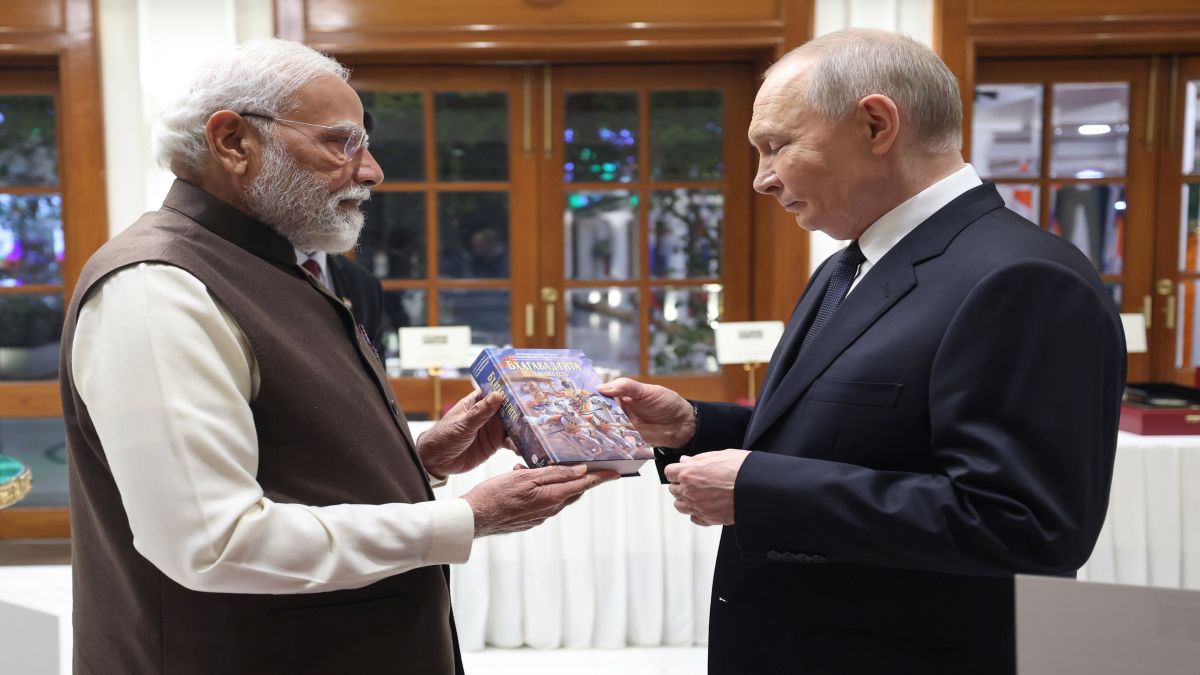
 "PM Modi gifts Vladimir Putin a Russian version of the Bhagavad Gita. Image Courtesy: @MEAIndia/X")
More than a decade since Prime Minister Narendra Modi came to power for the first time, India’s image at the international level has transformed significantly. Even the critics of this government would agree that the country has earned a respectable image for itself globally, all thanks to its material progress in addition to proactive diplomacy. One key aspect of this achievement is the way the Modi government has revived India’s rich history, its culture and its civilisational appeal. An example of the same was on offer during the visit of Russian President Vladimir Putin.
When Putin visited India for a two-day state visit this week, he was greeted in a very unique and warm way by even ordinary Indians. A pre-visit Friendship March was organised in Varanasi, PM Modi’s parliamentary constituency, where even an aarti ritual was performed on the picture of President Putin. In addition to this, internationally acclaimed sand artist Manas Kumar Sahoo created a sand animation to welcome him.
These touching gestures proved that Russia is seen as a dear friend by Indians across the board, but what truly stood out were the gifts that were given by Prime Minister Modi to President Putin. In addition to an intricately designed chess set from Agra, he was also given Assam black tea and a silver tea set from West Bengal’s Murshidabad, which is a celebration of the cultural significance of tea common to both India and Russia.
Among the total six gifts, a Russian translation of Srimad Bhagavad Gita was the most special gift which PM Modi gave to President Putin. Sharing a picture from this moment with his followers on social media platform X, PM Modi wrote, “Presented a copy of the Gita in Russian to President Putin. The teachings of the Gita give inspiration to millions across the world.”
Quick Reads
View AllSrimad Bhagavad Gita is a seminal text of Hinduism which is considered a philosophical statement delivered by Lord Krishna to the great warrior Arjuna in Kurukshetra while the latter is getting jitters about fighting the Mahabharata war. It starts with Lord Krishna explaining to Arjuna the futility of his worries and discusses the Karma theory, the importance of detachment, the fragility of the material world and, most importantly, the necessity of performing one’s duties.
This is not the first time that Prime Minister Modi has handed out such a thoughtful gift to a foreign dignitary, something which is rooted so deeply in India’s traditional values and thoughts. In 2023, he gifted a copy of ‘The Ten Principles of Upanishads’, a book co-authored by Irish poet William Butler Yeats, a great follower of Indian spirituality, to US President Joe Biden during his US visit.
This year also, when PM Modi met his counterparts at the G7 summit in Canada, almost all his gifts to them were a symbol of India’s millennia-old civilisation and culture. He gifted a Worli painting, one of the oldest Indian folk arts, to President of Mexico Claudia Sheinbaum Pardo and a Madhubani painting to President of South Korea Lee Jae-myung. In addition to this, he gifted a sandstone replica of the Konark wheel, inspired by the famous Konark Sun Temple at Odisha, to German Chancellor Friedrich Merz.
Even PM Modi’s gift to the President of France, Emmanuel Macron, was also very special, as he gave him a sculpture of Nandi, a sacred bull and Lord Shiva’s vehicle. The host of the summit, Canadian Prime Minister Mark Carney himself, received a brass Bodhi tree from PM Modi, which is a symbol of Buddhist tradition, as it was under a Bodhi tree that Lord Buddha attained enlightenment in India’s Bodh Gaya.
2025 will definitely go down as a special year in India’s history, as PM Modi has invested immense efforts in promoting Indic culture and heritage at the international level through his gifts. When he visited Trinidad and Tobago in July, he gifted the replica of the Ram Temple in Ayodhya and water from the Holy Sarayu River, where Lord Rama ended his mortal journey, to Prime Minister Kamla Persad-Bissessar.
In March, PM Modi paid a visit to Mauritius and gifted holy Sangam water from the Mahakumbh to President Dharambeer Gokhool. Not only this, but he also mixed the Mahakumbh water into the waters of Ganga Talao, a holy lake in Mauritius which is considered to be equivalent to India’s Ganga river in the country.
What all these gifts inspired by the folk arts, Indic culture and the country’s centuries-old traditions signify is that India is one of the oldest, most continuous and most thriving civilisations in the world.
Unlike the claims made by the colonialists and their sympathisers in the country that no notion of ‘India’ existed before the advent of the British, this celebration of India’s millennia-old symbols in the form of gifts reinforces the country’s ancient identity. It also serves as a timely reminder to the world of our rich heritage and values, which are based on deep philosophical principles of harmony and justice.
The Indic faith systems, including Hinduism, Jainism and Buddhism, point towards a world where material success is not the end goal but just a means to reach a higher level of consciousness. The gifts, including the Konark wheel, which signifies righteousness and the eternal movement of time, are a testimony to this. It shows that India’s rise during contemporary times is not a mere increase in its tangible fortunes but also a reawakening and resurgence of an entire civilisation. When PM Modi inculcates such symbolism in his gifts to foreign dignitaries, then it shows his commitment to India’s great culture and how deeply he admires its value systems and its philosophies.
(The author is a New Delhi-based commentator on geopolitics and foreign policy. She holds a PhD from the Department of International Relations, South Asian University. She tweets @TrulyMonica. The views expressed in the above piece are personal and solely those of the author. They do not necessarily reflect Firstpost’s views.)