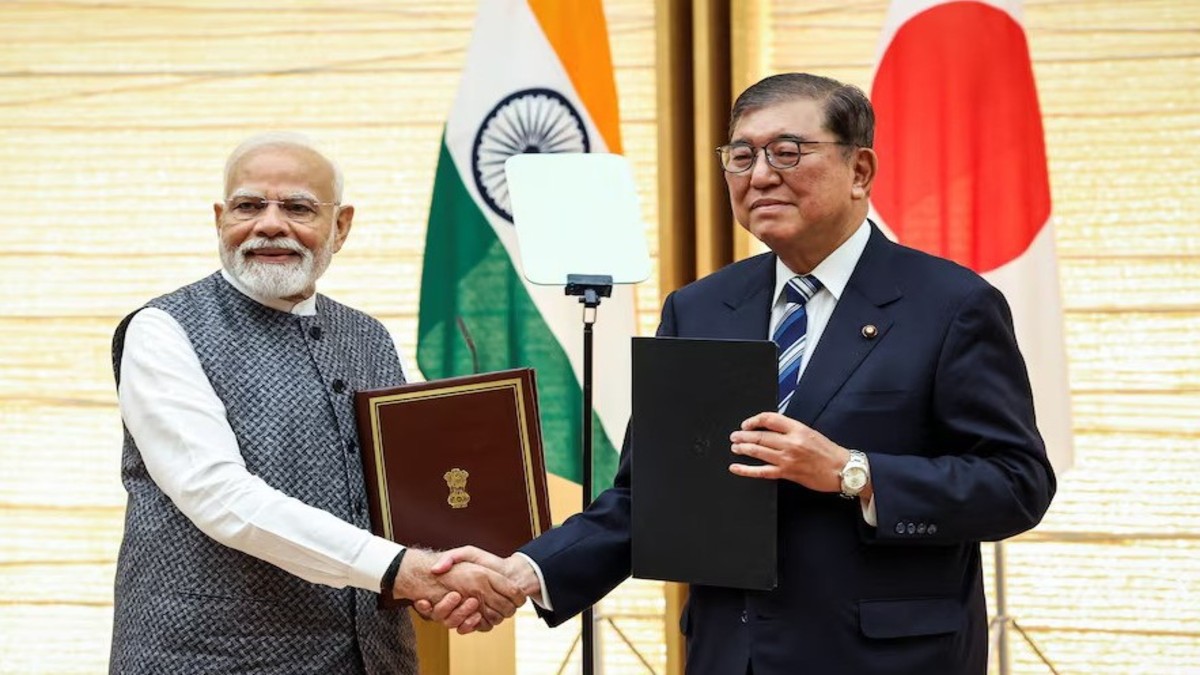
 "How India-Japan ties have reached a defining moment")
The India-Japan partnership has arrived at a defining moment. When Prime Ministers Narendra Modi and Shigeru Ishiba met on 29 August, the message from both leaders was unambiguous: New Delhi and Tokyo are not only aligned in vision but increasingly congruent in strategy. They see their partnership as indispensable to the future of the Indo-Pacific and, by extension, to the global order.
For two nations with varied histories and political cultures, this level of convergence is remarkable. It reflects shared anxieties about the turbulence of the current geopolitical environment, ranging from maritime security to economic resilience, and a shared ambition to shape the regional order in ways that secure prosperity for their people and stability for the world.
Three Pillars of Partnership
At the summit, the leaders mapped out cooperation in three priority areas: defence and security, economic resilience, and people-to-people ties. Each reflects not just pragmatic needs, but deeper complementarities.
On the defence front, the Joint Declaration on Security Cooperation elevates the relationship to a level that was almost unthinkable a decade ago. India and Japan are no longer tentative security partners: they are serious about aligning their doctrines, increasing interoperability, and coordinating in regional maritime and air exercises. The bilateral fighter exercise “Veer Guardian”, trilateral naval drills, and Japan’s participation in India’s multilateral Milan exercises mark this transition. Defence technology cooperation is now on the agenda in a concrete way.
Economically, the partnership is becoming broader and more strategic. The Joint Vision for the Next Decade places emphasis not only on trade and investment but also on critical minerals, clean energy, digital cooperation, and space. Japan’s technology and capital combine naturally with India’s scale and human resource potential. Both sides recognise that decarbonisation, digital transformation, and supply chain resilience are arenas where their interests align almost perfectly.
Quick Reads
View AllPeople-to-people connectivity is often overlooked in geopolitics, yet it is the foundation of a resilient partnership. The Action Plan for Human Resource Exchange envisions mobility for half a million people over five years, including 50,000 skilled Indian workers to Japan. For Japan’s ageing society and India’s young workforce, this is a mutually beneficial fit. It is not just economics; it creates the social ballast that strategic partnerships often lack.
The Indo-Pacific Imperative
What makes India and Japan natural partners today is the shared belief in a free, open, inclusive, and rules-based Indo-Pacific. Both countries have seen how unilateral attempts to change the status quo, whether in the East China Sea or South China Sea, undermine regional stability. Their joint opposition to coercive tactics, militarisation of disputed features, and restrictions on freedom of navigation reflects a clear-eyed understanding of the strategic challenge in Asia.
The India–Japan alignment is also nested within minilateral and multilateral frameworks. The Quad has matured into an enduring platform for regional stability. Unlike traditional military alliances, the Quad projects practical cooperation in areas such as technology, critical infrastructure, and disaster relief, while reinforcing deterrence. Japan and India both see this as an opportunity to bring their respective strengths to the table without losing strategic autonomy.
Equally significant is their emphasis on Asean centrality and frameworks such as the “Asean Outlook on the Indo-Pacific”. For both countries, Southeast Asia is the hinge between the Indian and Pacific Oceans. Ensuring that Asean retains agency and resilience in the face of external pressures is a shared objective.
A Wider Arc: From Africa to the UN
The Modi–Ishiba summit underscored that Indo-Pacific cooperation extends beyond Asia’s waters. Both countries are looking westwards, towards Africa. The Japan–India Cooperation Initiative for Sustainable Economic Development in Africa seeks to create industrial hubs in India as gateways for investment into Africa. This is an astute strategy: Africa represents both opportunity and vulnerability, and the ability of India and Japan to deliver tangible connectivity projects there will test the credibility of their global ambitions.
Equally, the two countries see themselves as reformers of the global order. Their mutual support for each other’s bid for permanent membership of a reformed UN Security Council is not new, but there is a renewed urgency. The leaders explicitly called for time-bound negotiations and text-based outcomes. This reflects not just frustration at the inertia of multilateral reform but also the belief that India and Japan, together, embody the voices of regions long under-represented in the Council’s permanent membership.
Security and Terrorism
Strategic congruence is not only about maritime security or economic resilience. It is also about confronting asymmetric threats like terrorism. Both leaders unequivocally condemned terrorism in all forms, including cross-border terrorism affecting India. By naming groups such as Lashkar-e-Taiba and Jaish-e-Mohammad alongside Isis and Al Qaeda, the statement sends a message of clarity. Japan, often more cautious in its diplomatic language, has now aligned more closely with India’s concerns, an indication of growing trust.
The Value of Congruence
Why does this congruence matter? First, it strengthens the resilience of the Indo-Pacific order at a time when US–China rivalry creates uncertainties. India and Japan are not formal allies, but their combined weight offers balance in the region.
Second, it creates pathways for middle-power diplomacy. Both countries recognise the value of working with partners such as Australia, Asean, and Africa. They are not seeking to replicate bloc politics of the past but to create flexible, overlapping networks of cooperation.
Third, it provides a model of partnership rooted in complementarity rather than symmetry. India brings scale, skills, youth, and geography; Japan brings technology, finance, and global influence. Together, they create more than the sum of their parts.
Challenges Ahead
Of course, congruence does not mean identity. India and Japan will sometimes diverge in approach, as in dealing with China, managing relations with Russia, or aligning with US strategic preferences. Japan’s alliance with Washington gives it a different lens, while India’s strategic autonomy remains non-negotiable. Yet, precisely because of these differences, the ability to find convergence is even more significant.
There are also delivery challenges. Infrastructure projects often suffer from delays; defence technology collaboration needs faster movement; people-to-people ties will require cultural adaptation in Japan and skill alignment in India. Political will from the top must translate into bureaucratic agility below.
Conclusion
At this summit, Prime Ministers Modi and Ishiba did more than exchange warm words. They articulated a vision rooted in strategic congruence—an alignment of values, interests, and ambitions. The challenge now is implementation: to ensure that the bold announcements become tangible outcomes and that this partnership becomes truly indispensable to the Indo-Pacific order.
The India–Japan relationship has always carried potential. Today, it carries responsibility. The future of the Indo-Pacific will, in no small measure, depend on how effectively New Delhi and Tokyo can turn congruence into action.
The writer is a former ambassador to Germany, Indonesia, Ethiopia, Asean, and the African Union, and the author of ‘The Mango Flavour: India & Asean After 10 Years of the AEP’. The views expressed in the above piece are personal and solely those of the author. They do not necessarily reflect the views of Firstpost.


 "Saudi Arabia, Turkey, Egypt, Jordan, Indonesia, Pakistan, Qatar, UAE accept Trump 'Board of Peace'")
 "'PM Modi a fantastic man... we're going to have a good deal': Trump tells Moneycontrol | Watch")
 "Greenland unveils 'crisis' guidelines as Trump renews call for talks on taking island")
 "Is Canada preparing for a US invasion as Trump unsettles allies? Report says...")
 "Saudi Arabia, Turkey, Egypt, Jordan, Indonesia, Pakistan, Qatar, UAE accept Trump 'Board of Peace'")
 "'PM Modi a fantastic man... we're going to have a good deal': Trump tells Moneycontrol | Watch")
 "Greenland unveils 'crisis' guidelines as Trump renews call for talks on taking island")
 "Is Canada preparing for a US invasion as Trump unsettles allies? Report says...")