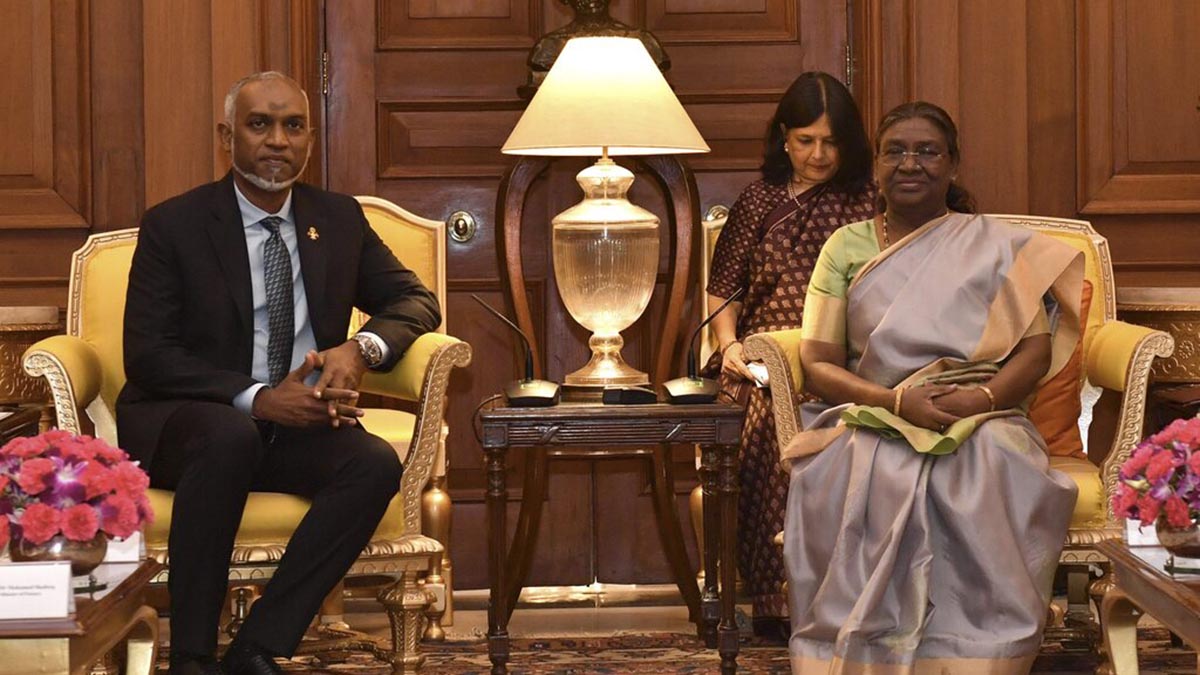
 "President Droupadi Murmu with President of Maldives Mohamed Muizzu during a meeting, at the Rashtrapati Bhavan, in New Delhi on June 10, 2024. PTI")
On his return home from New Delhi, Maldives President Mohamed Muizzu described his India visit as a ‘success’. According to him, the visit ‘played a pivotal role to enhance bilateral relations, benefiting Maldivians’. In New Delhi, earlier, he said he was committed to ‘preserve close, historic ties with India’. He was ‘honoured’ to be invited for Prime Minister Narendra Modi’s inauguration was Maldivian President’s reaction, before it all. After delegation-level talks a day after the swearing-in ceremony, India’s External Affairs Minister S Jaishankar, who is continuing in office under Modi 3.0, said that India too ‘looked forward to working closely with Maldives’.
It was Muizzu’s maiden visit to India after becoming president in November last. Since then, there have been new vibes, positive and not-so-positive. While the local media promptly reported PM Modi’s Eid greetings for Muizzu, the Maldivian authorities lost no time to clarify that the military personnel training Maldivian counterparts in southern Addu were not from India but Sri Lanka. Religious scholars’ interpretation of the India-sponsored Yoga Day celebrations on the High Commission premises this year too was positive compared to motivated attacks on public demonstration. On people-centric trade, India will begin delivering perishable goods to the South round-the-year, as against on specific days, thus far.
But the state of the Maldivian economy indicates that either the nation will have to go in for IMF-dictated structural reforms that accompany a bail-out package, but it may not be a popular measure, as neighbouring Sri Lankans have been complaining through frequent street-protests. The alternative would be to seek out massive budgetary support that not many nations are in the habit of extending. In the case of Maldives, India has been a near-loner in the matter, going back to the days of pre-democracy President, Maumoon Abdul Gayoom.
Today, under the changed geo-political and geo-strategic situations and also given the signals being sent out to New Delhi from Male, President Muizzu should walk the talk on bilateral ties. The spirit of what he says in Delhi should be felt on the ground in Male. Once there is clarity in the matter, it may not be impossible for the two sides to sit down and discuss a possible way out of Maldives current economic predicament. They need only to look out at common neighbour Sri Lanka, where even as the economic crisis was unfolding two years back, New Delhi rushed, almost unilaterally, food, fuel, funds and what not. India sees it all as a regional responsibility as the larger nation in the region, as a part of the ‘Neighbourhood First’ Policy, which PM Modi reiterated at his third inauguration, recently.
Impact Shorts
More ShortsSovereignty talks
However, in the Maldivian Parliament, where Muizzu’s People’s National Congress (PNC) holds a super-majority after scheduled polls in April, a hard-line member from his party wanted (at least?) three of India-funded agreements of the predecessor government of President Ibrahim ‘Ibu’ Solih probed by the House ‘National Security Committee’ (NSC), popularly known as the ‘241 Committee’. Prima facie, the move is seen as a ‘motivated attempt’ to try and torpedo bilateral relations when President Muizzu was seeking to put them back on the track, citing ‘national independence and sovereignty’. Also, the government of President Ibrahim Solih had even given 241 committee members access to the pact on the India-funded Coast Guard boat jetty for the Maldives National Defence Force (MNDF) in Uthuru Thila Falhu (UTF) Island – but without copying or reproducing them. No specific complaints followed.
Incidentally, Ahmed Azaan, MP, who has racked up the issue now in his previous avatar as a journalist, ‘sneaked into’ the UTF Island and produced photographs and videos, claiming to show one too many Indian soldiers – but almost none was visible. The Muizzu government, then and since, has reiterated that only 78 military personnel, who were manning the three aerial platforms gifted by India, were present and had been replaced by civilian counterparts, under a bilateral agreement to the effect. The Muizzu leadership’s future moves in relation to the 241 committee proceedings in the matter will be keenly watched.
Two, as a part of his presidential poll campaign, Muizzu had promised to take the people into confidence on all overseas agreements not only of the Solih government but also those of his future regime, if elected. After assuming power, the government however refused to present the agreements signed with Turkey during the President’s first official overseas visit in December, followed by the maiden ‘state visit’, this one to China – citing ‘national security reasons’. This double-standard, starting with the demand and access to the UTF agreement during the previous Parliament, and selective access, as is being sought with India and India alone as the target, does not send out the right signals.
As coincidence would have it, only days after Muizzu’s India visit, a senior Chinese official, Bater, after calling on the Maldivian President, repeated what has become the standard national refrain that Beijing ‘will advance cooperation with Maldives while respecting its sovereignty’. It is the kind of insinuation that China has reserved for India, especially in the Maldivian context, since March 2018.
In the contemporary regional context, there is no parallel to Beijing compromising Sri Lankan ‘sovereignty’ by taking over territory in Hambantota, in the name of a 99-year lease against unpaid debts – and later having the Sri Lankan Parliament to enact a separate law for the China-controlled Colombo Port City (CPC), which is being developed as an international financial market. Also, the inordinate delay in Sri Lanka getting Chinese debts re-structured as a part of a promised IMF bail-out package should not be missed, either.
There is also a Maldivian precedent on the other side of the spectrum, especially if Muizzu intends seeking a second term. President Mohammed Nasheed’s popularity nose-dived after he adopted IMF recommendations to cut down government jobs and salaries by 20 per cent, hike power-tariff, introduce ‘tax reforms’ and float the US dollar, the mainstay forex currency.
Now, the Muizzu administration has begun diversification on the forex front, by deciding on trade in Chinese yuan. Maldivian forex experts should be looking at future fall-outs that may or may not work out favourably for their country.
Incidentally, Maldives Economic Cooperation Minister Mohamed Saeed met with his Chinese counterpart Wang Wentao on the sidelines of the World Economic Forum meeting at Dalian, China, to take forward the bilateral FTA process stalled by the predecessor government of President Ibrahim Solih, and take forward other elements on economic cooperation contained in the 20 agreements signed during President Muizzu’s Beijing meeting with counterpart Xi Jinping in January.
Unsustainable promises
There are doubts if hard-liners backing the Muizzu administration are flagging ‘sovereignty issues’ and the like, using India as a peg, only to distract national attention from the looming economic crisis, about which both the World Bank and the IMF have been continually cautioning the Maldivian government since the Solih dispensation. Even while criticising the incumbent Solih regime for unsustainable poll promises, Muizzu too had made some that are coming home to roost.
The list includes Muizzu’s poll promise to clear all pending payments to fishermen for past procurement. Now, months after the twin-polls had been won, the government has decided not to procure more yellow fin tuna for now and also declared inability to clear the dues until the fiscal situation improved – all of it leading to the continuance of the fishers’ strike. Going beyond the poll promises, Muizzu has gone about launching more populist schemes like the ‘cool school’ programme aimed at full air-conditioning of all class rooms in government schools, which is the educational mainstay across the country. The scheme involves capital investments and also recurring expenditure in the form of electricity and maintenance charges. These are only samples.
According to official reports, the government’s recurring expenditure has grown substantially in the past months. Even the creditable claims that the Muizzu dispensation has cleared MVR 1 billion towards debt-repayments has only meant that the money in the till, or whatever is there, is going only to pay for the past and not for investment in the present and the future.
Against this, the Maldives Internal Revenue Authority (MIRA) has reported a 4.5-per cent fall in May collections this year, compared to the previous one.
The Bank of Maldives (BML), in turn, claimed to have sold $ 333 million more than available to buy, and conceded that it ‘is not sustainable’. BML also declared that it was ‘difficult to rise) card-limit over dollar-shortage’, as desired by the government. This was so, even as dollar-rate began its post-poll upward journey, at MVR 18, in the ‘open-market’, euphemism this for ‘black-market’. The government has also floated further Treasury Bills worth MVR 2 billion.
Nothing explains the prevailing situation than Deputy Speaker of Parliament, Ahmed Nizam, told the Public Accounts Committee that the government should reveal the state of the economy and clarify to the public if bitter medicine is needed to overcome the present downturn. Finance Minister Mohamed Shafeeq went a step further on the specifics when he declared that ‘job-cuts will be last cost-cutting measure’, as if it would not happen soon. However, the State-owned Road Development Corporation (RDC) has announced its decision to lay-off some employees forthwith.
There is an under-current of panic in the public arena, as this is being seen as a precursor for worse things to come. According to official figures, 11.53 per cent of the 262,670 working-age people in the country are government servants, up from 10 per cent, when the erstwhile Nassheed government (2008-12) decided to impose a 20-per cent cut in staff-strength and pay, in tune with IMF recommendations for loan-eligibility.
In the meantime, international credit-rating agency Fitch has downgraded Maldives’ long-term foreign currency issuer default-rating to ‘CCC:’ from ‘B-’, or ‘junk’, owing to rising external debt and weakening foreign reserves, etc. However, unlike the predecessor Solih government, which invariably contested such downgrades or even observations by the IMF and World Bank, the Finance Ministry has claimed that the ratings can be upgraded with the implementation of the government’s economic reforms measures. Finance Minister Mohamed Shafeeg also claimed that sustained cost-cutting has helped save MVR 2.5 billion thus far this fiscal, beginning January.
Based on discussions over a Finance Ministry paper, President Muizzu has also green-lit cost-reduction, revenue-growth and medium-term revenue strategy as a governmental policy. Accordingly, the government hopes to increase the revenue to GDP ratio to 35.5 per cent from 32.5 per cent as at present. The proposed measures include increased GST, Green Tax and import duty.
A ruling legislator has also presented a Fiscal Responsibility Bill in Parliament, one of whose key elements is to raise the government’s borrowing-limit from the Maldives Monetary Authority (MMA), the nation’s central bank. The Bill also proposes to give greater leeway for the government to print currency, which Muizzu had despised in his election speeches. To reduce excessive spending, a ruling MP has proposed fund-cuts for Aasandha, the popular public health insurance scheme, and also for various subsidies. He also wants the number of MPs reduced from the present 93 to the original 85, as every MP has to be paid a monthly salary of $5500-equivalent.
Road-show in India
Though no one is acknowledging it, the post-Covid recovery of the nation’s mainstay tourism industry is not commensurate with the over-burdening of the sector, as if it were a goose that laid golden eggs. Even though China has re-captured the top-slot as a tourist-supplier nation after three years of Covid lock-out, as desired by Muizzu during his January visit, the same cannot be said of India. This was especially so after the ‘Boycott Maldives’ social media campaign in India, earlier this year after three junior ministers (since suspended) posted defamatory material against India and PM Modi. Now, the Maldivian tourist operators association is planning a road-show in India, for attracting more guests back to the country, indicating a U-Turn from early Maldivian industry reaction to the ‘Boycott Maldives’ call.
In this midst of all this, Nasheed, who has since voluntarily stepped aside from active politics, to be associated with an international grouping on his favourite climate themes, has claimed that his Democrats, a breakaway group of present-day main Opposition, Maldivian Democratic Party (MDP), had supported Muizzu in the presidential poll. In the same vein, Nasheed also said that the Democrats now backed President Muizzu, ‘based on the prospect for India relations’. However, Nasheed has since seemingly moved from that position by responding positively in double quick-time to estranged friend Solih’s call for his breakaway Democrats to work again with the parent MDP. How this dynamics pans out within the MDP and at the national-level will be keenly watched, both inside and outside the country.
In the meantime, Solih has also backed the policies of his erstwhile government to revive the failing economy and said the Muizzu dispensation was not telling the truth about the Sovereign Development Fund (SDF), created by his controversial predecessor Abdulla Yameen, for repaying external debts when due. For his part, Yameen, still in home-prison, pending the High Court disposing the money-laundering conviction against him from his days as President (2013-18), cautioned the government that borrowing money from the central bank, which Finance Minister Shafeeg acknowledged, to printing money – both of which are injurious to the economy. Yameen implied that both Solih and Muizzu governments indulged in the same.
In the meantime, Foreign Minister Moosa Zameer met with US Secretary of State Athony Blinken in Washington, and United States Agency for International Development (USAID) administrator Samantha Power, and discussed bilateral matters, including defence cooperation, during a four-day visit. It is surmised that the defence talks were a take-off from where they had begun with the signing of a ‘framework agreement’ during then Defence Minister Mariya Didi’s ‘secret visit’ to Philadelphia, in the midst of Covid lock-down, in September 2020. It is however anybody’s guess how Maldives under Muizzu intends balancing defence cooperation with the US and China at the same time and how it hopes to keep its immediate Indian neighbour out of what essentially is a regional affair. It is also not known why Maldivian Defence Minister Ghassan Maumoon was not a part of the delegation that travelled to the US and held discussions also on bilateral defence cooperation.
The writer is a Chennai-based Policy Analyst & Political Commentator. The views expressed in the above piece are personal and solely those of the author. They do not necessarily reflect Firstpost’s views.