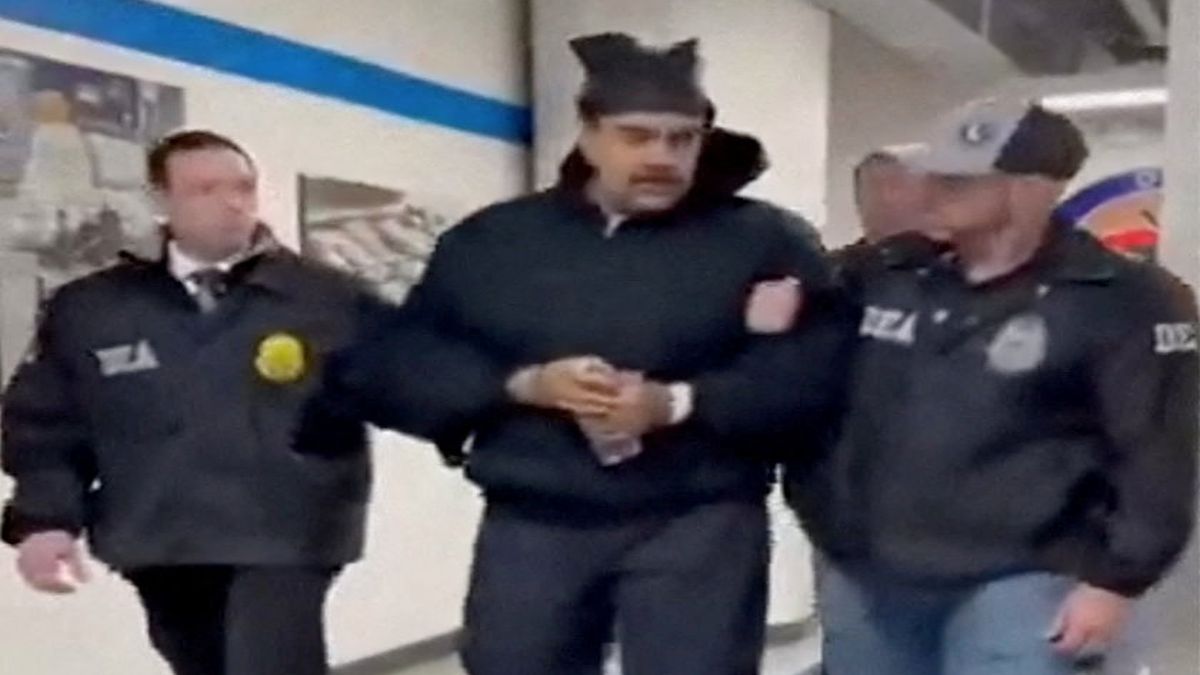
 "Maduro’s abduction exposes Western hypocrisy, mockery of international law")
Venezuela’s President Nicolás Maduro is now handcuffed and appearing in a US court. Along with him was his wife, similarly handcuffed—a shocking sight to the world—even as US President Donald Trump boasted about the strike as “brilliant”, while Venezuela held a day of mourning for 38 soldiers killed and another 24 security guards in the raid.
But in essence, the Venezuela adventure is not about Maduro at all. It is about what it means for the rest of us. True, few of us know or care about international law (IL), but here’s the thing. IL is what gives sanctity to your borders, ensures your right to fly out to another country, ensures your ships ply the oceans for trade, and a hundred other rights you take for granted. Most of all, it ensures that governments act within some guardrails—not much, but some.
The US kidnapping—for it is no less—of the President of Venezuela and his wife shatters that very thin glass ceiling on what countries and leaders can and cannot do. That’s disturbing. What’s worse is that no one, especially not the great democracies of the world, is prepared to do anything about it—at least not in hard terms. But as President Trump threatens a number of other countries, including Iran and Guatemala among others, the international system is shifting gears.
The US and Multiple Regime Changes
It is not that the US has not indulged in such acts before. It has done a lot more than most people are aware. A book, Gray Zone Warfare: The Way Ahead for India by Lt Gen Dushyant Singh, lists over 72 regime changes by the US since 1947-1989, of which only some six were overt, and of those, three were in Latin America. In fact, this part of the world dominates the list, showing the deep conviction of Latin America as part of the US “divine right” of intervention.
Most did not achieve their goals, and many were against established democracies, including France and Italy. There is another interesting statistic. The preferred strategy for regime change included electoral interference (exactly what Russia was accused of in US elections), and the top ten interference operations were in Italy (eight times), Japan (five times), Israel (four times), and Sri Lanka (four times). That list might well have included India, if allegations against USAID are to be believed.
Quick Reads
View AllCertainly, “regime change” was achieved using huge funds, non-governmental organisations, and a host of other institutions, all of which were subverted for US ends. In other words, both covert and overt interventions were not driven by fear of communism at all, but by solid self-interest.
Of Laws and Legitimacy
The US charges against Maduro have quite literally piled up over the years—in fact, since 1999—in terms of his partnering with narco-terrorists, running guns, and, most significantly, being described as an “illegitimate” government. No doubt the elections of 2024 were seen as suspect by many. Also true is that protests and violence after the elections were far more violent than before, in a country that has seen political violence earlier.
But that last charge is the key justification in bringing him to trial under US domestic law, plus the fact of his alleged massive cocaine activities that harmed US citizens. There are also declared charges that Maduro “stole” US oil assets, apparently because the infrastructure was set up decades ago by US companies, though that is not part of the charges. None of that will hold water under international law.
Kidnapping a head of state, however corrupt, is completely unjustified, and there is not an iota of “self-defence” involved in the use of force, which was certainly employed.
US Justifications and Loopholes
What the US seems to have resorted to first is a Justice Department legal memo from 1989 during the George HW Bush administration. In 1989, the media noted the unusual secrecy with which the Justice Department gave the Federal Bureau of Investigation (FBI) legal authority to apprehend fugitives from US law in foreign countries and return them to the United States without first obtaining the foreign state’s consent. This appeared to be consistent with US attempts at the time to seize Panama’s Noriega on similar charges of drug trafficking.
Called the President’s “Snatch Act”, it was a legal opinion that reversed earlier rulings during the Carter administration that expressly prohibited federal agents from undertaking such acts. Covert actions of all kinds—including political influence operations—are permitted under the National Security Act of 1947, where the President originally had near freedom to decide on any covert action abroad, though subsequent amendments did require greater congressional committee oversight.
But that line remains unclear, with anything short of war still giving the President considerable freedom. Notably, the administration briefing to a select bipartisan group framed the whole episode as a “law enforcement” operation, a tone that is unlikely to sit well with lawmakers. But with Republicans dominating in the Senate (53 to 47) and in Congress (220 to 213), planned legislation to bar the use of troops in Venezuela (or anywhere else) may be an uphill task, since it requires Republicans to break ranks.
International Law Doesn’t Apply
There is another notable issue. In an answer to the Senate Intelligence Committee, a US official, quoting Section 503(a)(5) of the Act, stated that while presidentially authorised action may not violate the Constitution, “Congress did not prohibit the President from authorising a covert action that would violate a non-self-executing treaty or customary international law”. Further, she stated, “…the United States respects international law and complies with it to the extent possible in the execution of covert action activities”.
In other words, the UN and international rules have no bearing on US covert actions.
For India and the rest of the Global South, it is not just the US action that is worrying. It is also the complete helplessness of the rest of the world—not just in preventing this abduction of a sitting President, but even other such adventures. Trump’s Greenland plan has Denmark and Europe fulminating, but there is not much they can do about it. Europe could send a “common defence force”, but for that they have to settle the Ukraine war, which is being fought to the last Ukrainian.
That support for a now unelected President Zelenskyy is another travesty. This is no “rules-based order”, which will make it increasingly difficult for India and other Quad members, among others, to stomach co-operation with US forces. The trouble is that the world’s worst countries, who have nothing to lose, will rally around Washington to pursue their own illegal aims. Pakistan is a prime example. And now Bangladesh, where the US hand in removing Sheikh Hasina—ironically for poor democratic practice—is likely to become another exercise in international disruption.
These are highly dangerous times. India must gather to itself those countries that can stand together for a true “rules-based order” based on Vasudaiva Kutumbukam—the world and all living things in it as one family—for their own interests. To become a standard-bearer of such high moral principles, however, the entire development model of the state must follow the principle that no one and nothing stands alone. Everything is related to everything else, which means going back to the Vedas for development models.
The clarity of these old texts needs to replace the old Western-inspired models of development. Let Bharat grow on its own terms and its own principles. When that path is set, the rest of the Global South will follow. Time for the best and highest of principles to be laid in stone. Meanwhile, keep your powder dry. Rule-making is a tough business.
(The writer is Director [Research and Analysis] at the Centre for Land Warfare Studies. Views expressed in the above piece are personal and solely those of the author. They do not necessarily reflect Firstpost’s views.)

 "Trump announces 25% tariff on Iran’s trading partners. How India may be affected")
 "India, US to resume BTA talks after 5 months as Gor pushes for trade deal with 'real friends'")
 "ICC sources rubbish Bangladesh sports adviser’s sensational claim of BCB being asked to drop Mustafizur")
 "Jerome Powell: The 'Fed chair with a spine' taking on Trump")
 "Trump announces 25% tariff on Iran’s trading partners. How India may be affected")
 "India, US to resume BTA talks after 5 months as Gor pushes for trade deal with 'real friends'")
 "ICC sources rubbish Bangladesh sports adviser’s sensational claim of BCB being asked to drop Mustafizur")
 "Jerome Powell: The 'Fed chair with a spine' taking on Trump")