

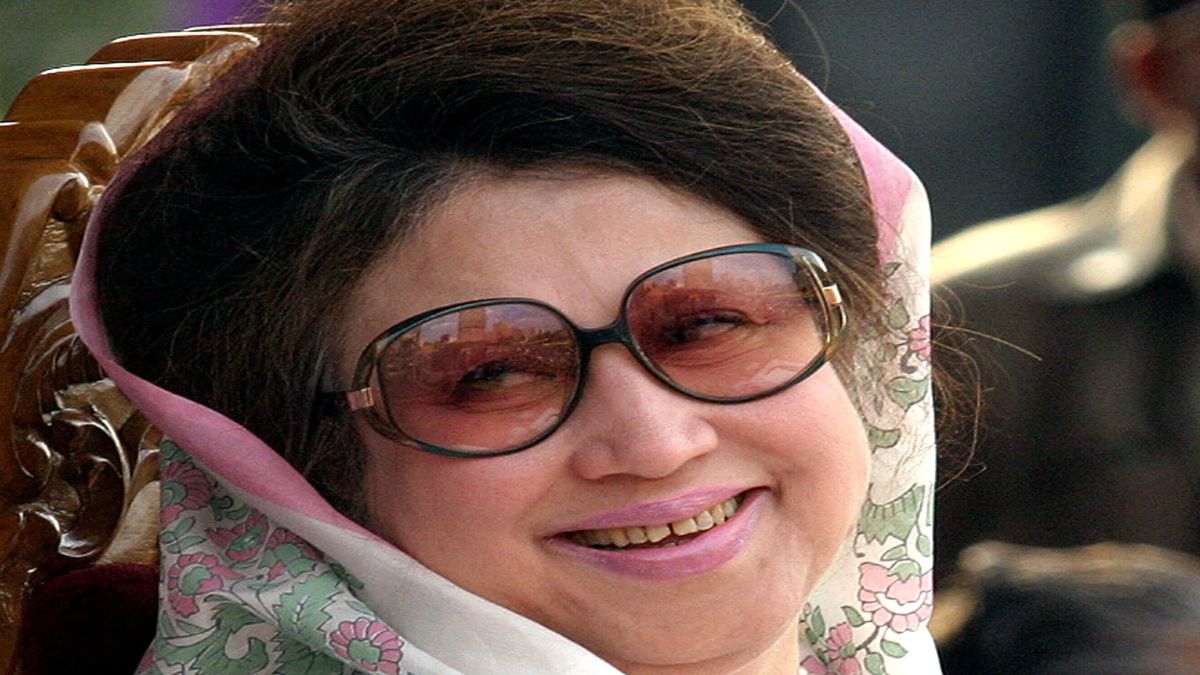
 "Khaleda Zia’s death casts a long shadow over Bangladesh’s February elections")
Begum Khaleda Zia passed away on 30 December 2025. She had been ailing for some time and was on a ventilator due to advanced cirrhosis of the liver, arthritis, diabetes, and chest and heart problems. She was 80 years old. During her final days, Bangladesh’s interim leader, Muhammad Yunus, called upon the nation to pray for her, describing her as a “source of utmost inspiration for the nation”.
Begum Zia was married to General Ziaur Rahman, who, as President, was assassinated during a 1981 coup. She later helped build a mass movement against General Ershad, the military dictator who was finally ousted in 1990.
She won her first term in 1991, becoming the first woman Prime Minister of Bangladesh. Her opponent in that election, and several since, was Sheikh Hasina. Khaleda Zia was criticised over an early 1996 election in which her party won 278 of the 300 parliamentary seats during a wide boycott by other leading parties, including Hasina’s Awami League, which demanded an election-time caretaker government. Her government lasted only twelve days before a non-partisan caretaker government was installed and a fresh election was held that June.
Khaleda returned to power in 2001 in a government shared with the country’s main Islamist party, Jamaat-e-Islami, which had a dark past involving Bangladesh’s independence war.
Though Khaleda Zia had been out of power since 2006 and had spent several years in jail or under house arrest on account of corruption charges—of which she was acquitted by the Supreme Court in January this year—she and the BNP continued to command significant support.
Her son and acting Chairman of the party, Tarique Rahman, known as the ‘Dark Prince’, returned to the country on 25 December after nearly 17 years in self-imposed exile in London and is widely seen as a strong candidate to become Prime Minister in elections due in February.
She will be buried with state honours beside the grave of her husband, President Ziaur Rahman, at Zia Udyan near Chandrima Udyan in Dhaka on 31 December. External Affairs Minister Dr S. Jaishankar will represent the Government and people of India at the funeral.
Rise to Power and Legacy
General Ziaur Rahman’s death on 30 May 1981 plunged Bangladesh into deep uncertainty. Although Khaleda had not been politically active during her husband’s presidency, senior BNP leaders saw her as the only figure capable of unifying the party’s competing factions and preserving his legacy.
After Rahman’s death, Vice-President Abdus Sattar became Acting President and later won an election. Within months, however, Army Chief General H. M. Ershad seized power in a bloodless coup in March 1982, imposing martial law. It was in this volatile context—with the military once again in control and political parties fighting for survival—that Khaleda began her ascent, eventually emerging as a central civilian figure challenging authoritarian rule.
Khaleda joined the BNP as a general member in January 1982, became its Vice-Chair in 1983, and was elected Party Chairperson in August 1984. In the decades that followed, she would win three national elections.
She governed more as a pragmatist than a visionary, aware that democracy rests on institutions. Her first term reset the constitutional balance, restoring parliamentary authority through the 12th Amendment and reducing the concentration of power in the executive.
Economically, she focused on export-led growth, foreign investment, labour migration, and the expansion of the garment industry. Among her most consequential policies was a nationwide stipend programme for girls’ secondary education.
After Sheikh Hasina consolidated power in 2014 and ruled the country for more than a decade, Khaleda Zia found herself sidelined, imprisoned, and politically constrained. She maintained that the corruption charges brought against her in 2018 were driven by political vendetta rather than justice.
Her fortunes shifted following the student-led uprising in 2024 that brought an abrupt end to Hasina’s rule. Zia was released from detention later that year, and in January 2025 Bangladesh’s Supreme Court cleared her of the final remaining corruption case, effectively restoring her eligibility to contest national elections.
Her public life unfolded alongside personal setbacks. Her elder son, Tarique Rahman, went into exile in 2008 after being arrested on corruption charges, while her younger son, Arafat Rahman Koko, died of cardiac arrest in 2015 while living in Malaysia.
While she fought for democracy and against authoritarianism—and it was during her premiership that Bangladesh transitioned into a parliamentary democracy—she was also a polarising figure. Her uncompromising style while in opposition, leading election boycotts and prolonged street movements, combined with recurring allegations of corruption while she was in power, inspired intense loyalty among supporters and equal distrust among her critics.
Political analyst Mohiuddin Ahmed wrote: “In the true sense, she was the first Prime Minister of independent Bangladesh to be elected under a neutral government. No one can take this achievement away from her.”
In the preface to the book Begum Khaleda Zia: Her Life and Her Story, Mahfuz Ullah wrote: “She established her own distinct political position at a time when a male-dominated society exercised absolute dominance.”
She was undoubtedly a dominant figure for decades in Bangladesh’s turbulent power struggles. Unfortunately, she lived to witness once again the re-emergence of political uncertainty and the erosion of democracy in Bangladesh.
Return of the ‘Dark Prince’
Her son, Tarique Rahman, who had been living in self-imposed exile in the United Kingdom, returned to Bangladesh along with his wife, Zubaida Rahaman, and daughter, Zaima, on Christmas Day to contest the upcoming elections and to be at his mother’s bedside.
The ‘Dark Prince’, as his detractors often describe him, was the de facto power centre from 2001 to 2006, when a coalition led by the BNP and Jamaat-e-Islami was in office.
Tarique Rahman returned to an ecstatic welcome from lakhs of supporters, many of whom walked long distances—some overnight—to line the streets of Dhaka, waving flags and chanting slogans in his support. He returned invoking echoes of American civil rights activist Martin Luther King Jr.’s “I have a dream” speech.
“Like him, I want to say, I have a plan for Bangladesh,” Rahman declared while kick-starting the BNP’s campaign for the general election on 12 February.
The BNP has been preparing for a return to power, and party leaders have indicated that if the party wins the upcoming election, Tarique Rahman—who filed his nomination papers from Dhaka-17 on 29 December—is expected to assume national leadership and become Prime Minister.
His opposition, however, will come from those disenchanted with entrenched political dynasties. If the BNP wins, the principal restraint on it is likely to be the possibility of another uprising.
Implications for India
Prime Minister Narendra Modi expressed grief over Zia’s death. In a post on X, he noted that as the first woman Prime Minister of Bangladesh, Zia’s important contributions to the development of Bangladesh, as well as to India–Bangladesh relations, would always be remembered.
“I recall my warm meeting with her in Dhaka in 2015. We hope that her vision and legacy will continue to guide our partnership. May her soul rest in peace,” he wrote.
However, Khaleda Zia opposed overland transit and connectivity links with India, both as Prime Minister and as Leader of the Opposition, a post she held twice from 1996 to 2014. A 2014 report by the Bangladeshi newspaper Dhaka Tribune quoted her as saying that transit permission must be balanced by the signing of the Teesta water accord. She also opposed the renewal of the 1972 Indo–Bangladesh Friendship Treaty, which many viewed as strategically important from a military perspective, arguing that it had ‘shackled’ her country.
There were also multiple issues, including support for separatist groups such as ULFA and NSCN, which were referred to as ‘freedom fighters’. However, post-2012, following a visit to Delhi to meet then Prime Minister Manmohan Singh, there was a pledge that future BNP governments would act against terrorist groups operating from Bangladeshi soil to attack Indian targets.
Prime Minister Modi met Begum Zia in Dhaka in June 2015 during his visit to Bangladesh. Khaleda Zia was then Leader of the Opposition. The meeting underlined the BNP’s intent to engage with Delhi and Delhi’s desire to broaden ties with Dhaka beyond Sheikh Hasina.
Given the present state of turmoil in Bangladesh and the anti-India rhetoric that has been building, it remains to be seen how relations will evolve if the BNP comes to power, possibly buoyed by a sympathy factor. However, this remains uncertain, as the youth are seeking change beyond the traditional parties.
Unfortunately, Bangladesh is stirring a vicious cauldron of hostility towards India and is also targeting its own minorities, while simultaneously courting both China and Pakistan. Given this complicated scenario, and the fact that the Awami League will not participate in the elections, among the possible contenders—the BNP, Jamaat, and the National Citizens Party (NCP)—the BNP appears the most likely to repair ties with India. Muhammad Yunus and his supporters have so far not endeared themselves to the masses.
India has consistently extended goodwill gestures to the government in Dhaka, but any new government will need to take concrete steps to protect minorities and respect Indian security concerns.
Conclusion
News of her death spread rapidly across the nation, prompting an outpouring of tributes and reflection on her legacy. Chief Adviser of the interim government of Bangladesh, Muhammad Yunus, expressed deep sorrow over her death and said the “country has lost an experienced and proven stateswoman”. He lauded her leadership, stating: “Through her uncompromising leadership, the nation was repeatedly freed from undemocratic conditions and inspired to regain liberty.”
President Mohammed Shahabuddin said: “The death of Begum Khaleda Zia has caused an irreparable loss to the nation.”
In a condolence message posted on X, the Awami League stated that Sheikh Hasina expressed her deepest condolences and said Khaleda Zia would be remembered “for her role in the struggle to establish democracy” and that “her contributions to the nation were significant”.
Her son, Tarique Rahman, stated that “throughout her life, she stood firm against autocracy, fascism, and domination, leading the struggle for freedom, sovereignty, and the restoration of democracy”. He added that “her resilience was not loud, but it was unbreakable”.
For Bangladesh, the February elections are crucial as they mark a potential democratic reset. However, the elections will now be marked by the absence of the two Begums who have influenced and dominated its electoral politics for decades. Their absence is certain to reshape the political contest.
Her death undoubtedly marks the end of an era in Bangladeshi politics and is expected to have significant political implications. There is little doubt that she leaves behind a legacy inseparable from Bangladesh’s political identity.
(The author is a retired Major General of the Indian Army. Views expressed in the above piece are personal and solely those of the author. They do not necessarily reflect Firstpost’s views.)


 "Did fireworks on champagne bottles trigger deadly blaze in Swiss ski resort bar?")
 "India-Bangladesh Ganga Water Sharing Treaty expiring in 2026: Will New Delhi renew pact? Talks kick off")
 "Mamdani pledges to usher in 'new era' for New York City in his first address as mayor")
 "China's 'war games' around Taiwan 'unnecessarily' raise tensions: US")
 "Did fireworks on champagne bottles trigger deadly blaze in Swiss ski resort bar?")
 "India-Bangladesh Ganga Water Sharing Treaty expiring in 2026: Will New Delhi renew pact? Talks kick off")
 "Mamdani pledges to usher in 'new era' for New York City in his first address as mayor")
 "China's 'war games' around Taiwan 'unnecessarily' raise tensions: US")



