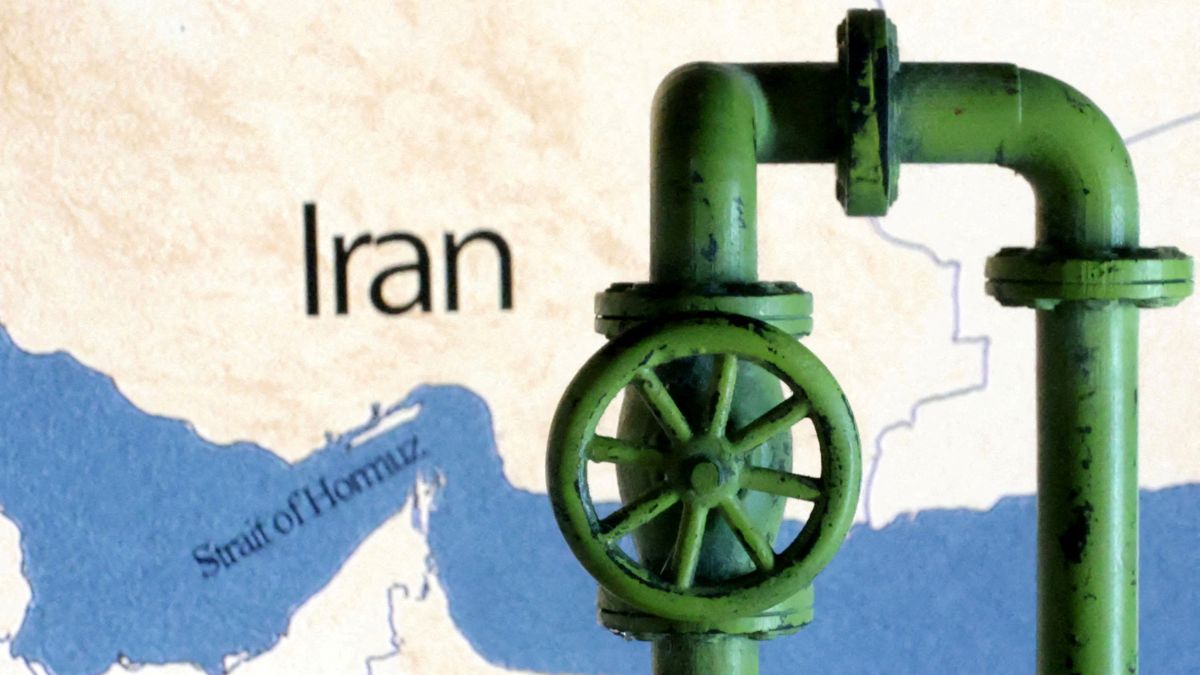
 "Tensions in the Strait of Hormuz escalate as Iran considers turning a vital global shipping lane into a toll route—raising serious concerns over violations of international maritime law and freedom of navigation. File Image/Reuters")
As the United States’ and Israel’s war on Iran completes a month now, the biggest casualty of this war has emerged to be the narrow waterway of the Strait of Hormuz, where smooth transit has become a thing of the past. The traffic allowed to pass through it is almost negligible, with just a day’s traffic during the normal course of time having transited in one entire month.
In fact, as per the reports appearing in Iranian government-aligned media, Iran is planning to pass legislation that will impose tolls on ships passing through the straits, which seeks to officialise its supervision over its waters. This is despite the fact that the ‘Straits’ of Hormuz are one of the most important shipping lanes in the world and also a major choke point on which economies of several countries are dependent. This includes the oil-exporting countries in the Gulf such as Saudi Arabia, Iraq, the UAE, Qatar, and Kuwait, besides Iran, as well as countries such as India, which is dependent on the waterway for as much as 45 per cent of its oil imports.
Unfortunately, while the war may have been waged by the United States, its own dependence on the Strait of Hormuz for oil needs is next to zero. Instead, it is countries in the Eastern Hemisphere—including China, India, Japan, and South Korea—that are bearing the brunt of the conflict. However, the longer the straits remain closed, the greater will be the impact on global oil supply chains, as crude oil volatility is already high, with Brent oil breaching the $100 mark recently. Thus, the Strait of Hormuz remains a crucial lifeline of world trade and oil supplies, with over one-fifth of global oil consumption and one-fourth of global maritime trade dependent on it.
Interestingly, the Strait of Hormuz, which is just around 30 miles wide at its narrowest point and connects the Persian Gulf to the Gulf of Oman and the Arabian Sea, shares boundaries with the UAE and Oman as well as Iran. However, due to its long coastline along with rugged and mountainous geography, it is Iran which enjoys overwhelming dominance over the waterway in terms of the sheer number of missiles, drones, fast-attack boats, and other military equipment that it can deploy.
Not to mention how the country also controls seven of the eight strategically located islands in the straits, some of which are also under dispute with the UAE. No wonder Iran has invested years of effort in anti-access/area-denial tactics customised for the straits, enabling it to create a high-risk environment for commercial navigation at will—something which we are witnessing due to the war currently. In comparison, the UAE does not have a similar geographical advantage, and Oman does not possess commensurate military capability.
Quick Reads
View AllIt is because of this dominance that Iran wields over the Strait of Hormuz that it is able to stall traffic, which the country is now planning to monetise by imposing a toll fee. This comes after multiple reports in the international media of Iran actually charging ships vast sums of money to pass through the straits since the war broke out in the last week of February 2026. The number of tankers that successfully transited the straits in March is nowhere close to pre-war levels, thus effectively demonstrating Iran’s decades-long claim that it could close the traffic if its red lines were breached.
Only a handful of ships are being allowed passage, including Indian ships. The normal two-way lane traffic has given way to a toll-booth-like arrangement, where Iran’s Islamic Revolutionary Guard Corps (IRGC) now first checks each ship’s nationality, cargo, crew, and ownership before letting them pass—mostly only after payment, which is reportedly as high as $2 million per transit. This is also reflected in the Chinese alternative payment system, CIPS, which has recorded an abnormally high volume of transactions this March.
Although Iran’s scheme of leveraging its control over the straits to collect such a fee may work during wartime, the reality is that its plan to do the same in an official capacity as the supervisor of the straits is unlikely to succeed in the long run. This is because Iran’s proposed legislation to impose toll fees would violate customary international law. Interestingly, a letter sent by Iran to the International Maritime Organisation not only informed it about the plan but also claimed that Iran is well within the principles of international law—something that is far from the truth.
The UN Convention on the Law of the Sea (UNCLOS), which Iran signed in 1982 but did not ratify, would still apply in matters concerning the strait. Part III of UNCLOS, which specifically governs “straits used for international navigation", clearly provides for a right of transit passage to aircraft and ships that cannot be suspended by coastal states. It is not within Iran’s authority to levy a fee for mere transit. Thus, it may frame it as a “security fee” or “sovereignty charge", but coastal states cannot turn a natural international strait governed by transit passage rules into a toll road at their own discretion.
This is very different from cases such as the Suez Canal, which levies a fee on passing ships because it was artificially constructed to shorten a naturally existing route. In contrast, the Strait of Hormuz is a natural geographic feature, and passage through it is a legal right for other countries. India’s Shipping Ministry has already called the move baseless, stating that it violates the freedom of navigation as provided under UNCLOS.
However, Iran does not seem deterred, making full use of its years-long investments to achieve its present capabilities. It is not only charging large amounts in yuan to grant passage but is also looking to institutionalise the practice through legislation. This does not mean that it will ultimately succeed in turning the Strait of Hormuz into a tolled waterway. GCC countries are unlikely to approve of such behaviour, as their economies are also heavily dependent on passage through the straits.
Meanwhile, Iran is reportedly considering making this a precondition for peace during negotiations with the United States, but this is unlikely to be accepted under any circumstances. Freedom of navigation as a principle has been consistently defended by the United States in the past, and Iran is unlikely to be an exception.
Currently, Trump is attempting to secure a workable peace, but the endgame will almost certainly involve restoring the Strait of Hormuz to its pre-war condition, with free passage for maritime traffic. Thus, Iran may eventually concede this demand in order to secure concessions elsewhere, but the fundamental nature of the Strait of Hormuz as a key global shipping lane—with a guaranteed right of passage—will not change.
(The author is a New Delhi-based commentator on geopolitics and foreign policy. She holds a PhD from the Department of International Relations, South Asian University. She tweets @TrulyMonica. The views expressed in the above piece are personal and solely those of the author. They do not necessarily reflect Firstpost’s views.)