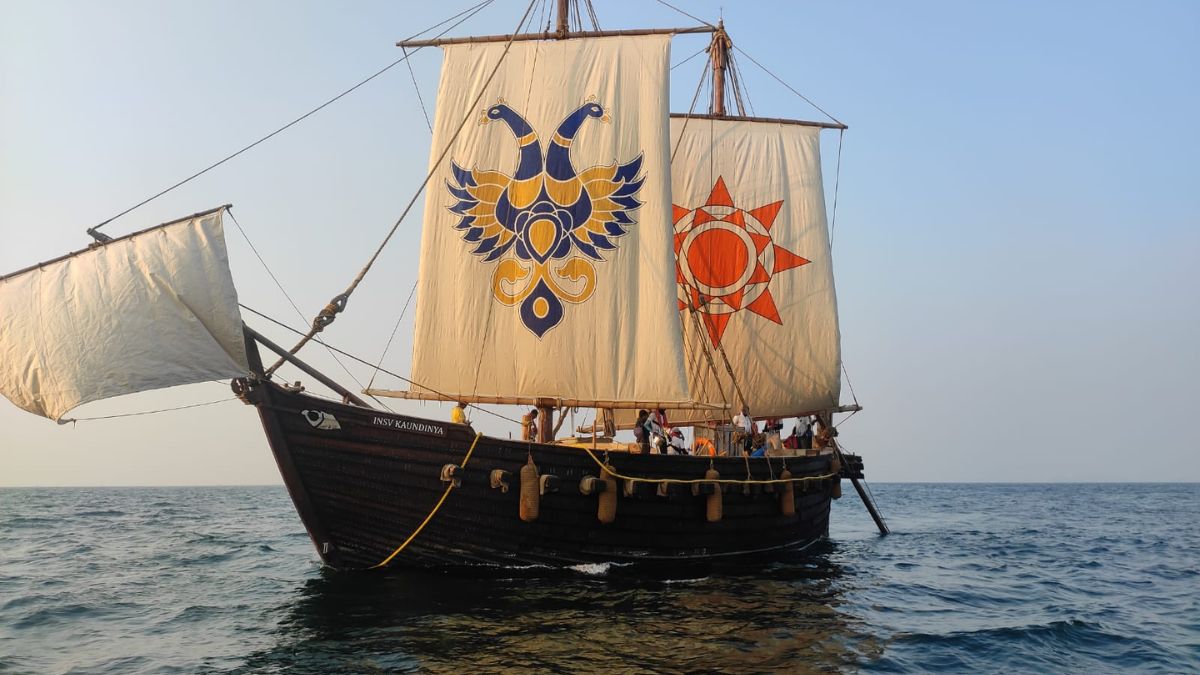
 "INSV Kaundinya: India’s push towards maritime decolonisation, reclaiming civilisational legacy")
On December 29, 2025, the Indian Navy flagged off the maiden overseas voyage of INSV Kaundinya from Porbandar on India’s western coast along the Arabian Sea. The expedition was formally flagged off by Vice Admiral Krishna Swaminathan in the presence of senior naval officials and the Ambassador of the Sultanate of Oman to India, Issa Saleh Alshibani. Built entirely using ancient Indian stitched-plank shipbuilding techniques and natural materials, Kaundinya is the Indian Navy’s first vessel constructed through indigenous methods believed to have been used centuries ago.
Kaundinya’s journey from India’s western coast to Oman is far more than a naval expedition. It is a conscious effort to reclaim India’s maritime past from the silences and distortions of colonial historiography and to restore confidence in indigenous knowledge systems that once sustained transoceanic connectivity across the Indian Ocean, demonstrating that India’s maritime history is not derivative, as colonial narratives suggest, but possesses its own agency and technological sophistication.
This voyage also affirms that India was never “sea-blind”; centuries of shipbuilding, navigation, and oceanic trade attest to a civilisation deeply connected with the maritime world.
Reconnecting with India’s Maritime Legacy
Described by defence officials as a “living ocean voyage”, the expedition reconnects contemporary India with historic sea routes that linked the subcontinent with the Arabian Peninsula long before European colonisation. In doing so, it challenges the colonial portrayal of India as a land-bound civilisation lacking maritime vision, technological capability, and strategic engagement with the seas.
By employing stitched-plank construction, coconut coir ropes, non-metal fastening techniques, and monsoon-based navigation, the voyage validates indigenous maritime knowledge through performance. It collapses the colonial binary between the “modern” and the “primitive” and demonstrates continuity rather than rupture in India’s technological traditions.
Quick Reads
View AllSailing an ancient-style vessel across open seas restores confidence in non-Western technological capabilities and challenges the assumption that maritime modernity is exclusively a Western achievement. Its voyage represents decolonisation not just as a theoretical critique but as a lived and operational practice, actively overcoming the mental slavery imposed by centuries of colonial domination.
Sanjeev Sanyal, a member of the Economic Advisory Council to the Prime Minister, remarked:
“Beyond the technical experiment, the Kaundinya project carries a broader historical objective. Indian history has often been portrayed as passive, overlooking centuries of maritime activity, trade, and exploration. Indians were not sitting around waiting for conquerors to give them civilisation. We had adventurers, mercenaries, traders, and sailors. Long before the Phoenicians, Indians were sailing across the Indian Ocean.”
The choice of Oman as the destination is historically and politically significant. India’s maritime engagement with Oman reflects centuries of trade, cultural exchange, and civilisational interaction that were fundamentally non-colonial in character. Unlike European naval voyages designed for conquest and extraction, Indian maritime activity historically emphasised exchange, reciprocity, and coexistence.
The presence of senior Indian naval officials and the Ambassador of the Sultanate of Oman at the flag-off ceremony underscores the enduring relevance of this shared maritime heritage. In this sense, the voyage aligns with post-colonial international relations by privileging recognition and mutual respect over coercion.
Decolonisation in Motion
Decolonisation, however, cannot be achieved solely through rewriting history or critiquing Eurocentric knowledge frameworks. It must not be limited to epistemology and ontology alone; it must also involve the revival of practices that colonial rule marginalised or erased. The Kaundinya voyage marks a shift from intellectual critique to embodied action. Unlike museums or symbolic commemorations, this project sails real waters, confronts real risks, and relies on historically grounded navigational practices.
Global maritime history has long been framed through a Eurocentric lens that centres the European “Age of Discovery”, portrays naval power as a Western monopoly, and presents Indian Ocean history as beginning with Portuguese arrival. Such narratives systematically marginalised Asian maritime agency and reduced India’s seafaring past to a derivative role.
INSV Kaundinya directly disrupts this epistemic hierarchy. Measuring approximately 65 feet in length and constructed entirely without metal nails using ancient Indian stitched-plank shipbuilding techniques, the vessel draws inspiration from historical depictions of Indian ships found in texts and archaeological records, blending traditional craftsmanship with contemporary naval expertise.
Prime Minister Narendra Modi, on X, lauded the voyage, noting, “Wonderful to see that INSV Kaundinya is embarking on her maiden voyage from Porbandar to Muscat, Oman. Built using the ancient Indian stitched-ship technique, this ship highlights India’s rich maritime tradition.” With a crew of eighteen sailors, the vessel is expected to cover approximately 1,400 kilometres over fifteen days, retracing maritime corridors that once enabled sustained civilisational contact between India and the Arab world.
Colonial historiography consistently portrayed India as maritime-blind, lacking shipbuilding capacity, navigational expertise, and seafaring confidence. This narrative obscured the reality that long before European colonial expansion, India was deeply embedded in maritime networks linking West Asia, East Africa, Southeast Asia, and East Asia. These connections were commercial, cultural, religious, and technological, forming the interconnected Indian Ocean world.
The Kaundinya voyage challenges the assumption that India’s maritime engagement depended on Western technology and demonstrates that India’s historical interactions with other regions were civilisational rather than imperial.
Kaundinya represents a fundamentally different maritime ethic rooted in connectivity, exchange, and mutual recognition. It reconnects past and present, heritage and strategy, memory and motion, rejecting the colonial rupture that framed India’s past as obsolete. The voyage also reinforces India’s identity as a cultural civilisational state whose historical engagement with the world was inclusive rather than coercive. From the Arab world to Southeast and East Asia, India’s outreach was based on cultural interaction rather than political domination, a distinction that continues to enhance India’s soft power and global appeal.
This non-domination approach has earned India admiration worldwide, particularly in East Asia. While India may not have the deep financial resources of countries like China, it wields a unique civilisational influence that stems from culture, shared values, historical engagement, and people-to-people connections. Unlike China, whose “civilisational state” is primarily political, India’s identity as a cultural civilisational state emphasises non-domination, cooperation, and enduring civilisational linkages.
Restoring Civilisational Maritime Agency
The revival of ancient maritime connectivity should not be dismissed as nostalgia. Initiatives such as the Kaundinya voyage represent decolonisation in practice, where history is reclaimed through action, indigenous knowledge is validated through experience, and civilisational memory is embedded into contemporary diplomacy. While ship voyages alone cannot restore lost networks, they serve as powerful reminders that Indian Ocean connectivity is not a colonial inheritance but a shared historical legacy that predates European colonisation and intervention.
Ultimately, the voyage of INSV Kaundinya represents decolonisation in motion, where history is not merely rewritten but re-sailed. By reclaiming indigenous maritime knowledge, restoring historical continuity, and re-centring India’s agency in the Indian Ocean world, the voyage transforms decolonisation from an abstract critique into a lived navigational practice. Every nautical mile covered by Kaundinya contributes to dismantling colonial historiography. Yet meaningful decolonisation also requires sustained civilisational re-engagement.
While India is a sovereign and independent nation, reviving the civilisational soul of Bharat demands deeper engagement with the regions that historically shaped its maritime consciousness—West Asia, East Africa, Southeast Asia, and East Asia. It is in these spaces that India historically expressed itself through trade, culture, and navigation, long before Western domination disrupted organic networks of exchange.
Reviving India’s maritime linkages with West Asia, Southeast Asia, and East Asia is essential not only for historical justice but also for redefining India’s civilisational role in the contemporary Indo-Pacific. Such engagement is therefore not only a strategic imperative for preserving India’s strategic autonomy and a civilisational necessity that allows India to rediscover its maritime self and engage the Indo-Pacific on its own historical and cultural terms but also a crucial driver in India’s development journey towards becoming a fully developed economy.
(The writer is a visiting research fellow at the International Centre for Peace Studies, New Delhi. Views expressed in the above piece are personal and solely those of the author. They do not necessarily reflect Firstpost’s views.)

 "Trump announces 25% tariff on Iran’s trading partners. How India may be affected")
 "India, US to resume BTA talks after 5 months as Gor pushes for trade deal with 'real friends'")
 "ICC sources rubbish Bangladesh sports adviser’s sensational claim of BCB being asked to drop Mustafizur")
 "Jerome Powell: The 'Fed chair with a spine' taking on Trump")
 "Trump announces 25% tariff on Iran’s trading partners. How India may be affected")
 "India, US to resume BTA talks after 5 months as Gor pushes for trade deal with 'real friends'")
 "ICC sources rubbish Bangladesh sports adviser’s sensational claim of BCB being asked to drop Mustafizur")
 "Jerome Powell: The 'Fed chair with a spine' taking on Trump")