

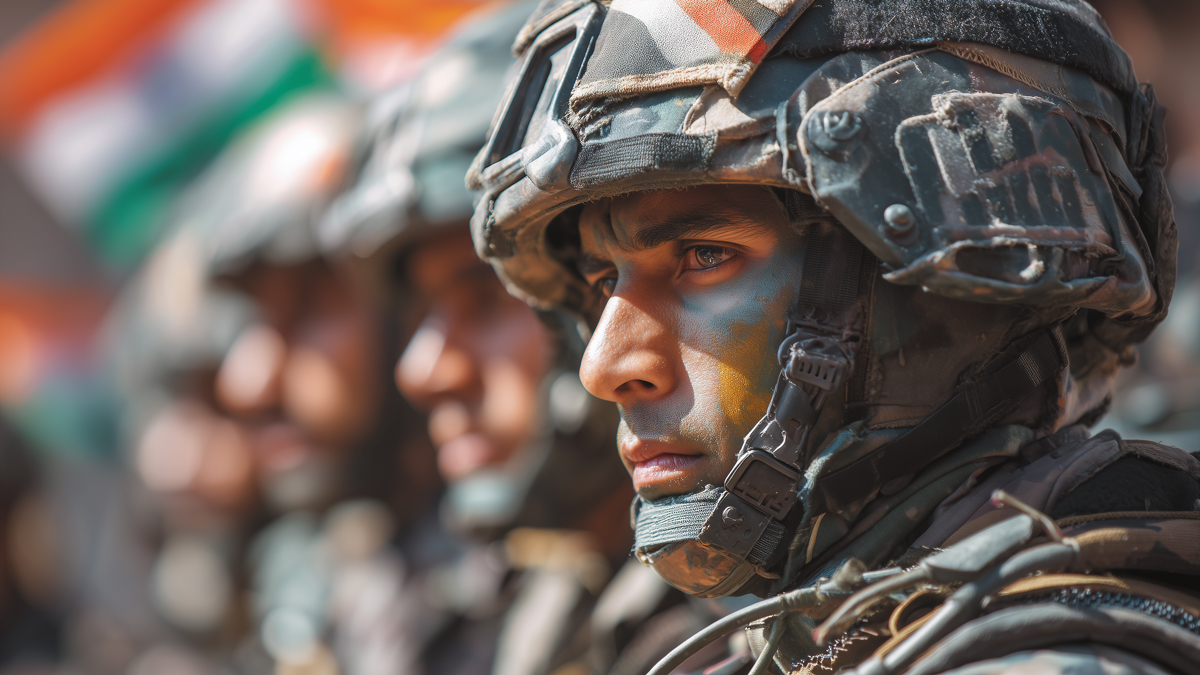
 "India’s strategic military environment in 2025: Managing power in an age of hybrid war")
The year 2025 will not be remembered for sweeping battlefield manoeuvres or dramatic territorial change. Instead, it will be recalled as a year that revealed—with unusual clarity—the nature of conflict India is now destined to manage: hybrid, contested, politically constrained, and fought as much in the psychological and informational domains as on land, sea, or air. Operation Sindoor became the most visible military episode of the year, not because of its scale, but because it illustrated the logic of restraint under pressure.
Hybrid Conflict as the Enduring Reality
By 2025, Pakistan’s ability to sustain proxy war in J&K had eroded significantly. From nearly 4,500 active terrorists in the mid-1990s, numbers declined to roughly 100 hardened operatives. This reduction generated a new compulsion in Pakistan’s deep state—the search for renewed relevance. In hybrid conflict, fading relevance can be as destabilising as military defeat.
While terrorist activity intensified south of the Pir Panjal, particularly in Jammu, the true centre of gravity remained the Kashmir Valley. Kashmir continues to command international attention, shape global narratives, and influence local sentiment. Any attempt to reinsert Pakistan into the strategic conversation required touching this core. India anticipated this dynamic and responded within a calibrated framework.
Pakistan assessed—correctly—that an Indian response would follow, but it also calculated that escalation would remain limited. Nuclear parity, India’s economic trajectory, international diplomatic scrutiny, and its self-projection as a responsible power were judged to be restraining factors. In that sense, Operation Sindoor unfolded in a carefully contested escalation space, shaped as much by perception as by force.
Restraint, Misread at Home
One of the less examined challenges of 2025 lay not across the border but at home. Large sections of public opinion continue to view conflict through the prism of Kargil or earlier territorial wars. Hybrid warfare, however, is deliberately ambiguous. It avoids clear battle lines and thrives below the threshold of declared war.
The leadership’s decision to halt operations after roughly 88 hours attracted criticism from those who interpreted restraint as weakness. In reality, that juncture marked the approach of dangerous escalation thresholds, beyond which political control would have diminished while strategic gains remained uncertain. Nuclear weapons are not abstract threats; they shape every operational decision. Nuclear parity does not prevent conflict, but it severely constrains choice.
Quick Reads
View AllThe recurring public demand to “simply capture PoK” reflects a widening cognitive gap between strategic reality and popular expectation. Left unaddressed, this gap risks undermining democratic consensus during future crises.
Escalation Control as Strategy
One of the clearest lessons of 2025 is that escalation management itself has become a strategic objective. Timing of response, the interval between provocation and retaliation, and the ability to stop at the right moment are now as critical as operational success.
Operation Sindoor demonstrated that limited engagement can coexist with credible deterrence. The challenge is not absence of capability, but disciplined application of force in pursuit of long-term strategic space rather than short-term emotional satisfaction.
Air Power: Capability, Constraints and Imperatives
Air power remains the decisive arm in any limited conflict. In modern war, it is quality, survivability, precision, and integration—not mere numbers—that shape outcomes. India’s experience in 2025 reinforces a hard truth: while professionalism and training remain high, deficiencies in modern air combat resources constrain strategic options.
Limited wars demand rapid dominance of the air domain. Delays or vulnerabilities invite escalation and external intervention. The imperative for accelerated acquisition of modern air combat platforms, force multipliers, and enablers is no longer debatable. Decision-making timelines must compress. Strategic restraint cannot compensate indefinitely for material shortfalls.
Theatre Commands: Conceptual Clarity Still Elusive
Closely linked to the air power debate is the question of theatre commands. The concept is rooted in assumptions of future campaign-style, multi-domain wars requiring tightly integrated command structures. Yet recent experience suggests that the dominant form of conflict confronting India remains hybrid—episodic, ambiguous, and politically constrained rather than campaign-driven. This raises legitimate questions about whether such far-reaching force restructuring is essential for the conflicts most likely to occur.
Concerns expressed, particularly by the Indian Air Force, reflect not resistance to integration but unease about fragmentation of scarce air assets and loss of operational flexibility in limited war scenarios where centralised control remains critical. Theatre commands may well be necessary for certain contingencies, especially on the China front, but their relevance to hybrid conflict on the Western front remains open to debate and demands deeper conceptual clarity before irreversible organisational change is undertaken.
Drones: From Experimentation to Scale
Unmanned systems have moved decisively from novelty to necessity. Extensive study and experimentation are underway, but the lesson of 2025 is clear: scale matters. Drones—across surveillance, strike, logistics, and counter-drone roles—will dominate future hybrid engagements.
A surge in domestic manufacturing is therefore imperative. Dependence on external supply chains during crises introduces unacceptable vulnerability. The next confrontation will not allow leisurely induction cycles.
Cyber: The Quiet Front Yet to Be Tested
One notable feature of 2025 was the relative absence of overt cyber escalation. This should not induce complacency. Cyber is the domain most likely to be tested next precisely because it offers deniability, reversibility, and strategic impact without visible violence.
Critical infrastructure, financial systems, communications, and public confidence are all cyber-vulnerable. Hybrid conflict will increasingly exploit this domain. Preparedness, resilience, and redundancy must now move from technical discussion to strategic priority.
The Next Trigger Is Not Hypothetical
An Indo-Pakistan limited conflict is not a distant contingency. It is as close as the next serious, sponsored proxy attack on a sensitive target in India. The disrupted Delhi car bomb attempt may have been an early indicator rather than an isolated episode. Expectation management must therefore include the likelihood of recurrence.
Equally important is the recognition that internal cohesion is a strategic asset. Hybrid war seeks not merely physical damage but social fracture. Communal or societal discord amplifies adversarial success at minimal cost. Weakness in this domain weakens India’s national fabric far more effectively than battlefield losses. Neutralising such efforts will require unconventional approaches—strategic communication, community engagement, narrative inoculation, and rapid counter-disinformation.
China: The Silent Constraint
While this assessment focuses on the Western front, China remains a constant strategic factor. The Line of Actual Control continues to tie down resources and attention. Any major escalation in the West must account for the possibility of opportunistic pressure in the North. China’s political and technological proximity to Pakistan further complicates risk calculus. This challenge, however, merits separate and focused analysis.
Civil-Military Fusion and Climate Reality
Civil-military coordination has been a recurring theme through 2025, yet progress remains uneven. The most under-addressed vulnerability lies in ecology and disasters. Climate-driven disruptions—floods, landslides, extreme weather—now directly degrade military infrastructure and war-fighting capability, especially in mountainous terrain.
A genuine Climate Sensitivity Culture must permeate government departments, civil administration, and the armed forces. Hybrid adversaries exploit disruption. Preparedness cannot remain episodic.
The Larger Lesson
India’s military environment in 2025 reaffirmed a fundamental truth: future conflicts will be ambiguous, politically constrained, and psychologically intense. Success will not always look dramatic. At times, it lies in containing escalation rather than pursuing maximal outcomes.
Operation Sindoor was not a universal template—but it was a powerful demonstration of controlled power and strategic restraint. India retains conventional options should tolerance thresholds be crossed; strategy is never static. But in an age of hybrid war, the hardest battles are often fought not on maps, but in minds—of adversaries, allies, and one’s own people.
(The writer is the former Commander of India’s Srinagar-based Chinar Corps. Currently he is the Chancellor of the Central University of Kashmir and a member of the National Disaster Management Authority. Views expressed in the above piece are personal and solely those of the author. They do not necessarily reflect Firstpost’s views.)

 "Bangladesh Protests Live: Police, army on street as post-Hadi violence targets Indian missions, Awami offices")
 "Who was Claudio Valente, Brown University shooting suspect who also killed MIT professor?")
 "Ukraine to US midterms: Will 2026 seal Trump's place in history?")
 "Bill Gates, quotes from ‘Lolita’ on woman’s body: What newly released Epstein photos reveal")
 "Bangladesh Protests Live: Police, army on street as post-Hadi violence targets Indian missions, Awami offices")
 "Who was Claudio Valente, Brown University shooting suspect who also killed MIT professor?")
 "Ukraine to US midterms: Will 2026 seal Trump's place in history?")
 "Bill Gates, quotes from ‘Lolita’ on woman’s body: What newly released Epstein photos reveal")



