

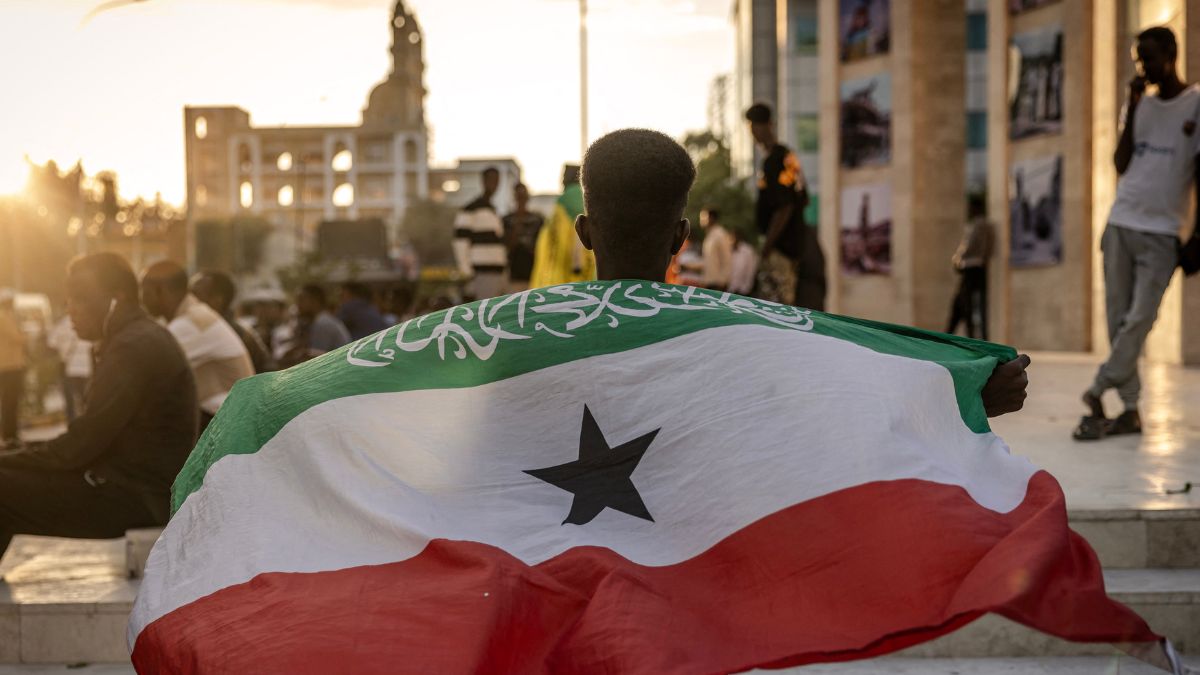
 "Israel recognises Somaliland: Why India should follow suit")
On December 26, 2025, Israeli Foreign Minister Gideon Sa’ar announced that Israel had signed an agreement with Somaliland President Abdirahman Mohamed Abdullahi, better known by the moniker Irro. “We signed an agreement on mutual recognition and the establishment of full diplomatic relations, which will include the appointment of ambassadors and the opening of embassies,” Sa’ar said, adding, “We will work together to promote the relations between our countries and nations, regional stability and economic prosperity. I have instructed my ministry to act immediately to institutionalise ties between the two countries across a wide range of fields.”
As word spread throughout the capital, Hargeisa, Somalilanders, who have laboured for more than three decades to win formal relations, erupted in spontaneous celebration. Celebratory fireworks exploded over the city.
Israel’s decision to shatter the de facto diplomatic consensus against recognising Somaliland should be welcome. More than any other aspirant country, Somaliland is ready for formal independence; indeed, by almost any metric – gross domestic product, industrial base, and governance capacity – Somaliland ranks above its neighbours. Indeed, it is not far beyond Pakistan and will be on a trajectory to surpass it once it receives access to international banking that recognition bestows.
Ethiopia’s government has long joked that Ethiopia would not be the first country to recognise Somaliland, but it would not be the third either. That many regional countries oppose Somaliland recognition has less to do with the merits of its case than it does with China. While diplomats traditionally oppose separatism in Africa, fearing the chaos that could accompany a cascade of new states and claimants transcending Africa’s colonial borders, Somaliland should be an exception.
Quick Reads
View AllSet by treaties during its period as a British protectorate, Somaliland’s borders are older than many countries in Africa. The Horn of Africa, too, has long been an exception to the Africa rule, with Eritrea achieving full independence from Ethiopia in 1993 and South Sudan formally splitting from Sudan in 2011. While Eritrea is essentially a prison state akin to Africa’s North Korea, and South Sudan descended into civil war amidst tribal disputes and a scramble for its oil revenue, Somaliland is largely peaceful and has had more than three decades of self-declared independence to refine its government bodies.
Most of the immediate opposition to Somaliland is based less on principle and more on fealty to China. Djibouti is perhaps the most hypocritical. It is ethnically Somali, but organised in the colonial era by the French, who colonised the port to serve as a coaling station akin to what the British Empire developed in Aden. In recent decades, however, Djibouti has subordinated itself to China, becoming one of Africa’s most indebted countries to Beijing in terms of percent of gross domestic product. Today, Djibouti even hosts China’s first overseas naval base.
Somalia, too, opposes Somaliland’s freedom as much to appease China as due to its own irredentist inclinations. Somaliland joined Somalia in 1960 but separated in 1991 as Somalia descended into anarchy and state failure. Returning Somaliland to Somalia was never realistic, as successful democracies tend to oppose subordinating themselves to chaotic kleptocracies.
China looms large in Mogadishu’s thinking. On December 21, 2025, Somali President Hassan Sheikh Mohamud told Chinese television that he backed China using military force to subdue Taiwan. As Somaliland has embraced Taiwan, Somalia has sought to profit by transforming itself into a Chinese colony in all but name.
It is against this backdrop that India should follow Israel’s lead and recognise Somaliland. To uphold the status quo would betray the principles for which India has long publicly stood: tradition or established power interests should be no reason to condemn Somaliland to Somalia’s colonisation.
Principle states like India should not force democracies to subordinate themselves arbitrarily to failed states, especially if the logic is to uphold colonial interests. For Somalia to talk about Somaliland independence shattering Somali unity is as farcical as Syria complaining Lebanese independence betrays Arab unity.
More importantly, if India aspires to protect itself and its interests in the Indian Ocean basin, it must not defer the African coast arbitrarily to Chinese interests. Beijing seeks to consolidate control over the littoral states – Djibouti, Somalia, Kenya, Tanzania and Mozambique – in order to shut India out or encircle it. By standing firm in favour of Somaliland, India can ensure it has a permanent portal into Africa and a means to trade with its second-most populous country, Ethiopia. Somaliland’s Berbera Port can be an important logistical hub, while its adjacent airport can ferry Indian businessmen and supplies almost anywhere in Africa.
India is a great power, but too often it hampers its influence and interests by acting as a reactive one rather than a proactive one. To follow Israel and open an embassy in Somaliland would send a signal that India determines its own destiny, stands by allies, and no longer accepts China’s arbitrary demands and positions. It is time for the Tiranga to fly officially over an Indian High Commission in Somaliland.
(Michael Rubin is director of policy analysis at the Middle East Forum and a senior fellow at the American Enterprise Institute in Washington, DC. Views expressed in the above piece are personal and solely those of the author. They do not necessarily reflect Firstpost’s views.)

 "India’s backyard in flux: From Gen-Z chaos in Nepal to civilian surrender in Pakistan")
 "'I see that happening': Trump says Russia, Ukraine & US could meet in trilateral talks soon")
 "Bangladesh to run out condoms in the next 39 days. Here’s why")
 "Back from exile, BNP’s Tarique Rahman files nomination to contest Bangladesh polls")
 "India’s backyard in flux: From Gen-Z chaos in Nepal to civilian surrender in Pakistan")
 "'I see that happening': Trump says Russia, Ukraine & US could meet in trilateral talks soon")
 "Bangladesh to run out condoms in the next 39 days. Here’s why")
 "Back from exile, BNP’s Tarique Rahman files nomination to contest Bangladesh polls")



