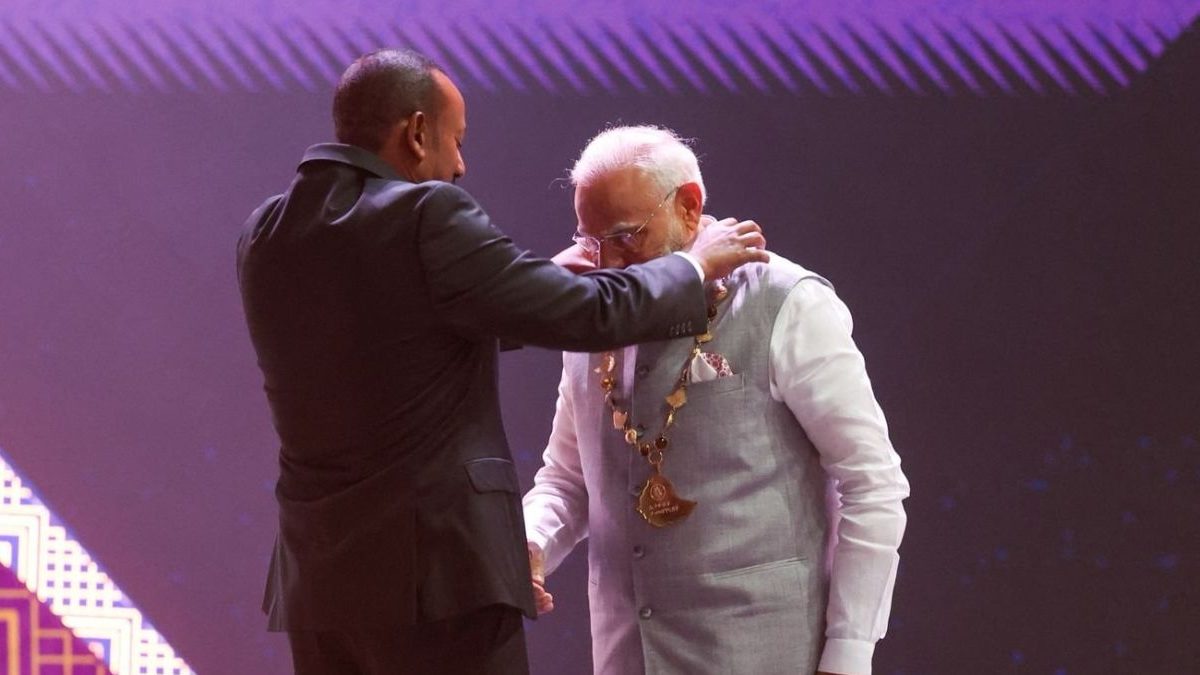
 "Prime Minister Narendra Modi on Tuesday was conferred with Ethiopia's highest award 'The Great Honour Nishan of Ethiopia' by his Ethiopian counterpart Abiy Ahmed Ali. Image Credit: Narendra Modi/X")
Prime Minister Narendra Modi’s visit to Ethiopia in December 2025 marked a defining moment in India-Ethiopia relations. During this visit, India and Ethiopia elevated their ties to a ‘Strategic Partnership’, signalling a commitment to a long-term, vision-driven relationship rooted in development and diplomacy. Other than elevating their ties to a ‘Strategic Partnership’, India and Ethiopia signed multiple agreements/MOUs ranging from customs cooperation, establishing a data centre at the Ethiopian Foreign Ministry, UN peacekeeping training courses, debt restructuring under the G20, more ICCR scholarships, and AI short courses for Ethiopians.
At a time when the global order is undergoing significant churn, the deepening engagement between India and Ethiopia shows that the Global South is defining international order on its own terms. India has also discussed partnerships in the arena of digital public infrastructure (DPI), mining, critical minerals, and clean energy. India has also promised to upgrade the Mahatma Gandhi Hospital in Addis Ababa, focusing on maternal and neonatal care. India and Ethiopia also agreed to collaborate through global platforms such as the United Nations and called for enhanced cooperation on climate change, renewable energy, and disaster resilience.
India and Ethiopia are also collaborating through initiatives such as the International Solar Alliance (ISA), Coalition for Disaster Resilient Infrastructure (CDRI), the International Big Cat Alliance (IBCA), and the Global Biofuel Alliance (GBA). The Prime Minister’s visit to Ethiopia was notable as he was conferred with the highest civilian award, recognising India’s role as a trusted development partner. The Prime Minister, in his maiden address to the joint session of the Ethiopian Parliament, emphasised that India and Ethiopia are natural partners in regional peace, security, and connectivity, highlighting that both countries have a lot to learn from each other.
The historical ties between India and Ethiopia date back over 2,000 years, when Indian traders engaged with the Aksumite Empire through ancient maritime routes via the port of Adulis. Indian traders exchanged silk and spices for Ethiopian gold and ivory. India and Ethiopia established diplomatic relations at the legation level in 1948, and full diplomatic relations were established in 1950, with Sardar Sant Singh as the first ambassador.
Quick Reads
View AllIndia has supported Ethiopia through education programs such as the Indian Technical and Economic Cooperation (ITEC), scholarship initiatives via ICCR, and development financing, including lines of credit for infrastructure. Ethiopia also has the largest number of PhD students from Africa studying in India. These engagements helped build trust and a foundation for contemporary strategic cooperation.
Economic ties have also gained momentum in recent decades. Over 650 Indian companies have invested over $5 billion in Ethiopia, particularly in the manufacturing and pharmaceutical sectors, generating over 75,000 jobs. Beyond economics, India and Ethiopia have also built a partnership in defence cooperation and capacity building. India was one of the first countries to provide military assistance to Ethiopia in 1956, starting with the establishment of the Harar Military Academy. Since 2009, India has supported the training of Ethiopian defence forces. This year, India and Ethiopia held the inaugural Joint Defence Cooperation (JDC), marking a major step in the elevation of defence ties.
Ethiopia has emerged as one of the fastest-growing economies in Africa, positioning itself as a key development anchor on the continent. Despite facing political and economic challenges in recent years, Ethiopia has demonstrated resilience through sustained public investment in infrastructure, manufacturing, and industrial parks. Its strategic location in the Horn of Africa, large domestic market, and focus on value-added production have made it an attractive investment destination.
For India, Ethiopia represents not just an economic partner but a long-term development ally capable of anchoring India’s economic engagement with Africa beyond extractive or commodity-driven models. Ethiopia’s inclusion in BRICS in 2024 also amplifies its strategic importance, as its presence in BRICS aligns with India’s broader vision of amplifying the Global South’s voice in global governance and the economic order. As India takes up the chairmanship of BRICS next year, the Prime Minister’s visit could not have come at a better time, as India seeks to position itself as a voice of the Global South in a rapidly evolving global order.
The elevation of ties between India and Ethiopia reflects a broader trend—from symbolic solidarity to substantive partnership—a step forward for Global South diplomacy. Rooted in historical trust, yet focused on contemporary issues, the India-Ethiopia relationship demonstrates how the Global South can cooperate on issues of strategic importance.
As India prepares to assume the chairmanship of BRICS, partnerships with like-minded countries will be essential in shaping an international order in which the Global South plays a prominent role. Therefore, Ethiopia is not just a bilateral partner but a key stakeholder in India’s vision of a developed, assertive Global South.
(Trishala Anand Sancheti is Research Fellow, India Foundation. Views expressed are personal and solely those of the authors. They do not necessarily reflect Firstpost’s views.)