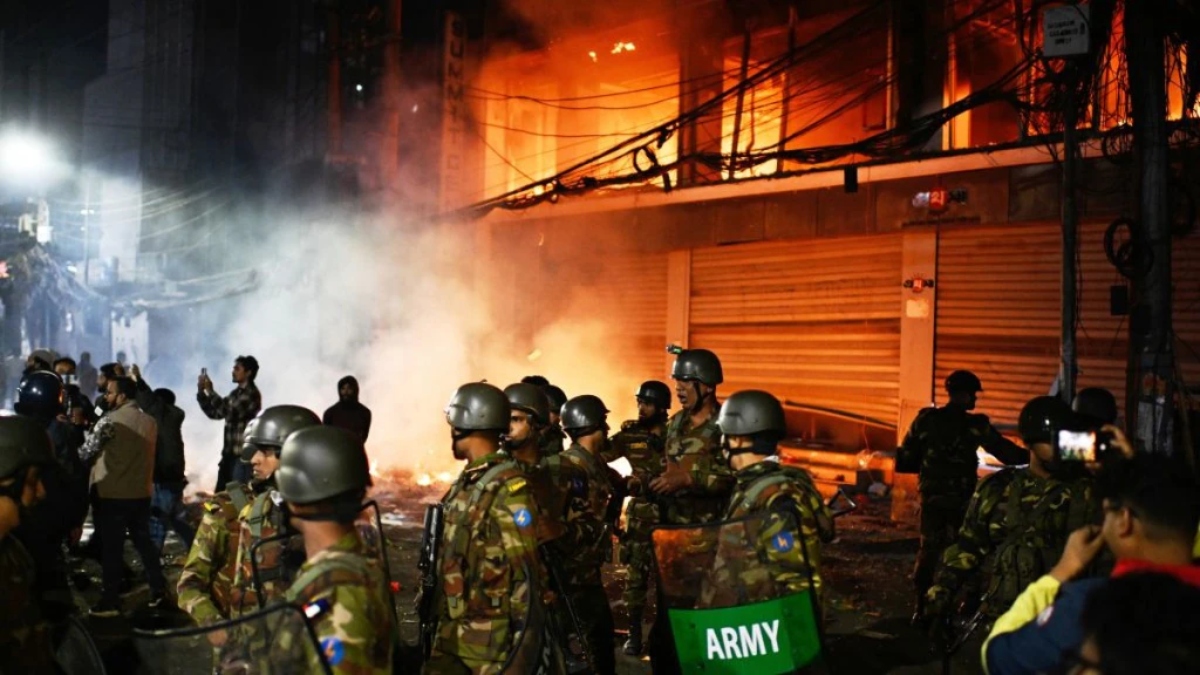
 "Protests in Bangladesh following the death of activist Sharif Osman Hadi in Dhaka, Bangladesh, on December 19, 2025. Hadi had been undergoing treatment in Singapore after being shot in the head. Image: PTI")
At moments of political transition, the loudest voices are often not the strongest but the most insecure. Recent remarks by figures associated with Bangladesh’s National Citizen Party (NCP), including inflammatory statements by Hasnat Abdullah about isolating India’s northeastern states, belong firmly in this category. Wrapped in nationalist bravado and historical revisionism, such rhetoric has been presented as defiance. In reality, it is better understood as a symptom of political marginality.
This is not merely about diplomatic theatre. Alongside threats directed at India, there has been a renewed and deeply troubling attempt by Islamist-aligned actors — including elements linked to Jamaat-e-Islami and sympathetic voices in Pakistan — to distort the historical record of 1971.
The most egregious claim is that India, rather than the Pakistan Army and its local collaborators, was responsible for the systematic killing of Bengali intellectuals during the final days of the Liberation War. This inversion of history is not accidental. It is a deliberate effort to muddy moral responsibility, rehabilitate collaborators, and recast perpetrators as victims.
Serious historians do not contest the facts of 1971. The targeted murder of academics, journalists, doctors, and cultural figures on December 14 was carried out by the Pakistan Army with the assistance of local Islamist militias, notably Al-Badr and Al-Shams. The objective was clear: to decapitate the intellectual leadership of a soon-to-be independent Bangladesh.
India’s role in that war was neither covert nor malign. It intervened openly after months of mass atrocities and an unprecedented refugee crisis and did so in support of Bangladesh’s independence. Attempts to shift blame onto India are not acts of reinterpretation; they are acts of political laundering.
Quick Reads
View AllWhat makes the current episode particularly revealing is the gap between rhetoric and reality. Despite its strident language, the NCP is not riding a wave of popular support—quite the opposite. Recent opinion polling indicates that the party’s perceived electoral viability has collapsed from approximately 4 per cent to 0.8 per cent. While Bangladesh’s political field remains fluid and a large portion of voters are undecided, the NCP barely registers as a serious contender. Established parties dominate public expectations, while the NCP struggles to move beyond fringe appeal.
This matters because it helps explain the tone. Jingoism thrives where legitimacy is thin. When a political movement lacks grassroots depth, organisational strength, or a credible governing agenda, provocation becomes a substitute for policy. Threatening India, invoking the emotive geography of the “Seven Sisters”, and flirting with historical revisionism are not signs of confidence. They are attempts to manufacture relevance by inflaming passions, drawing media attention, and positioning the party as a disruptive nationalist force in an overcrowded political arena.
India, however, would be mistaken to treat this rhetoric as a strategic threat in itself. The greater risk lies not in overestimating these actors, but in responding to them on their own terms. Escalatory language, public sparring, or heavy-handed posturing would only validate the narrative that India is an overbearing neighbour, eager to dominate Bangladesh’s internal discourse. That is precisely the trap such extremists hope New Delhi will fall into.
A more effective response lies in confidence rather than confrontation — in killing them with kindness.
This does not mean passivity, nor does it mean ignoring distortion. It means responding in ways that expose the weakness of radical narratives rather than amplifying them. India’s greatest strength in Bangladesh has never been coercion; it has been credibility built through history, economic interdependence, cultural proximity, and people-to-people ties. These are assets that fringe extremists cannot match.
By continuing to deepen economic cooperation, expand connectivity, and support development initiatives that tangibly improve lives, India reinforces a simple truth: cooperation delivers results, while rhetorical hostility delivers only noise. Trade corridors, energy links, educational exchanges, and cultural collaboration speak more persuasively than any diplomatic rebuke.
Equally important is the quiet defence of historical truth. Supporting scholarly exchanges, joint research, archival work, and cultural projects that document the Liberation War ensures that facts remain accessible and authoritative. When history is well taught and widely understood, revisionism struggles to gain traction. The aim is not to impose a narrative but to allow evidence to speak for itself.
There is also a broader regional lesson here. The Indian subcontinent has repeatedly seen fringe ideologies seek oxygen through provocation—denying them that oxygen—by refusing to elevate their claims through disproportionate responses, which is often the most effective containment strategy. The collapse in the NCP’s public support suggests that voters are far more concerned with economic stability, governance, and the rule of law than with theatrical threats against a neighbour.
Ultimately, the choice before India is not between strength and restraint. It is between short-term reaction and long-term influence. By responding to extremism with openness, consistency, and strategic long-term view, India not only protects its interests but also underscores the contrast between responsible statecraft and performative radicalism.
Extremists who distort history and trade in threats rely on outrage to survive. Kindness — grounded in confidence, truth, and sustained engagement — deprives them of their most valuable currency. Over time, it also reveals what the polling already suggests: that beneath the noise, their support is not rising, but fading.
(The author is a strategist in international relations and economic development. Views expressed in the above piece are personal and solely those of the author. They do not necessarily reflect Firstpost’s views.)