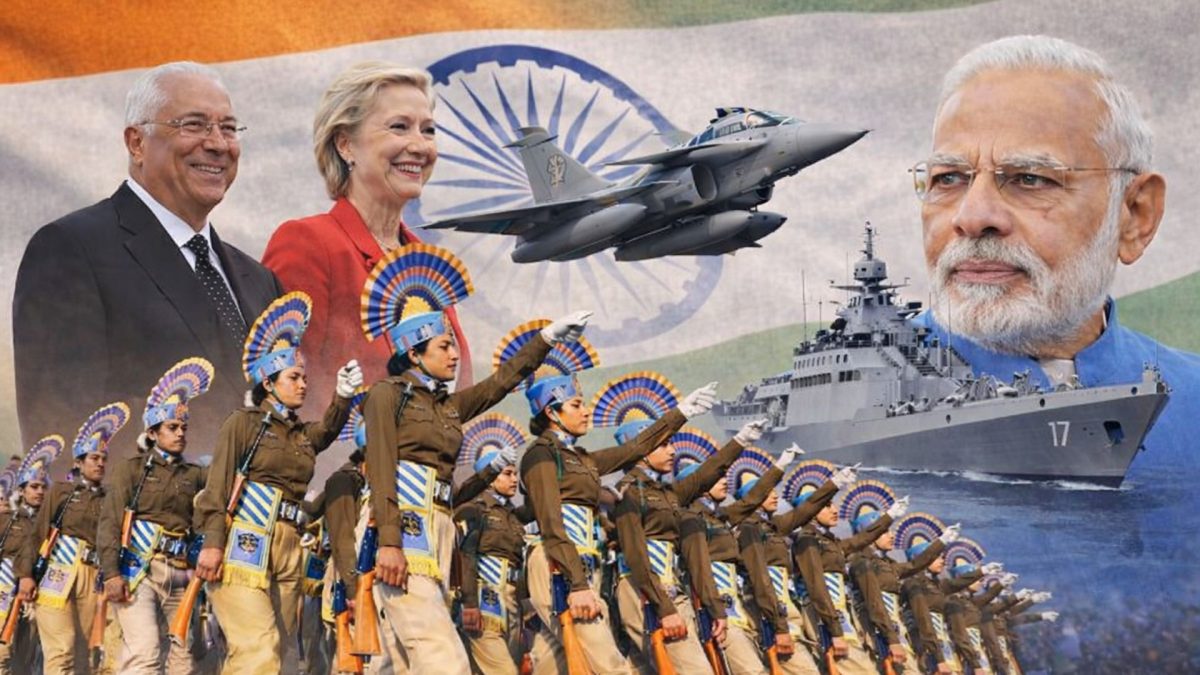
 "India’s global strategic position is defined by its strategic autonomy and its ability to balance relationships with major powers. Representational image")
As India celebrates its 77th Republic Day, with European Commission President Ursula von der Leyen and European Council President António Costa attending as the chief guests at the parade ceremony on Kartavya Path, the occasion invites reflection beyond the festivities. Republic Day is not merely a national celebration; it commemorates the moment when the Indian Constitution came into force, shaping India into the world’s largest democracy. The day symbolises the country’s unity, democratic values, and cultural diversity, showcased through the ceremonial parade in New Delhi. Reflecting contemporary priorities, the Republic Day 2026 theme, “Green Growth and Digital India”, underscores India’s vision of sustainability and innovation.
The parade also displays India’s military might, including tanks, missiles, and aircraft. There are marching contingents from the Army, Navy, Air Force, and police. The other major nations that display their military might through large-scale parades include China, Russia, France, and North Korea. Russia celebrates the “Victory Day” parade on Moscow’s Red Square on May 9, showcasing its military might. The annual Bastille Day military parade on July 14 along the Champs-Élysées in Paris is one of the largest in Europe and features personnel and equipment from all French armed forces. The US has historically held fewer large-scale military parades compared to the others, though a large parade was held in 1991 to mark the end of the Gulf War. A parade was also held in 2025 to mark the US Army’s 250th anniversary, as well as a controversial Independence Day celebration in 2019 arranged by the Trump administration.
Global Geostrategic Status 2026
The global geostrategic status in January 2026 is characterised by intensified great power competition, increased geopolitical fragmentation, rising protectionism, and a focus on industrial policy for supply chain resilience. Russia continues to slowly gain territory as the Ukraine conflict lingers. Some European nations are suggesting putting their troops on Ukrainian soil, and Russia has warned that it could create complications and expand the war. The Gaza Strip sees a fragile ceasefire as Israel continues sporadic punishing attacks.
On January 3, 2026, the United States launched military strikes (codenamed Operation Absolute Resolve) on Venezuela and captured President Nicolás Maduro and his wife, Cilia Flores. The operation has been roundly condemned as a blatant violation of international law. Meanwhile, Venezuela has started an ‘exploratory process’ to re-establish formal ties with the US. The USA is meanwhile threatening to acquire Greenland by purchasing it from Denmark or using military force. Clearly, President Trump is currently like “a bull in a china shop”. Europe is under pressure to defend itself from both Russia and the USA.
Quick Reads
View AllIran seems to be imploding with over two weeks of uprising. The USA and Israel are getting set to launch a massive attack, as Qatar, Saudi Arabia, and Oman have been trying diplomatically to ease the tension and urging the United States not to use force.
A more fragmented world sees US-China strategic rivalry, the weaponisation of trade, shifting alliances, significant electoral uncertainty in many nations, and growing tensions over critical resources and technology, all driving nations to prioritise planning and supply chain diversification. The two top economies, the USA and China, are competing across technology, trade, and influence, while rising nationalism challenges traditional globalisation. Governments globally are using subsidies, tariffs, and localisation drives to secure supply chains, creating new market opportunities and risks. All this is disrupting global trade flows and sending geopolitical shocks.
There is an institutional threat as the UN watches conflicts as a helpless spectator, and Trump leads the USA to pull out of 66 global organisations. This action targets 31 United Nations entities and 35 non-UN bodies, reshaping America’s role in global governance. Trump now wants a “Board of Peace” headed by him by name and with his own nominees to oversee Gaza peace. He also wants to annex/acquire Greenland. Forums like the G20 face challenges from polarised viewpoints, yet remain crucial for harmonising global agendas amidst growing multipolarity.
Clearly, the global geostrategic outlook for 2026 is defined by persistent volatility, the emergence of a multipolar world, the erosion of old international norms, and the increasing “weaponisation” of economic interdependence. Governments are prioritising economic and national security, leading to state interventionism and trade frictions. New, often transactional, rules for doing business are emerging. Alliances are shifting based on practical interests rather than ideology, and governments are increasingly using policies like tariffs and subsidies as geopolitical tools.
Competition for critical resources, including water, critical minerals, and energy, is intensifying, leading to new production and trade patterns and potential conflicts over access. Geopolitical competition to access critical minerals for technology and defence will intensify. Governments will treat Artificial Intelligence (AI) assets as national security priorities, and AI will act as a force multiplier for cyber conflicts. The politicisation of capital allocation and intensifying geopolitical competition will reshape the global financial system. Nations will focus heavily on economic security and integration with national interests.
The US is expected to remain a dominant player but faces potential stagflationary pressures from tariffs, a softening labour market, and policy volatility, including midterm elections in November 2026. Internal political divisions and the shifting global order pose challenges to Europe’s economic competitiveness and national security posture. Europe will face strategic doubt, a policy triangle of increasing defence needs, climate goals, and fiscal consolidation, which could drive political fragmentation. China’s GDP growth is expected to moderate to around 4.5 per cent due to a property market downturn and weak domestic demand. Dynamic powers like India are expected to see strong growth (7.5 per cent) but face challenges of a widening wealth gap. Geopolitical dynamics are expected to play out significantly across four key regions: North America, Asia-Pacific, Europe, and the Middle East, with each region facing unique challenges in balancing economic integration with national security goals.
India’s Neighbourhood Challenges
India’s neighbourhood challenges stem from geopolitical shifts, including China’s growing influence, political instability (such as in Bangladesh and Myanmar), economic vulnerabilities (debt crises in Sri Lanka), security threats (terrorism, insurgency), stalled regional cooperation (SAARC), and bilateral irritants (water-sharing, border issues), all testing its “Neighbourhood First” policy and efforts towards regional integration.
As of early 2026, India-Pakistan relations remain tense. Underlying drivers such as cross-border terrorism persist, with the potential for escalation triggered by terrorist attacks, as both nations maintain minimal engagement. The Trump administration’s sudden direct engagement with the Pakistan Army, proposed high tariffs (500 per cent) against India, and threat of sanctions in the case of continued economic engagement with Russia have created complex dynamics. This could potentially impact India’s otherwise balanced foreign policy focus. Tensions between Pakistan and Afghanistan also add to the volatile regional security landscape.
Relations between India and Bangladesh, which share one of the world’s largest land borders and deep cultural ties, have been in a spiral for more than a year following the 2024 overthrow of Sheikh Hasina (she fled to India). New Delhi has, in turn, protested hostile statements by parties in Dhaka and incidents of violence against Bangladesh’s Hindu minority.
With an old boundary dispute with China, India has three unfriendly neighbours on its frontiers and needs greater military power, as well as the ability to balance its security concerns with economic growth.
Top Global Militaries
To assert themselves as powerful players on the world stage, countries are fiercely competing to strengthen their military capabilities and allocating vast budgets to defence and military endeavours. Unsurprisingly, the USA continues as the unrivalled leader in military strength, a position it has maintained for some time, largely owing to its extensive manpower, significant financial resources, substantial material reserves, and industrial output.
Russia remains the second most powerful despite ongoing geopolitical tensions exacerbated by the Russia–Ukraine conflict. Its standing is strengthened by alliances with nations such as Iran, North Korea, and China. China is a close third, having benefited from its alliance with Russia. It continues to expand its military capabilities through substantial investments in defence research and development. Coupled with a robust industrial base, China is also a formidable force, improving its influence across Asia, Africa, and South America.
The three military leaders are followed by India, South Korea, the United Kingdom, France, Japan, Turkey, and Italy, in that order. Many are experiencing growth in their defence capabilities, largely driven by rising defence budgets, thriving industrial sectors, and strategic partnerships with established military powers. India’s other major neighbour, Pakistan, has its military standing influenced by its relationship with China, which has facilitated material acquisitions. Pakistan is ranked 12th globally.
India’s Military Power
India has the world’s second-largest military force by numbers, with over 1.4 million active troops, and has the world’s largest volunteer army. It also has the fifth-largest defence budget (US$81 billion, 1.9 per cent of GDP). India holds a strong global military standing, ranked fourth in the 2025 Global Firepower (GFP) Index, behind the US, Russia, and China, primarily due to its massive personnel strength, significant defence budget, diverse arsenal including nuclear weapons, repeated combat exposure, and growing focus on indigenous technology and modernisation, aiming for greater self-reliance and power projection, particularly in the Indian Ocean.
With one of the world’s largest active military forces, India possesses a nuclear triad that is growing and modernising, adding significant strategic depth. India is investing heavily in advanced technology, AI, robotics, hypersonic systems, cyber and electronic warfare, space-based defence, and indigenous production (such as Tejas jets, Arjun tanks, and a variety of missiles). It is expanding its blue-water navy to project power in the Indian Ocean region. Its air force has recently been ranked as the world’s third most powerful air force by some metrics.
While strong, it faces challenges in certain high-technology areas, including aero-engines. The Indian Air Force (IAF) is at an all-time low of 29 fighter squadrons, and major aircraft programmes (LCA, AMCA) are running behind schedule. The Indian Navy is looking for another aircraft carrier and many more AIP (air-independent propulsion) submarines. A backlog in made-in-India platforms is forcing it to look for systems abroad, including 4th/5th generation fighter aircraft, air defence systems, and submarines, among others.
Success in Major Wars Fought
The Indian Armed Forces have been engaged in several major military operations, including the Indo-Pakistani wars of 1947, 1965, and 1971, the 1961 Goa Liberation War with the Portuguese, the 1962 Sino-Indian War, the 1999 Kargil War, the Siachen conflict, and the 2025 India–Pakistan conflict “Op Sindoor”, among others. India achieved significant successes in most major conflicts, notably the decisive victory in the 1971 India-Pakistan War, leading to the creation of Bangladesh. During Operation Cactus (1988), the Indian military successfully thwarted a coup attempt in the Maldives, showcasing expeditionary capability.
The successful reclamation of territory in the 1999 Kargil War against the Pakistan Army posing as infiltrators was another major achievement. While the 1962 Sino-Indian War was a setback, India also secured key strategic wins such as Operation Meghdoot in 1984, which gave India strategic dominance over the Siachen Glacier, and saw victories in earlier conflicts like the 1965 India-Pakistan War, showcasing military resolve and strategic gains. During Op Sindoor, India decimated nearly 20 per cent of the Pakistan Air Force’s capability.
The 1962 tactical defeat, where China captured significant territory and highlighted gaps in India’s border preparedness, was a wake-up call for Indian policymakers to improve military readiness. Overall, India’s military history includes decisive victories, solidifying its position as a major regional power.
India’s Mature Geostrategic Positions
India’s global strategic position is defined by its strategic autonomy, balancing relationships between the West, China, Russia, and the Global South. India has a pivotal role in the Indo-Pacific through forums such as the Quadrilateral Security Dialogue (Quad), and its growing economic and technological strength positions it as a key voice for multipolarity, a rising defence partner, and a crucial player in global trade and innovation, while managing regional complexities with its neighbours, especially China.
India avoids rigid alliances and maintains flexible relationships with diverse powers (the US, Russia, and Europe), while advocating a more representative global order, as seen in its G20 push for African Union inclusion. India has been strengthening ties with Asean and other maritime nations, emphasising economic and security frameworks. In the changing global political landscape, India is maturely handling its relations with China.
Through initiatives such as the Voice of Global South Summit, India champions the interests of developing nations and promotes institutional reforms in global governance. India leverages its large, young workforce, growing digital economy, robust start-up ecosystem, and increasing defence manufacturing capacity to attract investment and build partnerships.
India maintains a carefully nuanced and restrained approach in global conflicts (Ukraine and the Middle East) and provides critical support to neighbours (for example, Sri Lanka), showcasing reliability. It dominates vital Indian Ocean trade routes. India’s young, skilled population drives innovation and economic growth. India acts as a diplomatic bridge connecting the Global South with developed nations.
While facing pressure to pick sides in major geopolitical conflicts, India has been carefully balancing relationships. It has simultaneously managed regional security dynamics, especially with Pakistan and China. In essence, India is moving from adaptation to actively trying to influence the global agenda, using its unique position as a growing economic power and democratic voice for a multipolar, inclusive world order.
The US exit from the International Solar Alliance (ISA) is significant for India. The ISA, a flagship initiative of the Prime Minister of India, represents one of the few international organisations based in India. American withdrawal from this India-led initiative signals that US domestic energy ideology takes precedence over strategic partnerships in the renewable energy sector. As the world’s most populous democracy and a major emerging economy, India can position itself as a bridge between developed and developing nations on multiple fronts.
Despite recent closer ties, India-US relations have become complex owing to trade and energy disputes that have escalated under the Trump II administration. India has adopted a “wait and watch” approach and decided to bide its time. Meanwhile, India has “tried and tested” friends in Russia and France who have stood by it for decades. India, like the rest of the world, including US allies in Europe, has to bide its time. Trump told House Republicans, “If we don’t win the midterms (November 2026), I’ll get impeached.” Trump has come under pressure to forget Venezuela and pivot towards domestic issues, especially concerns about inflation and prices.
Turkey is seeking to join Saudi Arabia and Pakistan in a Nato-style military alliance, potentially creating a new security alignment that could affect regional balances. In September, Saudi Arabia and Pakistan signed a defence pact that treats “any aggression” against one member as an attack on all, mirroring Nato’s Article 5. India has generally maintained good relations with most West Asian nations and Israel. It also enjoys good relations with South-East Asian nations.
Like the rest of the world, it is in India’s interest that peace returns to Ukraine and West Asia. India wants globalisation not to be hampered by tariffs and sanctions. India wants the USA not to act like a “global policeman” and to allow the United Nations and other institutions to function without restraint. The global “Doomsday Clock” is now 89 seconds to midnight, as the world is already perilously close to the precipice—an unmistakable warning that we are closer to disaster.
India’s Unified Payments Interface (UPI) has made it a global leader in digital payments, processing 46 per cent of the world’s real-time payment transactions. India is home to the world’s third-largest start-up ecosystem, with over 148,000 recognised start-ups generating significant employment opportunities. India has a combat-ready large military with high deterrence. India is a 5,000-year-old civilisation and has weathered many storms. It is time to be an optimist.
(The writer is former Director General, Centre for Air Power Studies. Views expressed in the above piece are personal and solely those of the author. They do not necessarily reflect Firstpost’s views.)