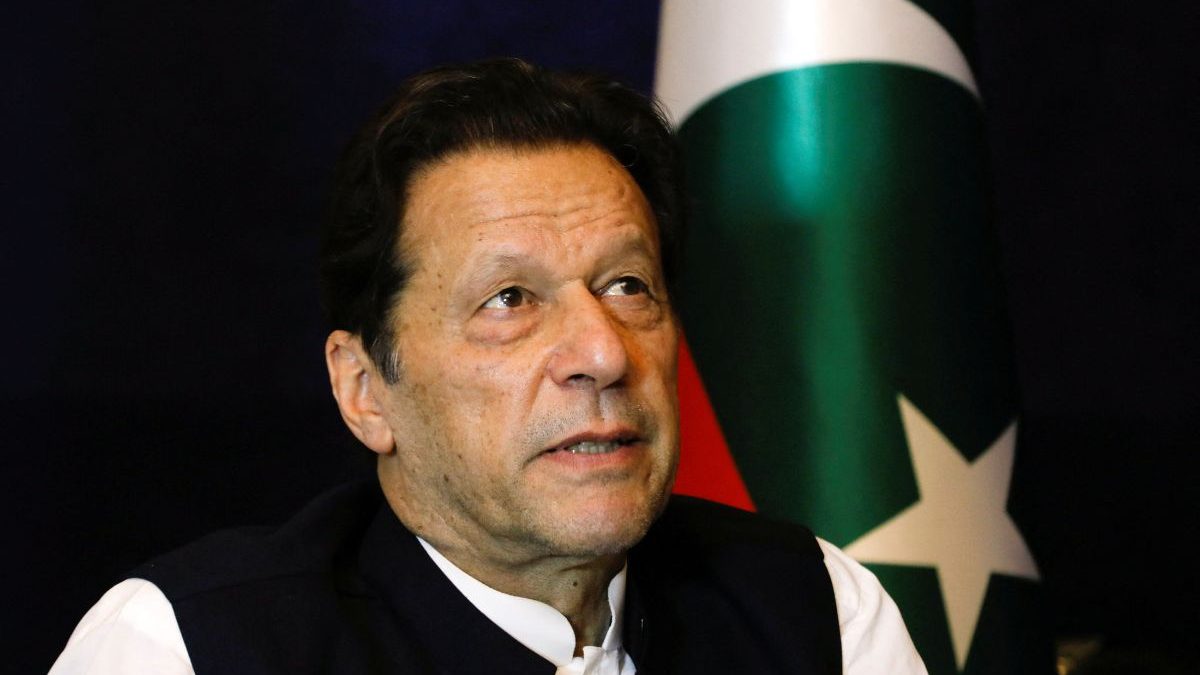
 "Imran Khan letter: A well-meaning appeal that could complicate India’s diplomatic position")
Two days have passed since fourteen former cricket captains from Australia, England, New Zealand, the West Indies and India — including Sunil Gavaskar and Kapil Dev — sent a letter to Pakistan Prime Minister Shehbaz Sharif expressing concern about the medical condition of imprisoned former Pakistani Prime Minister and cricket star Imran Khan. Surprisingly, the Pakistani authorities have not publicly responded to the captains’ appeal, which is more political than humanitarian. This is clever communication tactics on the part of Pakistan. It is contrary to its traditional practice of giving a quick and strong response to what it considers provocations.
Pakistan’s departure, so far, from its traditional approach to the letter is to avoid any chance of controversy at this time. This is because Prime Minister Shehbaz Sharif is taking part in the first Board of Peace (BOP) meeting in Washington on February 19. Some media reports indicate that Field Marshal Asim Munir will be part of his delegation. Pakistan wishes to consolidate its relations with the US and Sharif and Munir with President Donald Trump, who will chair the BOP. The Pakistani leaders would not want any matter to cast a shadow over their Washington visit. To project that all is normal in Pakistan, the army and the government have also persuaded Imran Khan’s party, the Pakistan Tehreek-e-Insaf (PTI), to stop its dharna against the lack of adequate medical facilities and his continuing imprisonment.
It remains to be seen whether Pakistan ignores the captains’ letter once the BOP meeting is over and Sharif returns to Pakistan. In any case, the Pakistani military leadership or the civilian government will show no flexibility towards Imran Khan despite the letter. If Pakistan responds, it will assure the captains that every care will be taken regarding Khan’s medical condition but that the law will prevail. Former England captain Mike Atherton, who is one of the signatories to the letter, has revealed in an article in the British newspaper The Times: “It was from Australia, through Greg Chappell, that the impetus came for a united voice from a number of former captains to heighten awareness about Khan’s situation”.
India will have to be wary that the Pakistanis do not use the opportunity provided by the letter’s content to ask the fourteen to turn their attention to the BCCI’s decision that Indian players will not show the usual courtesies on the field towards their Pakistani counterparts. They may thus try to embarrass India on this matter. This may also seek to draw Gavaskar and Kapil Dev into the issue to divide the fourteen. Perhaps it would have been best if they had avoided the temptation to sign off on or approve the letter to Shehbaz Sharif, which is essentially political in nature.
Quick Reads
View AllImran Khan has been in jail since May 2023. He was taken into detention over allegations of corruption against his wife, Bushra Bibi, and him in the Al Qadir Trust case. In response, Khan’s supporters went on the rampage and took on the army, also targeting army installations and monuments, including those of national martyrs. The army, under General Asim Munir as he then was — he is now Chief of Defence Staff in addition to being Army Chief; he was promoted to the rank of Field Marshal in May last year — cracked down on the protestors.
In May 2023 Khan had support in some sections of the army and was considerably popular in Punjab, while he controlled Khyber Pakhtunkhwa. Munir acted ruthlessly against army officers suspected of being sympathetic to Khan. In the 2024 elections he threw his weight behind the Pakistan Muslim League (N) and against Khan’s party, the Pakistan Tehreek-e-Insaf (PTI), whose candidates were compelled to stand as independents. The election results indicated that Khan remained popular; PTI candidates standing as independents won the largest number of seats.
However, Munir ensured that a coalition led by the PML(N), with the Bhutto-Zardari Pakistan Peoples Party’s (PPP) outside support, became a majority and formed a government. PTI members who joined a small party for technical reasons became the opposition. In all this, one factor became clear — Munir would simply not allow Khan to get out of jail.
To ensure this objective, Khan has been convicted under cases relating to Official Secrets and corruption in 2024 and 2025. He has been awarded long sentences of ten and fourteen years by the sessions and district courts. Appellate courts will hear his appeals in due course but, as long as Munir remains in office, he will ensure that Khan remains in prison. Munir and Khan both know that there cannot be two swords in a scabbard. It is for this reason that Munir will not allow Khan, who retains popularity and refuses to go abroad, to leave prison. In this perspective, the international captains’ appeal is a cry in the wilderness.
The captains write: “This appeal is made in the spirit of sportsmanship and common humanity, without prejudice to any legal proceedings”. However, the letter does not confine itself to Khan’s role as Pakistan’s cricket captain because it notes: “Beyond cricket, Imran Khan served as Prime Minister of Pakistan, leading his nation during a challenging period. Regardless of political perspectives, he holds the honour of having been democratically elected to the highest office in his country”. Having entered the political domain, the captains state: “As fellow cricketers who understand the values of fair play, honour and respect that transcend the boundary rope, we believe that a person of Imran Khan’s stature deserves to be treated with the dignity and basic human consideration befitting a former national leader and a global sporting icon”.
After stating these qualities of cricket and the values it inculcates in players, the captains “respectfully urge” the Pakistani authorities to provide: “Immediate, adequate and ongoing medical attention from qualified specialists of his choosing to address his reported health issues. Humane and dignified conditions of detention in line with international standards, including regular visits by close family members. Fair and transparent access to legal processes without undue delay or hindrance.” Taken together, these are nothing but political demands. Significantly, these are identical to those, among others, being made by the PTI and Khan’s family, including his sons from his first wife, Jemima. They live abroad.
Atherton’s article in The Times is also, in reality, a piece of political writing.
There is no way that Munir and Shehbaz Sharif will countenance the captains’ demands. This is especially so because the Pakistan judiciary is essentially aligned with the government. The Supreme Court did order a medical board to examine Imran Khan’s condition, especially regarding reports that the former Prime Minister had lost a significant degree of vision. The medical board, after examining him, is believed to have reported that his vision with glasses was normal in one eye and almost normal in the other. The PTI and Khan’s family have rejected the report, though the doctors claim that they consulted Khan’s personal physicians, who were satisfied with their examination and findings. The Supreme Court is likely to accept the report.
The letter gives an opening to Pakistan to try to embarrass India, for it states: “Cricket has long been a bridge between nations. Our shared history on the field reminds us that rivalry ends when the stumps are drawn — and respect endures. Imran Khan embodied that spirit throughout his career”. This formulation may lead the Pakistanis to suggest to the fourteen, especially Gavaskar and Kapil Dev, that the spirit of cricket they have invoked should be communicated to the Indian board and authorities regarding India’s conduct towards Pakistan in cricket. Indian players refrained from exchanging courtesies with Pakistan after the Pahalgam attack because of terrorism.
Pakistan and the world should be aware that decades of Pakistani terror against India have led to deep bitterness in this country and among its people. This will not easily go away. The sooner Pakistan realises this, the better.
(The writer is a former Indian diplomat who served as India’s Ambassador to Afghanistan and Myanmar, and as secretary, the Ministry of External Affairs. Views expressed in the above piece are personal and solely those of the author. They do not necessarily reflect Firstpost’s views.)


 "Iran War News Live: Azerbaijan withdraws envoys from Iran after drone strike on its airport")
 "'Hopeful not confident': Finnish President on a peace deal between Russia and Ukraine")
 "Decision to attack Iran taken after Modi had left the shores, says Israeli foreign minister")
 "Why US has given India a 30-day waiver to buy Russian oil")
 "Iran War News Live: Azerbaijan withdraws envoys from Iran after drone strike on its airport")
 "'Hopeful not confident': Finnish President on a peace deal between Russia and Ukraine")
 "Decision to attack Iran taken after Modi had left the shores, says Israeli foreign minister")
 "Why US has given India a 30-day waiver to buy Russian oil")