

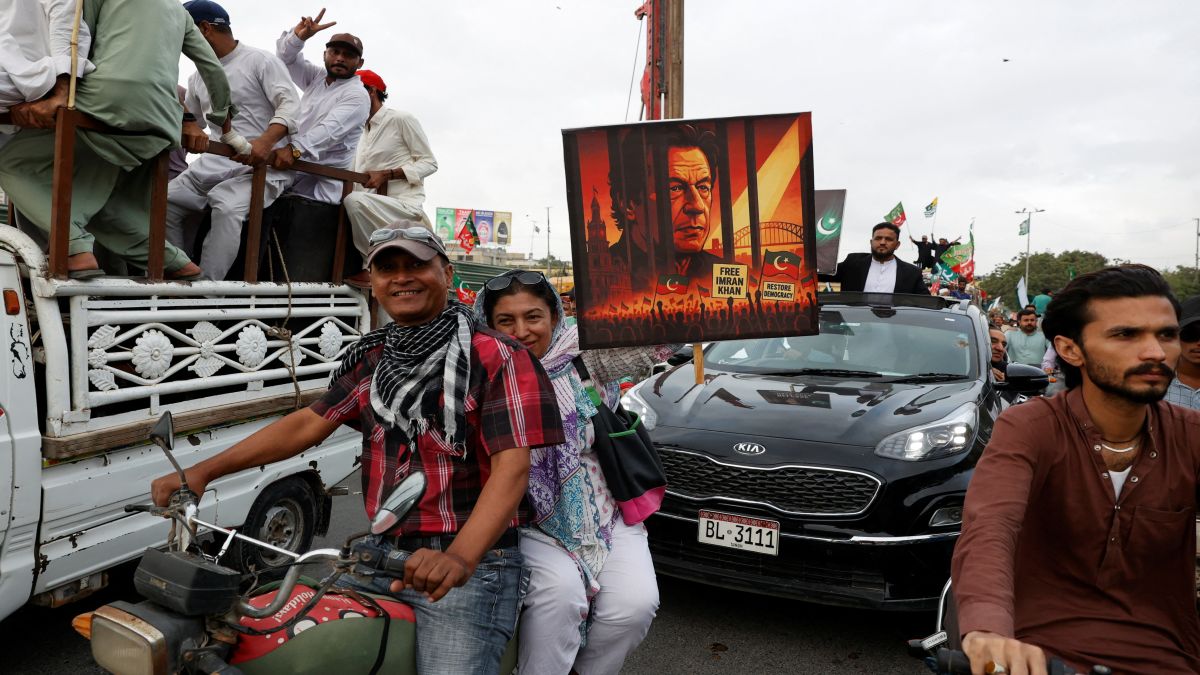
 "Munir’s iron grip, Khan’s death rumours push Pakistan towards a dangerous juncture")
Imran Khan is currently in jail serving a 14-year sentence on corruption charges related to the Al-Qadir Trust case, a charge he claims is politically motivated. He has been incarcerated since August 2023 and faces numerous other legal cases. Khan and his party, Pakistan Tehreek-e-Insaf (PTI), maintain that the dozens of cases against him are fabricated by the military establishment and the current government to keep him out of politics. The military denies these allegations.
Relations between Imran Khan and General Asim Munir are widely reported as highly strained and defined by a deep personal and political animosity. There is a significant power struggle between the jailed former prime minister and the powerful army chief, who is currently the most influential figure in the Pakistani establishment. The animosity reportedly stems from General Munir’s brief tenure as head of the Inter-Services Intelligence (ISI) in 2019, during which he was dismissed by Khan, allegedly after bringing corruption findings involving Khan’s wife, Bushra Bibi, to his attention.
Khan has repeatedly and publicly accused General Munir of being the “most oppressive dictator” in the country’s history and of orchestrating a vindictive political crackdown, his numerous arrests, and the mistreatment of him and his wife in custody. Khan has explicitly stated that he will not engage in dialogue with the current government or the military establishment, asserting that all power lies with General Munir. The relationship is characterised by ongoing political and legal battles, with no signs of reconciliation.
Imran Khan’s family members have voiced grave concerns over his safety and well-being, pointing to his total isolation, the denial of family and lawyer visits, and the lack of a “proof of life” as the basis for their fears amid death rumours. His sisters, Aleema Khan, Noreen Niazi and Uzma Khan, have been outspoken critics of the authorities’ treatment of Imran Khan. They state they have been denied visits for several weeks despite court orders, keeping the family in the dark about his condition. They reported being “brutally assaulted” by police while peacefully protesting and demanding to meet him outside Adiala Jail.
Quick Reads
View AllWhile they have used strong language about the general treatment, Aleema Khan has also been quoted as saying, “My brother’s life is not in danger,” and “No one can dare touch my brother,” suggesting a belief that public and international attention provides a level of protection, even as access is denied. They have consulted lawyers to file a petition demanding Imran Khan be produced in court to ensure transparency.
Imran Khan’s son, Kasim Khan, has made a direct appeal to the international community for intervention. He expressed deep concern over the “absolute blackout” of communication, noting the family has had “no phone calls, no meetings and no proof of life” for over a month. He highlighted that his father has been held in solitary confinement in a “death cell” with zero transparency, a deliberate attempt to hide his condition.
Imran Khan’s ex-wife Jemima Goldsmith has also used social media to raise the alarm, emphasising that while she may disagree with him politically, the situation concerns human rights and her children’s father. She has pointed out that all visits have been stopped and weekly calls to their sons have been cut off. She alleged that Pakistani authorities have threatened to arrest her sons if they visit the country to see their father.
Thus, the family’s primary fear stems from the total lack of communication and access, which they believe is an intentional strategy by authorities to conceal his well-being and is a clear violation of his basic human rights. The Islamabad High Court had ordered that former Prime Minister Imran Khan be allowed biweekly access for meetings with his family, lawyers, and friends. However, recent reports indicate that jail authorities have repeatedly failed to comply with this order.
The rumours of Imran Khan’s death triggered significant protests outside Adiala Jail, with thousands of his supporters from the Pakistan Tehreek-e-Insaf (PTI) party demanding proof of life and the restoration of visitation rights. Khan’s sisters, who have been denied access for weeks, accused the police of brutal treatment during a protest, further escalating tensions.
The Islamabad High Court had initially restored Khan’s visitation rights on March 24, 2025, and issued a subsequent directive on October 24, 2025, ordering Adiala Jail authorities to fully implement the approved meeting schedule. The agreed schedule was for family and lawyers on Tuesdays and friends on Thursdays.
Despite these clear court orders, Khan’s family members, including his sisters and lawyers, have been repeatedly denied access to meet him. As of late November 2025, the denial of access is ongoing, with his family and party members staging protests outside the jail.
Concerns have been raised by his party (PTI) about his well-being and location within the jail due to the lack of access and transparency. Jail officials have cited security concerns and alleged violations of rules (such as making political statements after meetings) as reasons for restricting access. The court has mandated that visitors sign an undertaking not to speak to the media after meetings to address this.
In essence, while the court has clearly mandated biweekly access, the implementation of this order remains a point of contention and is reportedly not being consistently followed by the jail authorities.
Rumours of former Pakistani Prime Minister Imran Khan’s death in jail have been officially denied by Pakistani authorities. Pakistani prison officials and the Ministry of Information have repeatedly dismissed the claims as “baseless”, “fake”, and part of a social media misinformation campaign. They insist Khan is in good health and receiving full medical attention at Adiala Jail in Rawalpindi.
The United Nations (UN) has consistently called on Pakistani authorities to respect and fully uphold Imran Khan’s human rights and due process protections. In the most recent statements (as of November 2025), Farhan Haq, the Deputy Spokesperson for the UN Secretary-General, reaffirmed the UN’s position, following concerns and speculation about Khan’s well-being and reports that his family had been denied access to him. He stated, “We have called for his human rights and due process rights to be respected.” The statement serves as a call to Pakistan’s institutions to ensure justice is not only done but is seen to be done, in compliance with both domestic and international human rights norms.
General Asim Munir was recently elevated to the rank of Field Marshal and granted extensive new powers, including authority over all three defence services and enhanced legal protections. Critics argue that the move consolidates his control over Pakistan’s military and political landscape, further marginalising Imran Khan’s Pakistan Tehreek-e-Insaf (PTI), despite Pakistan’s setbacks and losses following India’s Operation Sindoor. Amid recent rumours about Khan’s health and safety in jail, he has instructed his party to hold General Munir accountable if anything happens to him, highlighting the extreme level of distrust.
In conclusion, Imran Khan’s legal cases are indicative of deep divisions in Pakistani politics because they are widely seen as politically motivated tools used by entrenched elites and the powerful military establishment to sideline a popular opponent. The perception has intensified the struggle between Khan’s populist movement and the state’s traditional power structures, resulting in extreme polarisation and public unrest.
Ultimately, the cases are not just about legal technicalities but are a central front in a larger power struggle that has intensified political polarisation and brought the country to a critical juncture.
(The writer is a retired Indian diplomat and had previously served as Ambassador in Kuwait and Morocco and as Consul General in New York. Views expressed in the above piece are personal and solely those of the author. They do not necessarily reflect Firstpost’s views.)

 "Bangladesh: Hasina and UK MP Tulip Siddiq found guilty, sentenced in corruption case")
 "NIA raids 8 locations in Kashmir in ‘white collar’ terror module linked to Delhi blast")
 "Why has Israeli PM Netanyahu sought a presidential pardon? What happens next?")
 "Why is Elon Musk and his ‘half-Indian’ partner Shivon Zilis’ son’s middle name Sekhar")
 "Bangladesh: Hasina and UK MP Tulip Siddiq found guilty, sentenced in corruption case")
 "NIA raids 8 locations in Kashmir in ‘white collar’ terror module linked to Delhi blast")
 "Why has Israeli PM Netanyahu sought a presidential pardon? What happens next?")
 "Why is Elon Musk and his ‘half-Indian’ partner Shivon Zilis’ son’s middle name Sekhar")



