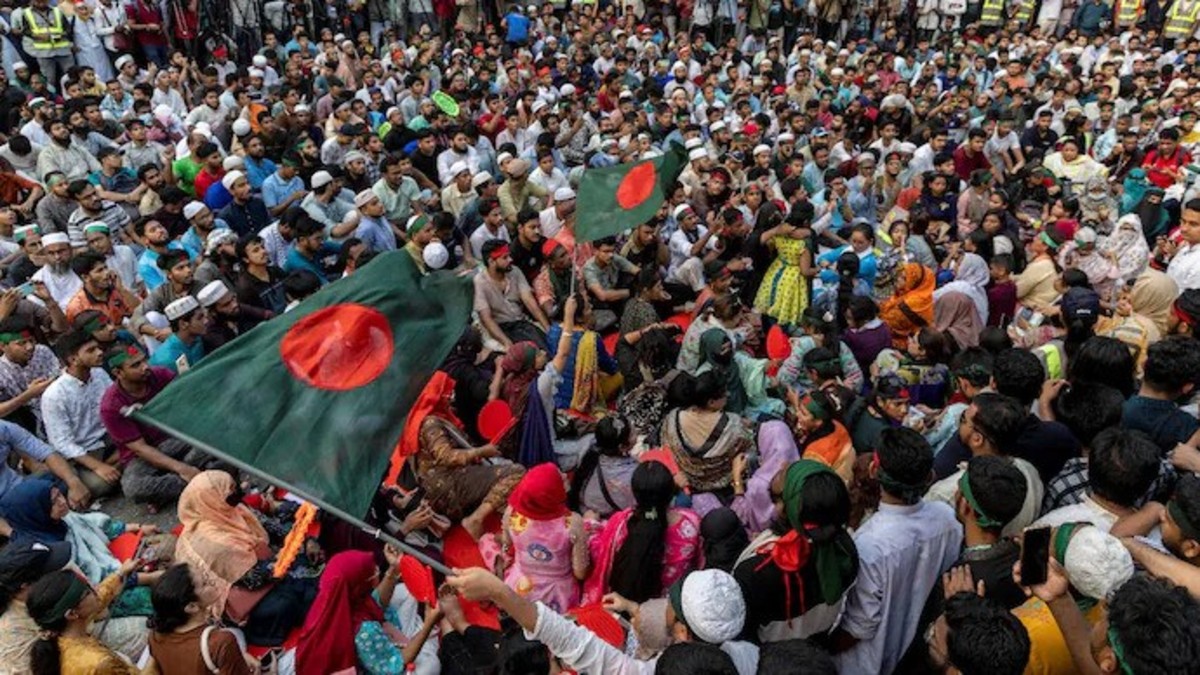
 "How Yunus’s capitulation to foreign powers is wrecking Bangladesh’s future")
Not long ago, Bangladesh was rocked by massive protests under the guise of student rights, demanding reform of a job quota system but spiralling into chaos that ousted Sheikh Hasina, branded a dictator, and unleashed vicious anti-Hindu violence. What began in July 2024 as university students challenging a 30 per cent job reservation for 1971 war veterans’ descendants turned into a deadly anti-government uprising by August, forcing Prime Minister Sheikh Hasina to flee to India. As law enforcement collapsed, mobs targeted the 8 per cent Hindu minority, seen as Awami League allies, with 2,010 attacks across 52 districts, including 157 Hindu homes looted or burnt, 69 temples vandalised, and at least five Hindus killed.
Muhammad Yunus, the Nobel laureate once celebrated as the “banker to the poor”, was thrust into Bangladesh’s interim leadership on August 8, 2024, as the answer to Sheikh Hasina’s authoritarian tenure, a saviour who would heal a nation torn by protests and restore faith in governance. Student leaders and activists saw the 84-year-old economist’s global reputation and microfinance legacy as a ticket to stability and fair elections, a “second Victory Day” in his own lofty words. Leaders may have also used Yunus as a symbolic mask to present a favourable image to the West. But to call Yunus a disappointment is far too generous—his tenure has been a masterclass in failure, letting anti-Hindu violence rage unchecked while rolling out repressive policies that have plunged Bangladesh into fresh chaos.
For more than a week, Dhaka’s streets have been choking under the weight of massive rallies led by the Bangladesh Nationalist Party’s (BNP’s) youth wings—Jatiyatabadi Chhatra Dal, Jubo Dal, and Swechchhasebak Dal—demanding political rights for the young and a clear path to elections. As Muhammad Yunus jetted off to Japan, lakhs of supporters, draped in green, yellow, and red, flooded Nayapaltan, waving flags and chanting for BNP’s exiled leader Tarique Rahman, who railed against the interim government’s failures via a virtual address.
The air crackled with frustration—roads from Shahbagh to Motijheel were paralysed, commuters stranded for hours, as the youth vented their rage against Yunus’s delays, accusing his regime of clinging to power while sidestepping the ‘democratic’ roadmap. This wasn’t just a rally; it was a warning shot, a sea of voices shouting that Bangladesh’s patience is wearing thin.
Quick Reads
View AllThe protests didn’t stop at Nayapaltan—anger boiled over at Dhaka’s heavily guarded secretariat, where government employees revolted against Yunus’s draconian ordinance allowing swift dismissals for “misconduct”, a move reeking of Hasina’s old playbook. Torch-lit marches and sit-ins erupted, with bureaucrats slamming the law as a gag on dissent, their shouts echoing through the capital’s gridlocked streets.
General Waker-Uz-Zaman, the army chief, piled on the pressure, publicly demanding December elections, while BNP leaders like Amir Khosru Mahmud Chowdhury warned of a deepening crisis without a vote. Caught between calls for reform and the clamour for polls, Yunus’s government—despite planning adviser Wahiduddin Mahmud’s insistence that he won’t quit—looks increasingly like a ship adrift, its promises of stability drowned out by the growing roar of a nation fed up with waiting.
Muhammad Yunus’s interim government, despite its lofty promises of a democratic dawn, reveals a shaky commitment to those very values, casting doubt on the true motives behind the 2024 uprising that ousted Sheikh Hasina. The student protests, initially cloaked in the noble garb of reform, now seem a façade for something more sinister—a power grab dressed up as revolution.
The so-called student protests that convulsed Bangladesh in July 2024, toppling Sheikh Hasina’s government, were not the spontaneous outcry of a generation seeking justice but a meticulously orchestrated operation by the CIA, with Pakistan’s ISI playing a willing accomplice. Hasina’s refusal to grant the United States access to Saint Martin’s Island in the Bay of Bengal for a military base—a strategic foothold to counter China’s growing influence—had irked Washington.
Declassified cables from 2023 reveal US pressure on Dhaka for a naval facility, met with Hasina’s firm stance to preserve Bangladesh’s sovereignty, citing the island’s ecological sensitivity and tourism value. Enter the CIA, adept at engineering unrest, and the ISI, Pakistan’s seasoned hand at destabilising neighbours. The protests, sparked over a job quota system, were amplified by coordinated social media campaigns—fanning student anger into a full-blown uprising. Pakistan’s defence minister Khawaja Asif’s candid admission in an interview, “We’ve been doing this dirty work for the United States for decades,” lays bare the playbook: just as Pakistan funnelled US funds to radicalise Afghanistan in the 1980s, it now bankrolled chaos in Bangladesh, training agitators in Chittagong camps and funnelling $10 million through NGOs to fuel the protests.
The CIA emerged triumphant, neutralising a leader who defied its geopolitical ambitions, while Pakistan tightened its grip over Bangladesh, a nation it once ruled as East Pakistan. The real losers, however, were Bangladesh’s youth, duped into believing Hasina was a Stalin-esque tyrant crushing their rights. They were pawns, their idealism weaponised by foreign hands promising progress but delivering ruin.
Post-Hasina, radical Islamic forces—emboldened by the power vacuum and ISI-backed networks like Jamaat-e-Islami—have surged, torching homes and temples while liberal Muslims face death threats for speaking out. Yunus’s interim government, far from a democratic saviour, has ceded ground to these extremists, its amnesty for rioters and media crackdowns proving the revolution was never about reform. Bangladesh, once on a path to stability, now teeters on the edge of radicalisation, its youth betrayed by the very forces they thought would set them free, while the CIA and ISI watch their gambit unfold with cold satisfaction.
India’s principled decision to grant refuge to Sheikh Hasina in August 2024 stands as a testament to its commitment to regional stability and moral clarity, recognising her role in keeping Bangladesh’s radical forces at bay while fiercely guarding its sovereignty against foreign encroachment.
Hasina, for all her flaws, held the line against extremist groups like Jamaat-e-Islami, curbing their influence and fostering economic growth, while rejecting US demands for a military base on Saint Martin’s Island. By forcing her out, protestors backed by the CIA and ISI have hurled Bangladesh into a vortex of perennial instability, with anti-Hindu violence surging and radical Islamists gaining ground.
Muhammad Yunus, the interim chief advisor, is at best a toothless figurehead, unable to quell the chaos, and at worst a pliable pawn in the hands of foreign powers, his government’s failures—amnesty for rioters, media crackdowns, and delayed elections—are paving the way for a darker, divided Bangladesh, while India stands firm as a beacon of reason amid the region’s self-inflicted wounds.
The writer takes special interest in history, culture and geopolitics. The views expressed in the above piece are personal and solely those of the author. They do not necessarily reflect Firstpost’s views.

 "'PM Modi a fantastic man... we're going to have a good deal': Trump tells Moneycontrol | Watch")
 "Is Canada preparing for a US invasion as Trump unsettles allies? Report says...")
 "Trump says Ukraine war deal ‘reasonably close’, plans Zelenskyy meeting in Switzerland")
 "‘Rules-based order is fading’: When Carney responded to Trump challenge in Davos | Full text")
 "'PM Modi a fantastic man... we're going to have a good deal': Trump tells Moneycontrol | Watch")
 "Is Canada preparing for a US invasion as Trump unsettles allies? Report says...")
 "Trump says Ukraine war deal ‘reasonably close’, plans Zelenskyy meeting in Switzerland")
 "‘Rules-based order is fading’: When Carney responded to Trump challenge in Davos | Full text")