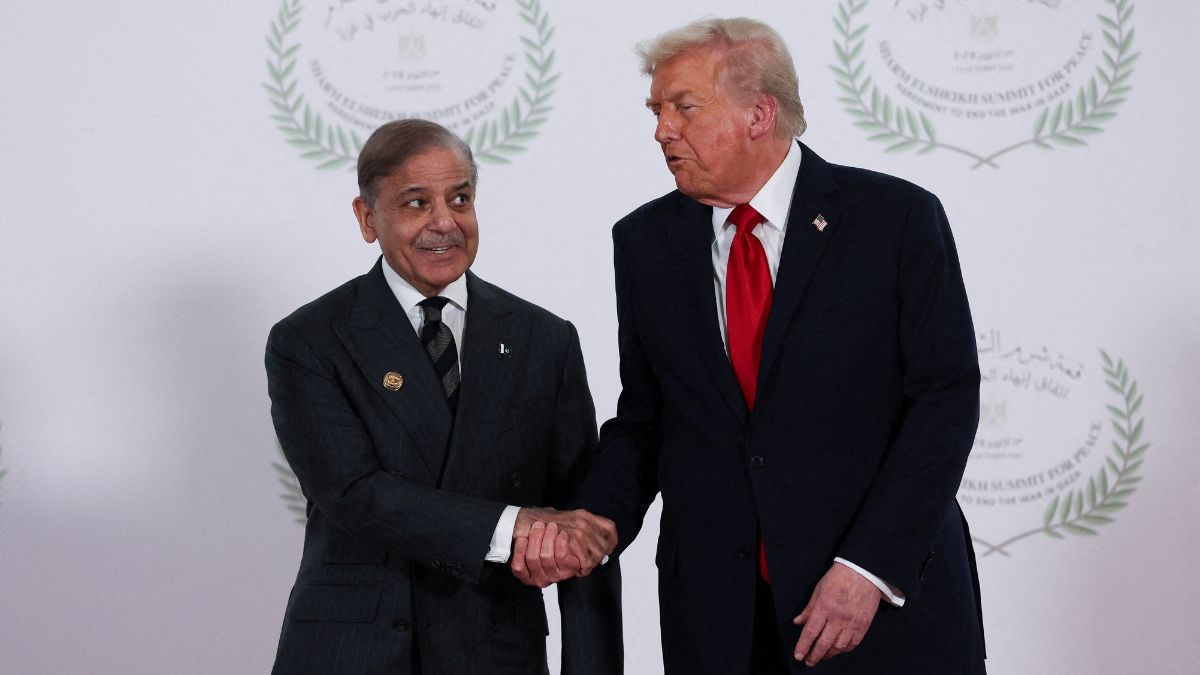
 "Sharif said that Pakistan “fully supports ongoing efforts to pursue dialogue” to end the war, adding that Islamabad would be “ready and honoured” to host negotiations if both sides agree. File Image/Reuters")
The British and their American progeny have a complicated relationship with the Islamic world. Medieval Muslims and Christians fought each other for 200 years during the Crusades from 1095 to 1291.
The defeat, centuries later, of the Ottoman Empire, which had allied with Germany in the First World War, opened the gateway to the Middle East for the West. What we are seeing today in the US-Israel-Iran war is a culmination of decades of deceit and genocide between three Abrahamic faiths: Muslims, Jews and Christians.
Following the Ottomans’ defeat in the First World War and abolition of the Ottoman Caliphate in 1924, Britain and France seized control of the Middle East. The League of Nations, precursor of the United Nations, gave Britain control over Jordan and Palestine (today’s Israel) and France control over Lebanon and Syria.
The modern crusades would soon begin but with a historical twist that brought Jews and Christians together against Arab Muslims who now lived under Western colonial mandates in the volatile 20th century Middle East.
Soon after it received the mandate for Palestine, Britain allowed Jews to enter the state from the early 1920s. Palestinians were systematically evicted from their homes. The population of Jews in Palestine rose from 60,000 in 1920 to 6,50,000 in 1948. The embryo of Israel was forming. In 1948, it emerged from Britain’s womb where it had been carefully nurtured.
Since the early 1900s Britain had controlled Iran’s oil reserves for nearly 50 years through the Anglo-Iranian Oil Company (AIOC). In 1951 Iran’s parliament (known as the Majlis) legislated to nationalise Iran’s oil.
Quick Reads
View AllOrchestrated by America’s CIA and Britain’s MI6, street unrest broke out in Tehran. The duly elected prime minister, Mohammad Mosaddegh, was overthrown in a coup.
The Shah, Mohammad Reza Pahlavi, briefly fled to Italy but returned within a few days to reclaim his throne under the patronage of the US and Britain. Iran and its oil were now firmly under Western control till the Islamic Revolution 26 years later in 1979.
Meanwhile in India
Britain knew that Indian freedom would lead to the dissolution of the British Empire. It did. By 1957, Malaya was free and split into Malaysia and Singapore. Nigeria, Kenya and other British colonies in Africa and several in the West Indies followed in the 1960s. The British Empire was over — but not its imperial agenda.
Bankrupted by the Second World War and in deep debt to the United States, Britain still continued to punch above its geopolitical weight. America was a willing ally in building an Anglo-Saxon world order with the US as the senior partner and Britain as its quiet accomplice.
The two cultivated a close relationship with Pakistan. During British rule in undivided India, Muslims were co-opted as a martial race. It kept Hindus at bay and India in perpetual communal strife.
At the United Nations, Britain and the US supported Pakistan following the India-Pakistan conflict in 1947-48. Through the Cold War, as India led the non-aligned movement but leaned towards the Soviet Union, Pakistan slipped further into the US-UK camp, acting as a gun-for-hire. As a reward Islamabad was given the status of a non-NATO ally.
The US tilt towards Pakistan was on full display during the 1971 Bangladesh war. Both Britain and the US later sold advanced weapons to Pakistan, knowing they would only be used against India in a war or for terrorist attacks on Indian soil.
Cut to today. US President Donald Trump makes no secret of his admiration for Pakistan’s jihadist terror-sponsoring army chief Asim Munir.
Pakistan’s army has a single obsession: India. Without conflict with India, Pakistan’s army would be out of business. Most senior Pakistani army officers are businessmen and real estate developers. An estimated one-third of Pakistan’s businesses are owned by serving or retired armed forces officers.
Munir is cut from different cloth. He too is obsessed with India but his obsession is that of a radicalised mullah, not a trained army officer.
That is what endears him to Trump who himself is a real estate developer-turned-president. Trump likes to deal with tough, unscrupulous men. That is why the two members of his inner circle, secretary of war Pete Hegseth and deputy chief of staff Stephen Miller, were the most vociferous advocates of the war against Iran.
In Munir, Trump has found his Pakistani Hegseth and Miller: Men without scruples and willing to kill school children during what Trump described as a “little excursion” into Iran.
Munir would likely have passed orders to instruct the Pakistani terrorists who killed 25 tourists and one guide in cold blood in Pahalgam in April 2025 to taunt their victims before they were shot: “Go tell Modi”.
That is the kind of man Trump would turn to for an exit ramp from a war in Iran the US cannot win. Like Pakistani Generals and politicians, fabrication comes easily to Trump. He makes things up as he goes along. In the first week of the war, he said the US had obliterated Iran’s offensive capabilities, including missiles and drones. Towards the end of the fourth week of the war, Iranian missiles and drones continue to hit targets in Israel and the Gulf states.
Few will remember that the Gulf monarchies — which are in effect US neo-colonies with no military capacity to defend themselves as the Iran war has shown — hired former Pakistani army chief Raheel Sharif to head a joint Saudi-UAE military task force to attack Yemen in 2015. The operation has been an embarrassing failure for the Gulf’s two wealthiest monarchies.
Yemen remains a potential threat to shipping in the Red Sea. Raheel Sharif, who turns 70 this June, remains nominally commander-in-chief of the 41-nation Islamic Military Counter Terrorism Coalition (IMCTC).
Munir is a fundamentalist. Historically the fate of jihadist army chiefs has been grim. That doesn’t worry Trump as he uses Munir for a delusional exit ramp from Iran. Trump’s presidency will anyway be over in two-and-a-half years. Till then, Pakistan will continue to flatter and deceive Trump as it has flattered and deceived every past US president.
(The writer is an editor, author and publisher. Views expressed in the above piece are personal and solely those of the author. They do not necessarily reflect Firstpost’s views.)