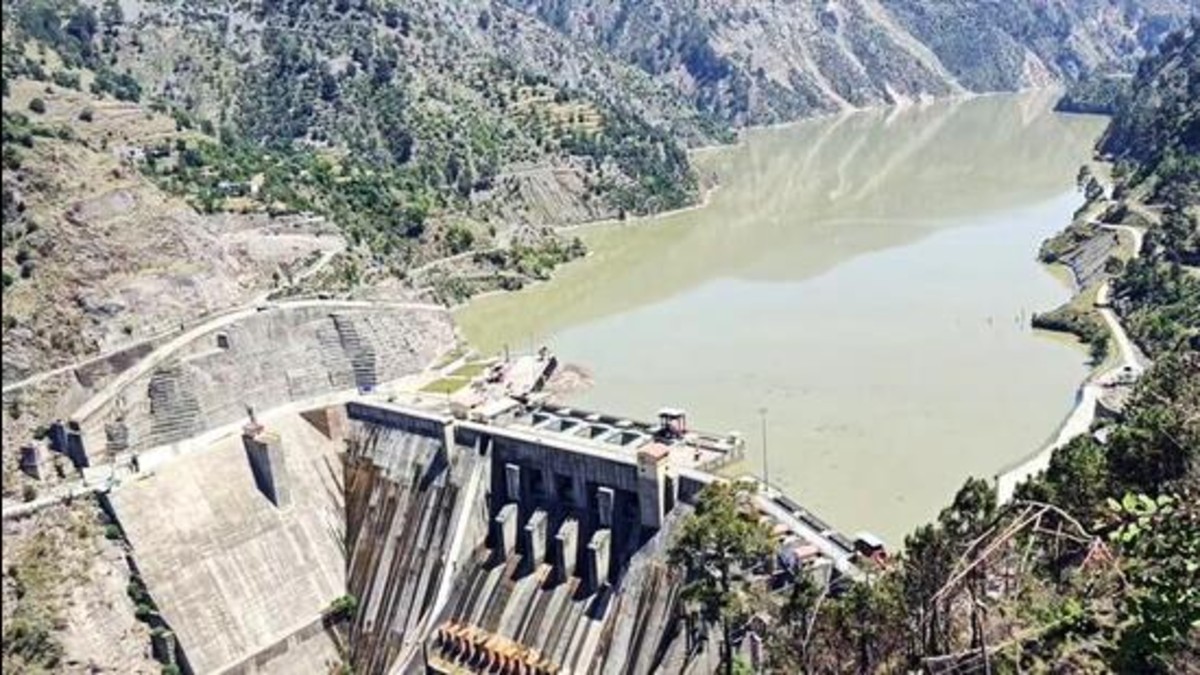
 "How suspension of Indus Water Treaty will wreak havoc on Pakistan")
The ghastly killing of 26 people by The Resistance Force (TRF), an offshoot of the Lashkar-e-Taiba (LeT) terror outfit at Pahalgam in Kashmir, following Pakistan Army Chief General Asim Munir’s anti-India and anti-Hindu hate speech, has provoked India to retaliate. Though the group later backtracked on the responsibility for the attack, nobody buys it.
The preliminary steps taken are the abeyance of the Indus Waters Treaty, closure of the integrated check post Attari, travel ban on Pakistani nationals under the SAARC Visa Exemption Scheme (SVES), staff reduction in the High Commission, suspension of visa services, and suspension of all symbolisms during the Retreat Ceremony at Attari, Hussainiwala, and Sadki in Punjab. However, the Indus Waters Treaty secures salience.
Indus Waters Diplomacy
The Indus Waters Treaty was signed on September 19, 1960, between Prime Minister Jawaharlal Nehru and the President of Pakistan, Mohammad Ayub Khan, concerning the waters of the Indus system of rivers. The water sharing undergirded friendship and goodwill despite Partition, Pakistan’s invasion of Kashmir, its religious antagonism, and irrational hatred against the Hindus.
Since its inception from the troubled historicity of colonial cunning, convoluted geopolitics, and religious exclusivity and rioting, Pakistan has been neither a friend nor exercised any goodwill.
India has tried everything in its capacity to achieve the impossible. Each time it has failed and never learnt a lesson from it. Pakistan always benefitted from India’s Stockholm syndrome. Pakistan should have been defanged through economic veto or riverine disconnect. The enemy was given the leeway to cultivate more enmity. Partition was Pakistan’s choice. It should have been allowed to suffer the choice it made.
On the contrary, India always distinguished between the Pakistani state and people and hence took a generous approach. This has historically been heavier on India. However, since 2014, India’s Pakistan policy has undergone change. The 2016 ‘surgical strike’ and the 2019 Balakot ‘airstrike’ illustrate the grit, courage and resolve to hit back at the den of terrorism.
Quick Reads
View AllWhen Muhammad Ali Jinnah’s religious bigotry overshadowed his remarks on Cyril Radcliffe’s negotiations on the Punjab water system in the aftermath of the Indian Independence Act of July 1947, he responded vehemently that “he would have Pakistan remain a desert rather than a fertile field watered courtesy of the Hindus”. Why was the Indus Waters Treaty of 1960 signed when the founder of Pakistan saw Hindus in the Indus water?
Moreover, Prime Minister Narendra Modi was right to say in the event of the Uri attacks in 2016, “Blood and water can’t flow together at the same time." He reiterates that resolve, keeping the treaty in abeyance immediately after the Pahalgam massacre. It explains the importance of the Indus waters for Pakistan. This non-kinetic action embodies serious economic repercussions for Pakistan. The hit-back at Pakistan in 2016 and 2019 will see recurrence in 2025 as well. Terror and talk do not concur. Kinetic action will definitely follow to mark India’s zero tolerance for terrorism.
Be that as it may. The Indus water system includes the Indus, Jhelum, Chenab, Sutlej, Beas, and Ravi. The World Bank, under President Eugene Black, was a signatory to this negotiation on water-sharing. Pakistan’s dependencies on the Indus waters are irreversible. Since India has kept this treaty in abeyance because of the Pahalgam attack, it will hurt Pakistan seriously. Kishenganga (330 megawatts) and Ratle (850 megawatts) hydroelectric power plant projects on the Jhelum and the Chenab in 2018 have rattled Pakistan in the past. These are the western rivers where Pakistan has the unrestricted use of water. The power plants can be the chokepoints to restrict water flow. Pakistani water dependencies will be affected severely if India weaponises them.
The current decision to keep the treaty in abeyance will definitely add more pressure on Pakistan. The treaty allows India to build hydroelectric power plant projects that are subject to design specifications. Pakistan approached the World Bank in 2016 to facilitate the matter through an ad hoc court of arbitration to assess the structural aspects of the two hydroelectric power projects.
The World Bank followed the procedural parts of the treaty in terms of the Court of Arbitration and the neutral expert. Since 2016, the World Bank has been working in consultation with both parties. However, it has not reached a conclusive stage to restrict India’s hydro projects.
India’s increasing diplomatic heft and international stature will not accept pressure or arbitrariness. Pakistan has been enjoying the Indus basin water for a long while, constantly resorting to terrorism against India. Its economy is deeply reliant on Indus waters, but the undying religious hatred remains unabated. Its hostility must be checked through both kinetic and non-kinetic options.
Pakistan Army Chief General Asim Munir’s hate speech against India and cross-border terrorism at Pahalgam establishes Islamabad’s resolve to fan the flame of communalism and provoke the Muslims in India. He underlines the impossibility of Hindu-Muslim unity for religious reasons and refers to Partition to stoke communalism. He stated that Pakistanis are “fundamentally different from Hindus in religion, culture, traditions, thoughts, and ambitions”.
Balochistan and Khyber Pakhtunkhwa show balkanisation tendencies in Pakistan. Unrest continues in Sindh over the Pakistani government’s controversial canal project. It raises concerns about the impending water scarcity in the lower riparian regions. The simmering tension may intensify because of India’s decisions to weaponise the Indus Treaty to punish Pakistan economically for its sponsorship of cross-border terror. India will fast-track its hydro project constructions on the Jhelum and Chenab.
On the eastern rivers, India has already built the Shahpurkandi Dam on the Ravi and is planning the Ujh Dam to redirect its water to Indian fields. The surplus water from the eastern rivers will hardly go to Pakistan. India was generously giving its water share to Pakistan. The latter always responded with cross-border terrorism, killing innocent Indians in the name of religion.
Fallout on Pakistan
Kishanganga Dam on the Jhelum was completed in 2018 and may dry Pakistan’s downstream Mangla Dam. The under-construction Ratle project on Chenab will restrict water flow to Punjab in Pakistan. Shahpurkandi dam on the Ravi ensures its water is solely for India. The planned Ujh dam on the Ravi will exercise further reduction on the downstream water flow. Pakistan’s electricity and agriculture will face a serious crisis. Food security will meet grave danger. Famine situations may arise.
Pakistan’s freshwater dependencies on the Indus water systems are inconceivably high. It will not happen soon because diverting the Western waters for Indian consumption is not easy. It takes time. India’s capacity-building measures are not adequate enough now to completely stop the water flow to Pakistan.
However, the decision impacts Pakistan psychologically. India may restrict the flow in the long run and cause massive damage to Pakistan without wasting a bullet. Its fragile economy experiences more vulnerability. Inflation will hit it hard. Balkanisation will become the natural corollary.
Rivers feed 23 per cent of Pakistan’s agricultural needs. Around 68 per cent of the rural population find their sustenance from the river waters. Punjab and Sindh will specifically be hit if water diversion happens. Rural livelihoods will face economic and ecological stress.
Rice, cotton and wheat crops will be affected, causing agricultural distress and shock. Electricity production from Tarbela and Mangla dams will fall, leaving Pakistan in darkness. Soil degradation and underground water depletion due to over-dependencies will intensify the crisis. Inter-state problems will worsen. Pakistan’s export basket, especially rice, cotton and textiles, will shrink. The geopolitics over river water will be India’s chokepoint to force Pakistan to refrain from terrorism.
Pakistan will use its propaganda machinery and resort to legal recourse to underline the gravity of the matter. What are Pakistan’s options then? To settle disputes and differences, Pakistan will reach out procedurally to the Indus Commission and subsequently refer it to the Court of Arbitration. Dispute settlement by the international institutions is less likely and inordinately lengthy.
Jajati K Pattnaik is an Associate Professor at the Centre for West Asian Studies, School of International Studies, Jawaharlal Nehru University, New Delhi. Chandan K Panda is an Assistant Professor at Rajiv Gandhi University (A Central University), Itanagar. The views expressed in the above piece are personal and solely those of the authors. They do not necessarily reflect Firstpost’s views.


 "'PM Modi a fantastic man... we're going to have a good deal': Trump tells Moneycontrol | Watch")
 "Is Canada preparing for a US invasion as Trump unsettles allies? Report says...")
 "‘Rules-based order is fading’: When Carney responded to Trump challenge in Davos | Full text")
 "Davos 2026 Live Updates: Trump says he won’t use force to take Greenland, warns Europe is ‘not heading in the right direction’")
 "'PM Modi a fantastic man... we're going to have a good deal': Trump tells Moneycontrol | Watch")
 "Is Canada preparing for a US invasion as Trump unsettles allies? Report says...")
 "‘Rules-based order is fading’: When Carney responded to Trump challenge in Davos | Full text")
 "Davos 2026 Live Updates: Trump says he won’t use force to take Greenland, warns Europe is ‘not heading in the right direction’")