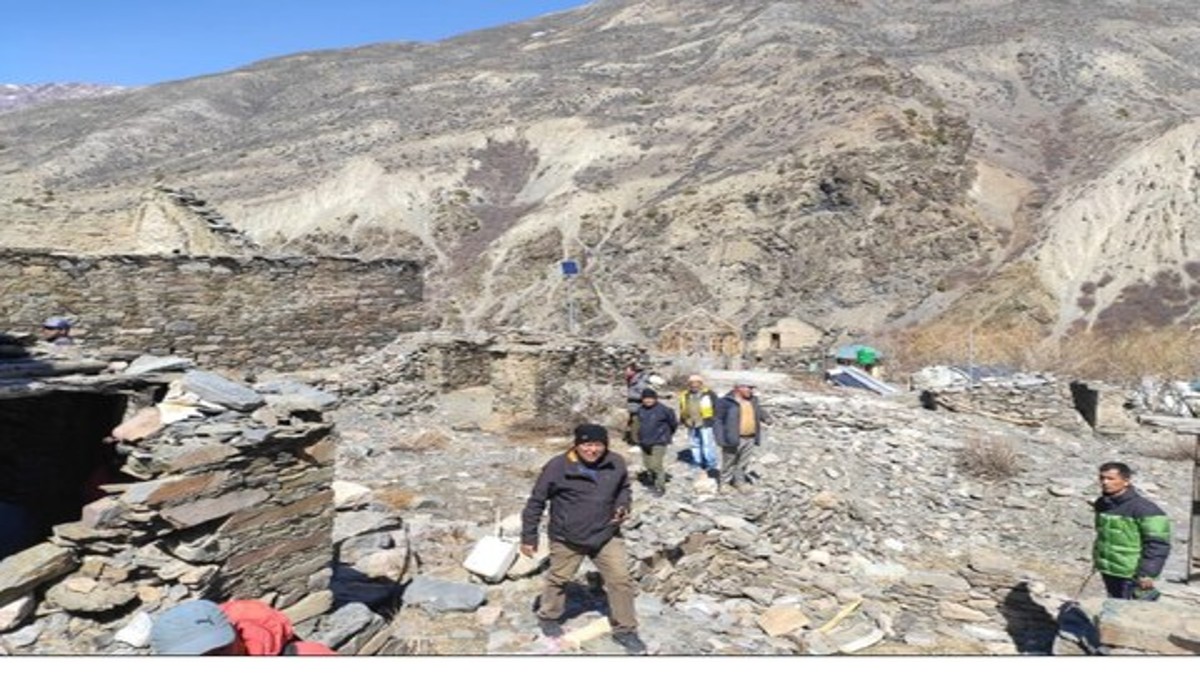
 "Till date, the details of the occupation of Nelang remain shrouded in secrecy, though we know that it is also an outcome of the Himmatsinghji Committee. News18")
Though historically intimately linked, two separate events took place recently, nearly 1,000 miles away from each other.
During a visit to the central sector of the Indo-Tibet boundary in Uttarakhand, Chief of Defence Staff (CDS) General Anil Chauhan directed Army formations to work for the rehabilitation of the border villages of Nelang and Jadung, near the Line of Actual Control in Chamoli district.
During the 1962 Indo-China war, both villages were abandoned, and their residents were relocated to safer nearby areas.
Far away in the east, at the Tawang War Memorial in Arunachal Pradesh, the Indian Army, along with the Tawang administration and the local Monpa population, commemorated the 74th anniversary of the arrival of Maj Bob Khathing in the area.
In 1951, the Manipuri Naga officer took over the administration of the border town of Tawang, south of the McMahon Line; a communiqué of the Defense PRO in Guwahati thus explained, “After the valiant Major undertook a treacherous march from the plains of Assam to Tawang, negotiating Sela and Bomdila passes during peak winters, leading a contingent of 200 Assam Rifles troops and 600 porters for a difficult maiden mission, thus materialised the formal establishment of Indian civil administration at Tawang.”
The above two events are linked as the takeover of both places’ administration is the result of a decision of the Himmasinghji Border Defence Committee created by the Army Headquarters on November 12, 1950.
Impact Shorts
More ShortsLet us remember the facts
On October 7, 1950, the communist troops advanced in eastern Tibet, and after smashing the ill-trained and ill-equipped Tibetan army, Chamdo, the capital of Kham Province, fell to the invaders.
On November 7, Sardar Patel, the deputy prime minister, despite his poor health, sent a long letter to the prime minister about the implications of the Chinese invasion of Tibet for India’s northern border.
Five days later, the dying Sardar (who passed away on December 15) constituted this committee to examine the possibility of Chinese communist troops occupying the areas south of the McMahon Line or elsewhere on the Indo-Tibet border and “to consider the feasibility or advancing outposts of the Assam Rifles in order to forestall such ingress”.
Besides Maj Gen Himmatsinghji, deputy minister of defense (chairman), it included Lt Gen Kulwant Singh, K Zakaria, head of the Ministry of External Affairs’ historical division, SN Haksar, joint secretary also from MEA, Group Captain MS Chaturvedi from the Indian Air Force, and Waryam Singh, deputy director of the Intelligence Bureau.
After discussing at great length the advisability of pushing forward a post to Tawang, it was decided to go ahead. It was also decided to send troops to Nelang (then written Nilang) and Jadung (then Jadhang), two tiny villages south of the Tsangchok-la, the pass marking the watershed in the area, in the Chamoli district.
The Role of Jairamdas Daulatram
One man was central in the setting up of Maj Khathing’s expedition to Tawang; it was Jairamdas Daulatram, the governor of Assam. It is sad that his role has been more or less forgotten today.
On December 10, 1950, he managed to get the concurrence of the Ministry of External Affairs headed by Nehru; a Joint Secretary concurred with the Committee, “We cannot agree to a unilateral occupation of Tawang by the communists.”
The ball then started rolling, and preparations for the expedition began. Maj Khathing received detailed instructions from Nari Rustomji, the advisor to the governor, on behalf of Daulatram himself.
Eight Tasks
Precise tasks were given to the young and bold officer.
The first task was to occupy Tawang. Khathing was asked to explain to the local population and Tibetan officials that he was “doing no more than is being done by the administration in other parts of Indian territory;” in 1914, Tibet had agreed to the McMahon Line, north of Tawang being the boundary.
The major was ordered to “treat any Tibetan or other officials you may meet with courtesy, but nevertheless let them understand that jurisdiction in the area vests in you and not in them.”
He was directed to submit detailed reports about the Tibetan ‘influence’ in the area and the nature of taxes collected. He was further told to abolish all existing taxes and substitute them with lighter taxes to be paid to the Political Officer, representing the Indian government: “There will be no forced labour and everything needed will be duly paid for.”
An important task was to communicate to the local people that “none of their religious practices will be interfered with”.
The sixth point was that in case Khathing met with armed opposition, he was to cable Shillong (the governor’s office) immediately, “indicating the strength and position of opposing forces.”
Fortunately, due to Khathing’s intelligence and diplomatic skills, this would not be necessary, and 74 years later, he was still considered by the Monpas as their liberator.
Khathing was also asked to keep daily wireless telegraphic contact with Daulatram after crossing the Se-La pass. It is what Khathing did, and his dispatches and cables still make fascinating reading.
Finally, Daulatram asked Khathing to “conduct [the] operation with tact, firmness, and discretion”.
Difficult Logistic
The logistics of the expedition were not easy; for example, the question of porters and loads was difficult to coordinate. One can imagine having as many as 200 troops and 600 porters to feed.
Another issue was ‘political presents’ for the local authorities, in particular the monastery officials. The possibility of airdropping rations and material at Dirang Dzong on the way was also discussed: “Luckily the one platoon at Dirang Dzong has already got one year’s supply of rations …the [new] platoons can simply borrow rations there.”
One most difficult matter was the currency, as traders in the area were usually using Tibetan currency: “…when we go in and take over this Tawang area up to the McMahon line, then this area automatically becomes Indian Territory, and as such, the official currency must and will be the Indian Rupee.”
During the following weeks, a huge amount of silver coins would be sent to Khathing as a temporary measure.
Once preliminary arrangements were over, Khathing left Assam in mid-January 1951; he would reach Tawang on February 6. He informed Shillong that he had already met the representatives of the Tsona Dzongpons (district commissioners from Tsona in Tibet) and the Tawang monastery officials on their way.
On February 9, 1951, the Tsona Dzongpons met Khathing again, and the latter reported to the governor: “As regards the lay officials, like Tsona Dzongpons and Drekhangs, the salt monopolists and grain collectors, I have not allowed them to exercise any of their powers and influence.”
Undoubtedly, the merit of having taken over Tawang’s administration goes to Daulatram as well as to the most reliable major.
Nehru’s Reaction
On March 18, 1951, the prime minister noted: “I hear constantly about the activities of the North and North-East Border Defense Committee. These activities have resulted in action being taken on the Tibetan border and in Nepal. At no stage have these matters been brought up before me for consultation, although apparently consultations have taken place with the Governor of Assam and other people far away. …I am greatly concerned about this matter because …the manner of our going to Tawang and taking possession of it and thus creating some international complications, has not been a happy one. I am yet not quite clear how all this was done without any reference to me.”
One can imagine what would have happened if the prime minister had been in the loop.
The Occupation of Nelang/Jadhang
Till date, the details of the occupation of Nelang remain shrouded in secrecy, though we know that it is also an outcome of the Himmatsinghji Committee, which sent a report in two parts to the Government of India.
The first part consisted of its recommendations regarding Sikkim, Bhutan, NEFA, and the eastern frontier bordering Burma. The second part contained the recommendations on the borders in Ladakh, Punjab, Uttar Pradesh, and Nepal; it was submitted in September 1951. The preliminary reports recommended that the Indian forces should immediately occupy Tawang and Nilang.
Already in May 1950, the Ministry of External Affairs had sent a note to the Ministry of Defense asking the latter to comment on the feasibility of walking into the Nilang/Jadhang area. The Ministry of Defense then observed: “The area under dispute is an extremely difficult country physically and climatically, with hardly any communications. It therefore follows that operations in the area will have to be confined to short periods and undertaken by specially trained infantry organized on an ad hoc basis with very scanty artillery support and no support whatsoever from either tanks or aircraft.”
If the Sardar were able (from wherever he is) to see the recent events in these two places, he would certainly be extremely pleased.
The writer is Distinguished Fellow, Centre of Excellence for Himalayan Studies, Shiv Nadar Institution of Eminence (Delhi). Views expressed in the above piece are personal and solely that of the writer. They do not necessarily reflect Firstpost_’s views._