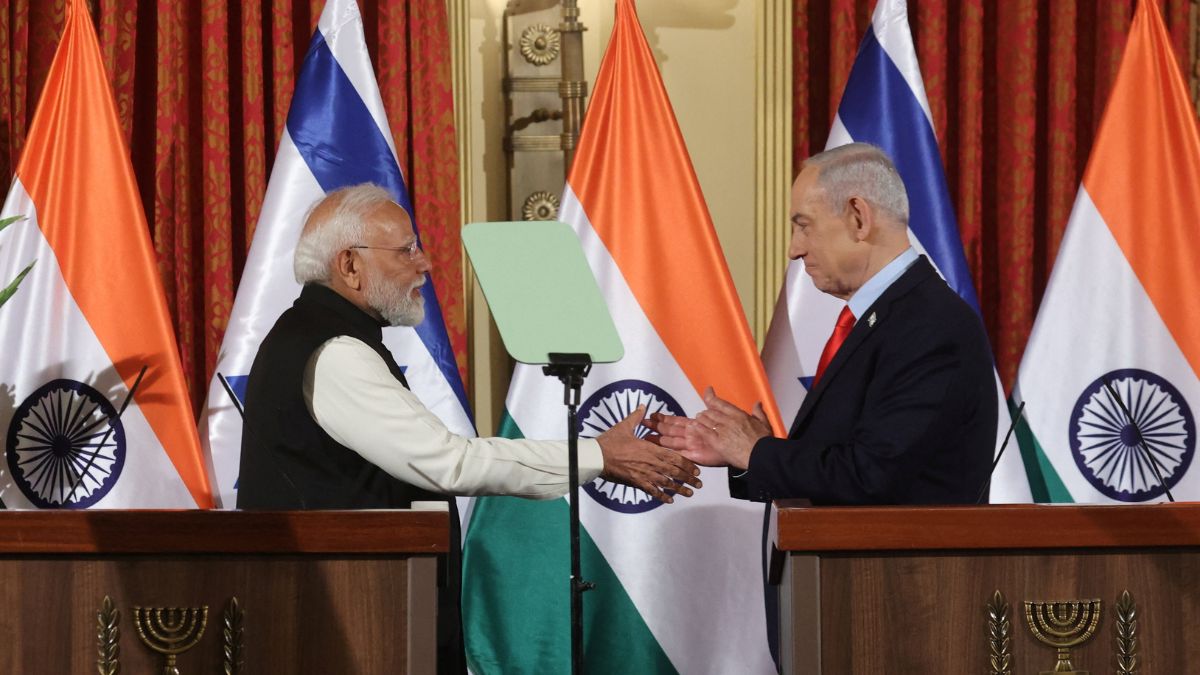
 "Prime Minister Narendra Modi and Israel's PM Benjamin Netanyahu reach to shake hands as they attend a press conference in Jerusalem on February 26, 2026. Reuters")
When Prime Minister Narendra Modi touched down in Tel Aviv for his second official visit to Israel on February 25–26, 2026, it wasn’t just another diplomatic jaunt. It was a declaration, not of faction, but of strategic conviction. Nine years after his historic first visit in 2017, this return trip reflects not impulsive alignment but long-term partnership, calibrated by shifting global fault lines and India’s own evolving worldview.
For PM Modi and New Delhi, this visit sits at the crossroads of history and geography. The 2017 trip had marked the first ever by an Indian prime minister to Israel and elevated bilateral ties to a strategic partnership. His current 2026 visit consolidates that trajectory, deepening cooperation not just in defence and security but in next-generation technology sectors. From artificial intelligence to quantum computing, precisely at a time when many global powers are losing coherence and credibility on the world stage.
Critics of the Indian government may try to argue that such engagement signals a retreat from India’s historical support for the Palestinian cause. Voices from the Opposition, for instance, have suggested that the visit undermines India’s legacy of championing Palestinian self-determination, established decades ago when India recognised the State of Palestine in 1988 and maintained consistent rhetoric in global forums.
To understand why this critique misses the point, however, you have to step back from the reductive binaries of “pro-Israel” versus “pro-Palestine” and appreciate the realities of Indian foreign policy and the global order in 2026.
India’s diplomacy, long anchored in non-alignment, has never been about picking sides in simplistic terms. New Delhi formally recognised Israel in 1992, decades after independence, not as a rebuke to Palestine but as an acceptance of geopolitical reality; and even today it continues to support the principle of a two-state solution and peaceful resolution in the Middle East. It has voted in favour of UN resolutions backing Palestinian statehood, in line with global consensus emphasising diplomacy and dialogue rather than violence.
But while India supports Palestinian aspirations, of course we also understand that simple moral posturing accomplishes little. The strategic partnership with Israel is rooted in concrete cooperation on defence, counter-terrorism, technology, and agriculture, domains that keep India safer and more prosperous. As of 2025, Israel was India’s second-largest trading partner in Asia, with bilateral trade measured in billions of dollars. Such collaboration has a real impact on economic growth and national security.
Quick Reads
View AllCritics often overlook the core of India’s diplomatic philosophy under Modi: de-hyphenation. This is not just jargon; it’s a deliberate policy choice to treat India’s relations with Israel and with Palestine as distinct and independent, not bundled as one at the expense of the other. The 2017 visit was a watershed moment precisely because Modi chose to engage with Israel on its own terms, not as an adjunct to talks in Ramallah or Cairo.
There is, of course, a rational logic to this approach. The world as we knew it in the 20th century, dominated by stable Western leadership, is morphing into something far more unpredictable. The United States, long cast as the guarantor of global order, is itself fractured, struggling with domestic polarisation, casting doubt on its capacity for consistent leadership abroad. Europe, meanwhile, confronts its own internal economic and geopolitical dilemmas, oscillating between rhetoric and reality when it comes to Middle East policy. Many European nations vocally criticise Israeli actions on Palestinian issues, yet their influence in brokering meaningful peace remains limited at best, inconsistent at worst.
In such a landscape, India’s diplomatic choices are not flights of fancy. They are affirmations of strategic autonomy. The ability to make sovereign decisions unshackled from moral absolutism or geopolitical servitude. India’s engagement with Israel does not diminish its belief in Palestinian rights, but it does acknowledge that the world is not binary. There is strength in diversification of partnerships, especially when raw power centres are wobbling.
This global uncertainty makes India’s role particularly interesting. It sits astride two worlds: a rapidly rising global power with deep ties to the West and a leader of the Global South with historical empathy for anti-colonial struggles. India’s diplomatic balancing act, strengthening ties with Israel while consistently supporting Palestinian self-determination in multilateral fora, embodies this dual role.
Addressing criticism at home, that diplomacy with Israel equates to abandoning Palestine is thus a false choice. India’s position is not betrayal; it is balance. In the United Nations and other international platforms, India has reaffirmed the two-state solution and advocated for peaceful resolution through diplomacy. At the same time, it recognises the strategic reality that Israel, despite its controversial policies, holds significant value as a partner in an increasingly unstable region.
Even when US-Iran tensions have spiked and Middle Eastern geopolitics appear increasingly volatile, India’s commitment to robust, direct engagement with players on the ground, rather than distant chastisement, reflects a foreign policy crafted for the 21st century, not the echo chamber of 20th-century idealism.
Opposition voices also often overlook another essential fact. Public opinion and government positions are not always congruent. Indian governments have consistently reiterated support for Palestinian rights, irrespective of the party in power. Over the years, India has maintained a balanced stance, urging diplomacy, opposing unilateral actions, and emphasising dialogue as the sustainable route to peace.
International relations is not a morality play. It is a calculus of interests, risks, and long-term vision. In a world where old alliances show cracks, where traditional backers are unreliable, and where autocracies leverage chaos to expand influence, India’s Israel engagement is not blind alignment. It is a well-thought-out strategic partnership. One that safeguards Indian interests, fosters technological advancement, strengthens national security, and preserves space for India to be heard on global platforms.
India’s second visit to Israel is neither capitulation nor capitulation masked as strategy. It is an assertion of India’s growing role in a risk-prone world, a voice that refuses to be cowed by simplistic narratives and transactional criticism.
In an era of unreliable allies, shifting power architectures, and an increasingly fragmented global order, India is forging relationships that serve its interests and its ideals. That is not a contradiction. It is diplomacy at its most sophisticated.
(The author is a freelance journalist and features writer based out of Delhi. Her main areas of focus are politics, social issues, climate change and lifestyle-related topics. Views expressed in the above piece are personal and solely those of the author. They do not necessarily reflect Firstpost’s views.)