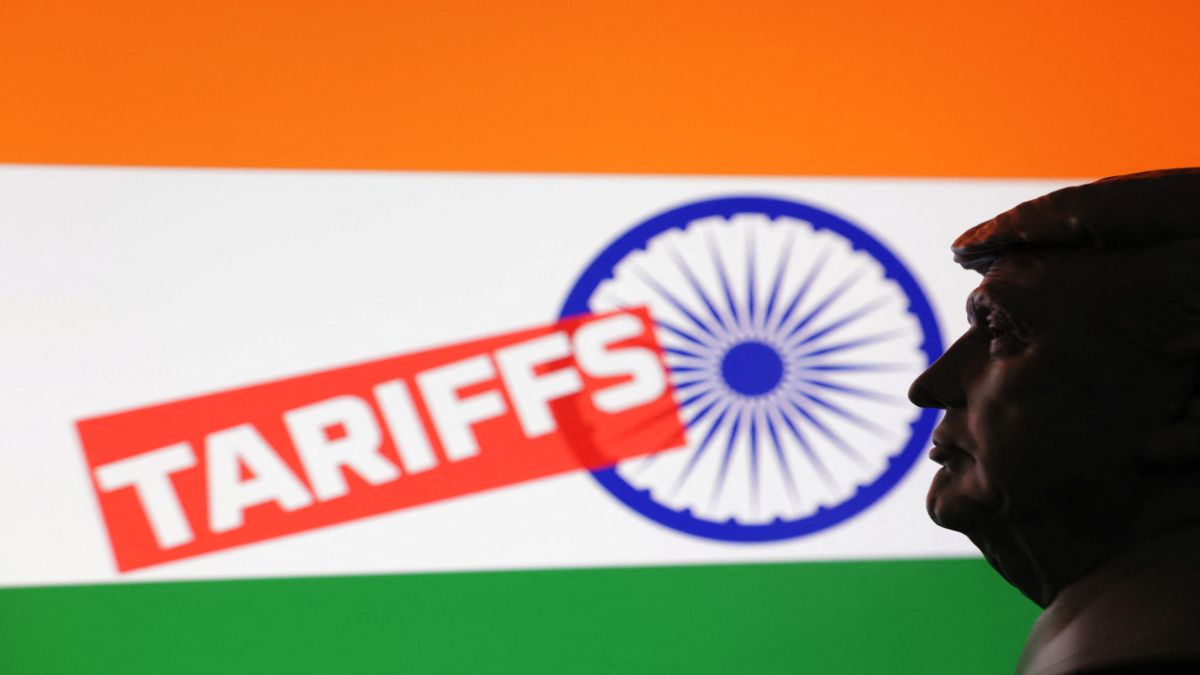
 "Head-on | IMF reveals strength of India’s economy amid Trump’s tariffs")
At a recent press conference in the White House, US President Donald Trump was asked why he was singling out India by imposing a 25 per cent “punishment tariff” when China buys more Russian oil than India. Cornered, Trump mumbled incoherently before moving quickly to the next question.
Is India’s relative economic vulnerability the reason why Trump is targeting India and not China? Trump may be making a serious mistake.
According to the International Monetary Fund (IMF), India is the world’s fifth largest economy and will soon be the fourth largest with a GDP of $4.19 trillion. But that’s only part of the story. By purchasing power parity (PPP), IMF data places India as the world’s third largest economy with a GDP of $14.59 trillion.
How can these two sets of figures be reconciled? PPP is increasingly being regarded as a more accurate measure of both GDP and per capita income. The Economist’s “Big Mac index” regularly adjusts per capita income of different countries to take into account living costs. The same theory guides purchasing power parity-based computations.
The IMF explained the logic behind PPP in ranking countries across geographies: “How fast is the global economy growing? Is China contributing more to global growth than the United States? To answer the questions, one must compare the value of the output from different countries. But each country reports its data in its own currency.
“One of the two main methods of conversion uses market exchange rates—the rate prevailing in the foreign exchange market (using either the rate at the end of the period or an average over the period). The other approach uses the purchasing power parity (PPP) exchange rate—the rate at which the currency of one country would have to be converted into that of another country to buy the same amount of goods and services in each country.”
Quick Reads
View AllWhich method is better? Market rates or PPP? According to the IMF, “International organisations use different approaches. The World Bank uses market-based rates to determine the weights in its regional and global aggregations of real GDP, whereas the IMF and the Organization for Economic Cooperation and Development (OECD) use weights based on PPP rates. Each methodology has its advantages and disadvantages.
“PPP exchange rates are relatively stable over time. By contrast, market rates are more volatile, and using them could produce quite large swings in aggregate measures of growth even when growth rates in individual countries are stable. Another drawback of market-based rates is that they are relevant only for internationally traded goods. Nontraded goods and services tend to be cheaper in low-income than in high-income countries. A haircut in New York is more expensive than in Lima; the price of a taxi ride of the same distance is higher in Paris than in Tunis; and a ticket to a cricket game costs more in London than in Lahore.
“Indeed, because wages tend to be lower in poorer countries, and services are often relatively labour intensive, the price of a haircut in Lima is likely to be cheaper than in New York even when the cost of making tradable goods, such as machinery, is the same in both countries. Any analysis that fails to take into account these differences in the prices of nontraded goods across countries will underestimate the purchasing power of consumers in emerging market and developing countries and, consequently, their overall welfare. For this reason, PPP is generally regarded as a better measure of overall well-being.”
India’s GDP (PPP) was $14.59 trillion in 2024-25 as per IMF. China leads the table with a GDP (PPP) of $35.29 trillion, followed in second place by the United States with a GDP (PPP) of $28.78 trillion. Japan ($6.72 trillion) and Germany ($5.69 trillion) make up the world’s five largest economies by purchasing power parity.
The GDP gap between the US and India at market rates is 7:1 ($29 trillion vs $4.19 trillion). But by PPP, the GDP gap falls to 2:1 ($28.78 trillion vs $14.59 trillion)
At the relative growth rates of the two countries’ economies, how soon will the GDP (PPP) gap between the US and India close? India’s average annual economic growth is projected at between 6 and 8 per cent. A reasonable annual average growth rate over the next 15 years is 7 per cent.
The annual average growth rate of the US economy is meanwhile projected at 2 per cent in line with its average growth rate over the past 15 years.
Thus, India’s GDP (PPP), growing at 7 per cent per year, would double every 10 years and quadruple in 20 years. Using the current IMF GDP base of $14.59 trillion, India’s GDP (PPP) would be around $58 trillion in 2045.
How about the US economy? Again, using the current IMF GDP base of $28.78 trillion, US GDP (PPP), growing at an average of 2 per cent per year, would be around $42 trillion in 2045 against India’s $56 trillion in the same year. Clearly the point where Indian GDP (PPP) overtakes US GDP (PPP) will lie at some point between 2035 and 2045, possibly around 2040. Fifteen years from now is a blink in the eye in historical terms.
What about per capita income? According to the IMF’s World Economic Outlook published in October 2024, India’s per capita income (PPP) is $11,940. This compares to India’s per capita income at market rates of around $3,000. The per capita income of the US (PPP), again according to the IMF, is $89,105.
At current growth rates and with the population of both India and the US projected to rise by around 8-10 per cent over the next 20 years, Indian per capita income (PPP) of $11,940, growing at 7 per cent a year, could quadruple to $48,000 in 2045. US per capita income (PPP) would over the same 20 years, growing at 2 per cent a year, rise to $1,30,000 in 2045.
Thus, the US in 20 years will still be thrice as wealthy as India in 2045 (compared to eight times as wealthy by PPP in 2025) but India’s economy (PPP) will be larger than America’s.
As India negotiates tariffs with the US, both President Donald Trump and Prime Minister Narendra Modi will be aware that the decisive shift in global economic power these numbers demonstrate is well under way.
The writer is an editor, author and publisher. Views expressed in the above piece are personal and solely those of the author. They do not necessarily reflect Firstpost’s views.


 "'PM Modi a fantastic man... we're going to have a good deal': Trump tells Moneycontrol | Watch")
 "Is Canada preparing for a US invasion as Trump unsettles allies? Report says...")
 "Trump says Ukraine war deal ‘reasonably close’, plans Zelenskyy meeting in Switzerland")
 "‘Rules-based order is fading’: When Carney responded to Trump challenge in Davos | Full text")
 "'PM Modi a fantastic man... we're going to have a good deal': Trump tells Moneycontrol | Watch")
 "Is Canada preparing for a US invasion as Trump unsettles allies? Report says...")
 "Trump says Ukraine war deal ‘reasonably close’, plans Zelenskyy meeting in Switzerland")
 "‘Rules-based order is fading’: When Carney responded to Trump challenge in Davos | Full text")