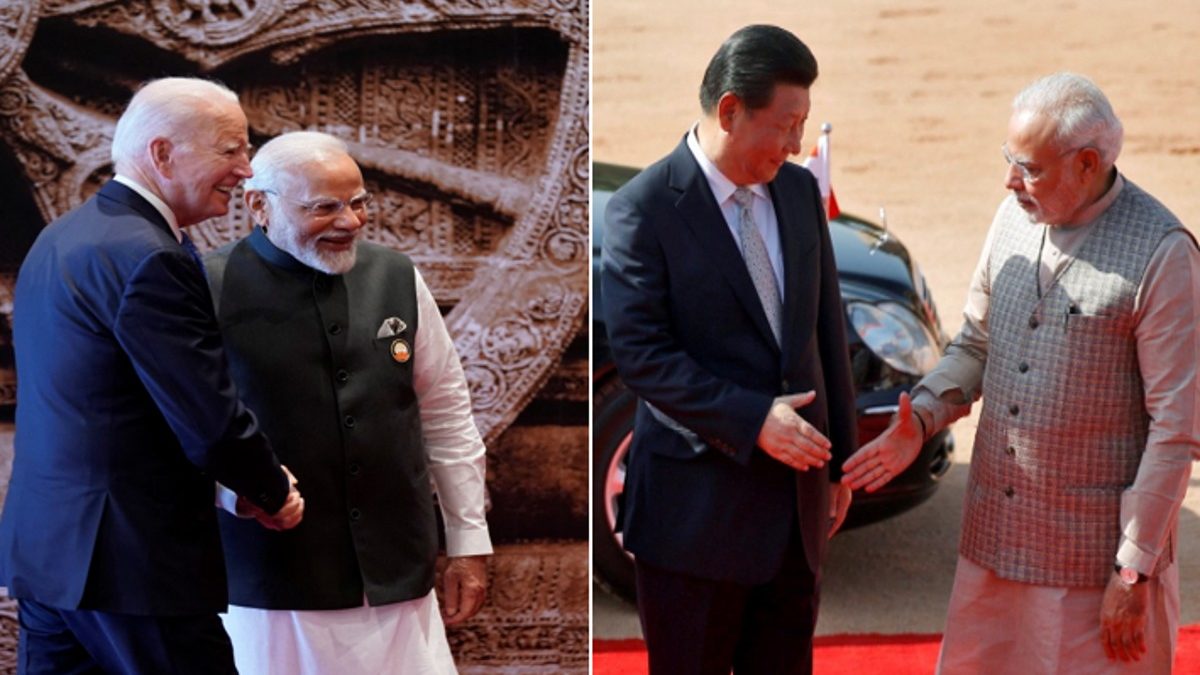
 "Thaw or tactics, India’s strategic priority is to move the slide rule on foreign policy from the US side towards the centre, still distant from the Chinese side but making sure neither superpower takes India for granted")
Troops from China’s People Liberation Army (PLA) occupied Indian territory along the Line of Actual Control (LAC) exactly four years ago. Much has changed in the India-China dynamic since then.
India has drawn closer to the United States as a strategic partner. At the same time, New Delhi has not hesitated to call Washington out over contentious remarks made about India’s democracy and media freedom.
In these four years, India has successfully weathered the Covid-19 pandemic and trade disruptions caused by the Russia-Ukraine and Gaza wars. Its economy remains the world’s fastest growing among major powers.
China meanwhile has had four difficult years since it launched its assault on the LAC in April 2020. It expected a quick victory. Instead the PLA suffered greater casualties, according to independent intelligence analysts.
China’s economy has slowed to an annual growth rate of below five per cent. Global financial institutions expect China’s long-term annual growth trajectory to fall to three per cent.
In Pakistan, China’s Belt and Road Initiative (BRI) suffered a blow last month following a terrorist attack that killed five Chinese engineers, including a woman, working on the China-Pakistan Economic Corridor (CPEC). Three hydroelectric projects in Pakistan have been suspended by Beijing. Several Chinese engineers and workers have left Pakistan following the terror attack.
The United States has meanwhile launched a tech war on China, banning the sale of advanced semiconductor chips to Beijing, setting China’s artificial intelligence (AI) infrastructure back by at least five years.
Impact Shorts
More ShortsJapanese Prime Minister Fumio Kishida’s visit to Washington last week signalled a hardening of positions against China by the US-led West in the Indo-Pacific at a time when China is embroiled in maritime clashes with the Philippines and other maritime states.
The rhetoric from China against India has noticeably quietened. Prime Minister Narendra Modi’s comments on China in an interview last week with the US weekly magazine Newsweek are significant:
“Stable and peaceful relations between India and China are important for not just our two countries but the entire region and world. I hope and believe that through positive and constructive bilateral engagement and at the diplomatic and military levels, we will be able to restore and sustain peace and tranquillity in our borders.”
The comments drew an immediate response from Beijing. China’s foreign ministry spokesperson Mao Ning said: “China noted PM Modi’s remarks. Sound and stable China-India relations…are conductive to peace and development in the region and beyond.”
The mouthpiece of the Chinese government, China Daily, was even more forthcoming: “Modi’s latest remarks could be interpreted as a gesture of goodwill, as the two sides try to find a fair, reasonable and mutually acceptable settlement to their border disputes at an early date and turn the final page on them.”
The Chinese foreign ministry then issued a more detailed statement: “We hope India will work with China, approach bilateral relations from a strategic height and long-term perspective, keep building trust and engage in dialogue and cooperation and seek to handle differences appropriately to put the relationship on a sound and stable track.”
Thaw or testing the waters?
As over 1,00,000 Indian and PLA soldiers continue to face each other across the LAC, China has realised that India is not the pushover it expected when it made its cross-border ingress in April 2020.
But has China re-thought its long-term relationship with India or is the current thaw a tactic to buy time till Beijing gets its economy back in shape and sorts out geopolitical tensions with the littoral states in the South China Sea?
India has strategic reasons for softening its own stance against China. While the eyeball-to-eyeball standoff across the LAC and China’s act of renaming areas in Arunachal Pradesh are provocations, the Indian government is looking at the long term.
Washington-Beijing-New Delhi will form the triad of global power after the 2030s. At a growth rate of eight per cent a year, India’s GDP will double every nine years and quadruple in 18 years.
Indian GDP is estimated at just under $4 trillion in 2023-24. At the cusp of 2040, India’s economy will therefore be $16 trillion — around the same as China’s GDP today.
In the meantime, China’s GDP, hobbled by a debt-ridden real estate sector that accounts for 30 per cent of its economy and an ageing workforce, will likely grow at three per cent a year.
By 2042, that will take China’s current $18 trillion GDP, at a compounded annual growth rate (CAGR) of three per cent over 18 years, to $28 trillion.
The gap between the Chinese and Indian economies ($28 trillion-$16 trillion) will have narrowed to approximately the current gap between the US and Chinese economies.
Chanceries in Washington, Beijing and New Delhi are fully aware of these empirical estimates and their geopolitical implications.
What are those implications?
From G2 to G3
The first implication is that we are moving from a bipolar global world order with two superpowers, the US and China, to a future tripolar world order with India supplying the smaller but pivotal third angle in this developing triangle.
This will be contested by the two incumbent superpowers. China, despite its recent dulcet remarks of cooperation, still regards India as an interloper. America, annoyed with India’s show of geopolitical independence as a leader of the Global South, shows its displeasure periodically through ventriloquists in the State Department and the Pentagon.
India too is no longer reluctant, as in the past, to call out China’s aggression in the South China Sea. External Affairs Minister S Jaishankar, during a recent meeting with Enrique Manalo, the Philippines secretary of foreign affairs, said: “India firmly supports the Philippines upholding its national sovereignty.”
Thaw or tactics, India’s strategic priority is to move the slide rule on foreign policy from the US side towards the centre, still distant from the Chinese side but making sure neither superpower takes India for granted.
All of this is not lost on Washington. It deploys the West’s embedded media to remind India of its place in the global hierarchy.
The Economist can be relied on to swiftly do Washington’s bidding. In a recent forked tongue editorial that marks much of its journalism, The Economist wrote: “Some of India’s power is unquantifiable. As a flawed democracy with an ultra-pragmatic foreign policy (it has forged closer bonds with America at the same time as refusing to condemn Russia’s invasion of Ukraine) it is closer to the median world view among the G77 than is China.
“India’s pitch to lead is also substantively different. Because it worries more about a China-led Asia than an American-led world, it is inherently more pragmatic about its approach to reforming international rules. It wants to be a bridge to the West, not a battering ram.”
The Economist is wrong. India doesn’t seek to be a bridge to the West but within half a generation – 18 years or less – be the balancing pivot in a new G3 world order.
The writer is an editor, author and publisher. Views expressed in the above piece are personal and solely that of the author. They do not necessarily reflect Firstpost’s views.