

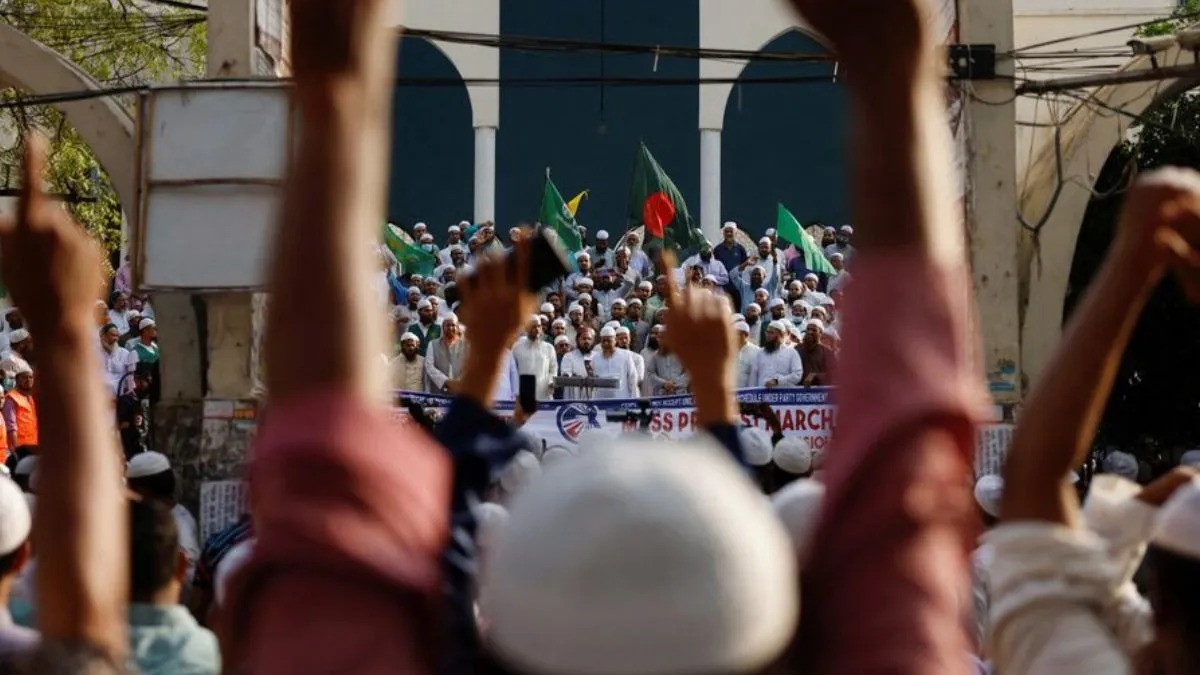
 "Head-on | Bangladesh and the ghost of East Pakistan")
The coup in Bangladesh, engineered by Islamist students, revived the ghost of East Pakistan that Sheikh Mujibur Rahman had slayed in 1971 with the help of the Indian Army.
Under his daughter, deposed Prime Minister Sheikh Hasina, Bangladesh’s economy soared. Its per capita income is nearly double Pakistan’s. Its textile industry is world-class. It jailed or exiled Islamists.
Now those Islamists are back and calling the shots using Nobel laureate Muhammad Yunus as a fig leaf to turn Bangladesh into a bad copy of Pakistan.
Sheikh Hasina is not blameless. She rigged the January 2024 election. She was allegedly corrupt. But for all her faults, she created a secular, relatively prosperous Bangladesh.
The Islamists who deposed Sheikh Hasina had help from elements in Pakistan and the United States. A rigged election is often the pretext for regime change. The US deep state has long experience in forcing regime change – in Iraq, Libya, Afghanistan, Sudan, Somalia and across South America.
Bangladesh was a more difficult target: a functioning democracy with close economic and security links to India, America’s strategic partner.
The US campaign to discredit Sheikh Hasina and trigger the Islamist coup was camouflaged as a student protest against a rigged election in January 2024 which the Islamist-learning Bangladesh National Party (BNP) boycotted.
Impact Shorts
More ShortsWhy would the US prefer a jihadi-led interim government in Bangladesh rather than a secular government led by Sheikh Hasina, however corrupt she allegedly was?
Washington prefers plaint dictators to democratically elected leaders. It was happy doing business with Pakistan’s Generals. They were corrupt and did America’s bidding.
Indian leaders didn’t. For decades, US foreign policy tilted towards Pakistan. Most notoriously, the US turned a blind eye to West Pakistan’s genocide in East Pakistan. Washington sent the US Seventh Fleet to the Bay of Bengal in an attempt to intimidate India’s armed forces backing Sheikh Mujibur Rahman. Millions were killed in West Pakistan’s genocide in East Pakistan, triggering India’s military intervention in December 1971.
Prime Minister Indira Gandhi had anticipated America’s duplicity in the event of war. In August 1971, India signed a treaty with the Soviet Union. Called the Treaty of Peace, Friendship and Cooperation, it forced the US Seventh Fleet to halt its advance into the Bay of Bengal.
Zorawar Daulet Singh writing in The Hindu captured the role of Islamabad and Washington in attempting to stop the emergence of an independent Bangladesh: “By July 1971, the veil had been lifted. Pakistan had served as a middleman in the US-China detente. In December 1971, it was crunch time as the fate of America’s ally Pakistan hung in the balance. The US aircraft carrier Enterprise was despatched to the Indian Ocean as a gambit to raise Pakistan’s morale.
“At a meeting chaired by Mrs. Gandhi to assess the implications of the Seventh Fleet’s presence in the Bay of Bengal, her adviser DP Dhar urged India to leverage the special treaty with Moscow that had been formalised in August 1971. On December 14, Mrs. Gandhi’s confidant PN Haksar cabled Dhar in Moscow saying it was necessary ‘to make a public announcement carrying the seal of the highest authorities in the Soviet Union that involvement or interference by third countries… cannot but aggravate the situation’. Shortly thereafter, the Soviets ‘sent a top-secret message to Nixon’ warning the US ‘against involvement or interference’.”
The genocide in East Pakistan by the West Pakistani army in 1970-71 under the uncritical gaze of the US can hardly be replicated today in Bangladesh by the Islamists who seized power in August this year. Pakistan is in the throes of a quasi-civil war. The US is waiting for President-elect Donald Trump to take office.
This is what Trump posted last month about Bangladesh: “I strongly condemn the barbaric violence against Hindus, Christians, and other minorities who are getting attacked and looted by mobs in Bangladesh which remains in a total state of chaos.”
In her first public address since her ouster on August 5, 2024, Sheikh Hasina spoke virtually to an audience at an event in New York on Sunday, December 1 to mark ‘Vijay Diwas’ and the liberation of Bangladesh. She accused Muhammad Yunus, advisor to the interim Bangladesh government, of triggering genocide following her ouster: “The armed protestors were directed towards my residence. If the security guards had opened fire, many lives would have been lost. In a matter of 25-30 minutes, I was forced to leave.
“Today, I am being accused of genocide. In reality, Yunus has been involved in genocide in a meticulously designed manner. The masterminds – the student coordinators and Yunus — are behind this genocide. Hindus, Buddhists, Christians — no one has been spared. Eleven churches have been razed, temples and Buddhist shrines have been broken. When Hindus protested, an ISKCON leader was arrested.”
Indian media’s Deep State
Though the Islamist coup could set Bangladesh back by years economically and socially, sections of the Indian media have tried to draw a false equivalence between Pakistan, Bangladesh and India.
In an op-ed in The Indian Express, the academic Pratap Bhanu Mehta wrote grimly: “South Asia is a precipice. India, Pakistan and Bangladesh are now vulnerable to the fatal kiss of religious nationalism destroying both democracy and decency in their societies. It is anathema for an Indian audience to think of these three countries on the same plane. But with varying degrees of intensity, they are now displaying symptoms of the same political disease.”
The illogic in Mehta’s argument is matched by his vitriol against the Indian government and his empathy for Pakistan. He says with sympathetic understanding: “Pakistan has reached a point where the ideological basis of its state is bound to fail, or at best just stutter along.”
But no empathy for India: “India uses the fires in Pakistan and Bangladesh to shore up the claims of a Hindu state.”
No caveats. Just false equivalence. The interim government of Bangladesh, packed with Islamists, is given a free pass. It’s all India’s fault in Mehta’s blinkered view. The bias is matched by rage bordering on the visceral.
The visit of India’s foreign secretary Vikram Misri to Bangladesh scheduled for December 10 is unlikely to extinguish Islamist fires. But the student radicals who led the coup against Sheikh Hasina are now confronted with running a country and its fragile economy. That may prove more difficult than engineering a jihadist coup with the help of Pakistan and a complicit Washington.
The writer is an editor, author and publisher. Views expressed in the above piece are personal and solely those of the author. They do not necessarily reflect Firstpost’s views.

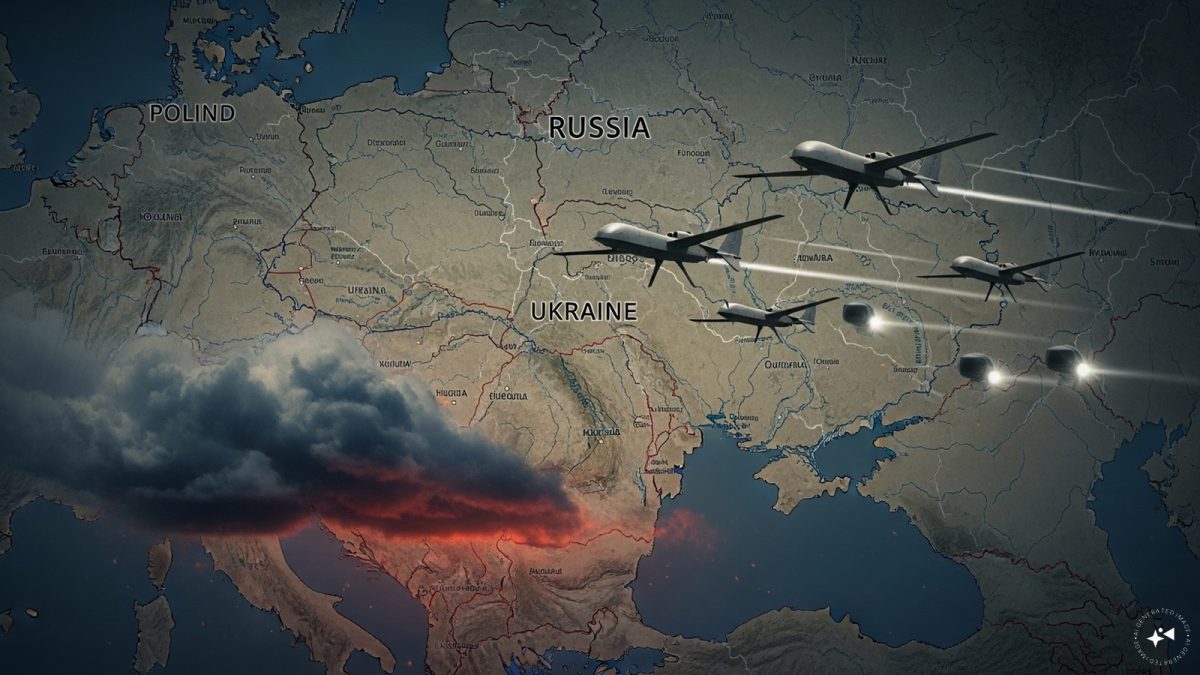 "Russian drones over Poland: Trump’s tepid reaction a wake-up call for Nato?")
 "As Russia pushes east, Ukraine faces mounting pressure to defend its heartland")
 "Why Mossad was not on board with Israel’s strike on Hamas in Qatar")
 "Turkey: Erdogan's police arrest opposition mayor Hasan Mutlu, dozens officials in corruption probe")
 "Russian drones over Poland: Trump’s tepid reaction a wake-up call for Nato?")
 "As Russia pushes east, Ukraine faces mounting pressure to defend its heartland")
 "Why Mossad was not on board with Israel’s strike on Hamas in Qatar")
 "Turkey: Erdogan's police arrest opposition mayor Hasan Mutlu, dozens officials in corruption probe")



