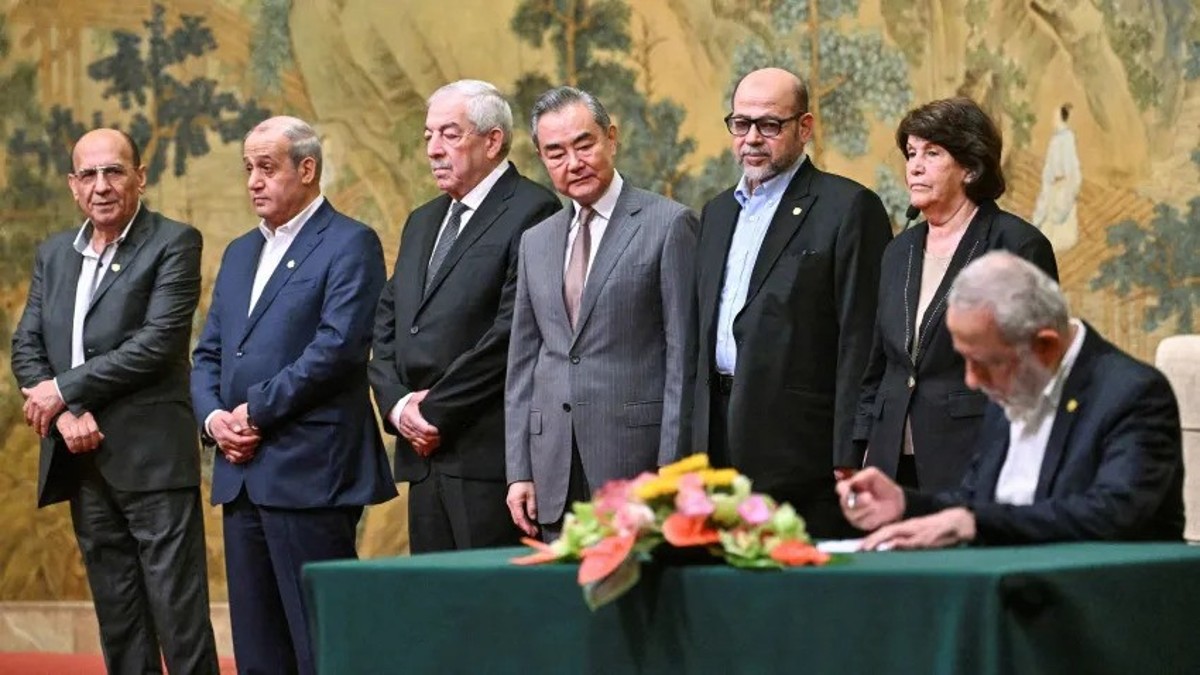
 "As per the West Asia experts, while China may be singing tunes of self-praise in bringing an end to factionalism in Palestine, there is no dearth of such agreements in the past, with none of them actually succeeding. Image: AP")
Nothing speaks about a country’s power more than its growing ambition to shape new realities across the world. One such attempt was made by China this week when it brokered “peace” between different Palestinian factions, including the militant arm Hamas and the much more moderate, in comparison, Fatah.
In addition to these two rivals, representatives from twelve other factions were also present at a three-day conclave in Beijing, where all of them decided to work for unity by burying their differences for the larger cause of national unity. One of the most important outcomes of the peace dialogue was the ‘Beijing Declaration’, where the united Palestinian factions decided to form a “national reconciliation government” once war ends in Gaza.
Needless to say, China is elated with its latest ‘diplomatic achievement’. The state-controlled Chinese media can’t stop gushing about it, which is nothing but literally a self-pat on the back. As per a headline in CGTN, the state-run English language TV channel in the country, the Beijing declaration has been welcomed “overwhelmingly” by the global community.
Scratch beyond the headline and you see just a couple of China-friendly countries and Hamas spokespersons themselves welcoming it. The piece further credits China for the Saudi-Iran détente and the reconciliation wave in the Middle East, but one can only wonder which other reconciliation are they referring to? Because the growing acceptance of Israel in the region, which culminated in the ‘Abraham accords’, was an American effort under Trump and had nothing to do with China in reality. But truth never stops China from gloating in self-importance. Its media has already declared the agreement a milestone in Hamas-Fatah relations, a big move towards Palestinian national unity.
An opinion piece published in the Global Times has even claimed that while the US foments chaos in the region, it is only China that brokers peace. China is using the opportunity to suggest that it can play the role of mediator in other theatres as well. For instance, Chinese Foreign Minister Wang Yi and his Ukrainian counterpart Dmytro Kuleba met in South China’s Guangdong province on Wednesday.
Impact Shorts
More ShortsDuring the talks, Kuleba said that China can play a constructive role in bringing peace between Russia and Ukraine. This, no doubt, is a significant statement, provided that US President Joe Biden has decided to withdraw from the presidential race and the American commitment to Ukraine’s security is showing signs of distress. But China is using such suggestions to paint a picture of itself as the next big thing on the global peace scene.
As per Beijing, the Saudi-Iran rapprochement, the brokering of peace between Palestinian factions, and now this affirmation of its peace-making capability by the Ukrainian foreign minister are all ominous signs of its arrival on the international security scene. In the Chinese scheme of things, the world needs China’s leadership to keep it more stable and secure, and now they are even openly asking for it. But is China really helping the world become more peaceful in reality?
In order to answer this, let’s analyse the détente that was brokered between Saudi Arabia and Iran a year and a half ago by Beijing. No doubt that the agreement reached between the Saudis and Iranians to restore diplomatic ties did play a great role in normalising their relations. The re-opening of embassies and exchange of diplomats did provide the two sides an opportunity to communicate openly about certain common issues as well.
In November last year, Iran’s late President Ebrahim Raisi also paid a visit to Riyadh. However, ties have not defrosted to the extent that Beijing is claiming. The regional issues still dominate in their relations with Saudi Arabia, making sure that Iran’s efforts to mobilise support for Hamas do not succeed.
In another instance that shows things haven’t turned as warm as claimed to be, an entourage of 30,000 Iranians was denied permission to perform a pilgrimage to Mecca by the Saudis, citing a technical disagreement over flight protocols.
The fact remains that the two sides are still very suspicious of each other. Iran is wary of the US-Saudi partnership, and Saudi Arabia is cautious of the Iranian network of proxies. The continued support for Hamas as well as Hezbollah and the Yemeni Houthis by Iran to target Israel only complicates the matter further. It is seen in Saudi Arabia as an attempt to prevent normalisation of its ties with Israel. Riyadh is now back to fearing a ‘Shia crescent’ propagated by Iran to encircle it in the region. All this makes any further progress after the peace agreement questionable, if not completely untenable.
Coming back to the Hamas-Fatah peace, first of all China’s efforts have done nothing but even discredited Fatah leader Mahmoud Abbas’s credentials by bringing him to sign peace with an actor who is being viewed as a terrorist across the world.
Hamas’s October 7 attack on Israeli civilians has exposed its shady antecedents to even those who didn’t care about its existence till a year ago. Israel itself didn’t leave an opportunity to criticise this solidarity with terrorists, as foreign minister Israel Katz condemned Abbas for siding with murderers and rapists.
As per the West Asia experts, while China may be singing tunes of self-praise in bringing an end to factionalism in Palestine, there is no dearth of such agreements in the past, with none of them actually succeeding. What’s also tragic to note is that a section of the commentariat in India is also endorsing Beijing as a hero for negotiating peace between Palestinian factions. But they seem to have forgotten that out of those factions, many, such as the Palestinian Islamic Jihad movement, are designated terrorists.
China has never shied away from using terrorism as a strategic weapon. It continues to back Pakistan-based terrorists who target India. What’s ironic is that despite bringing unity between different militias who arm-twist Israel with violence, Beijing is claiming to be the next big peace-maker in the world. In India we must not only spot this irony but also call out China’s hypocrisy vehemently.
The author is a New Delhi-based commentator on geopolitics and foreign policy. She holds a PhD from the Department of International Relations, South Asian University. You may follow her on X: @TrulyMonica. The views expressed in the above piece are personal and solely those of the author. They do not necessarily reflect Firstpost’s views.