

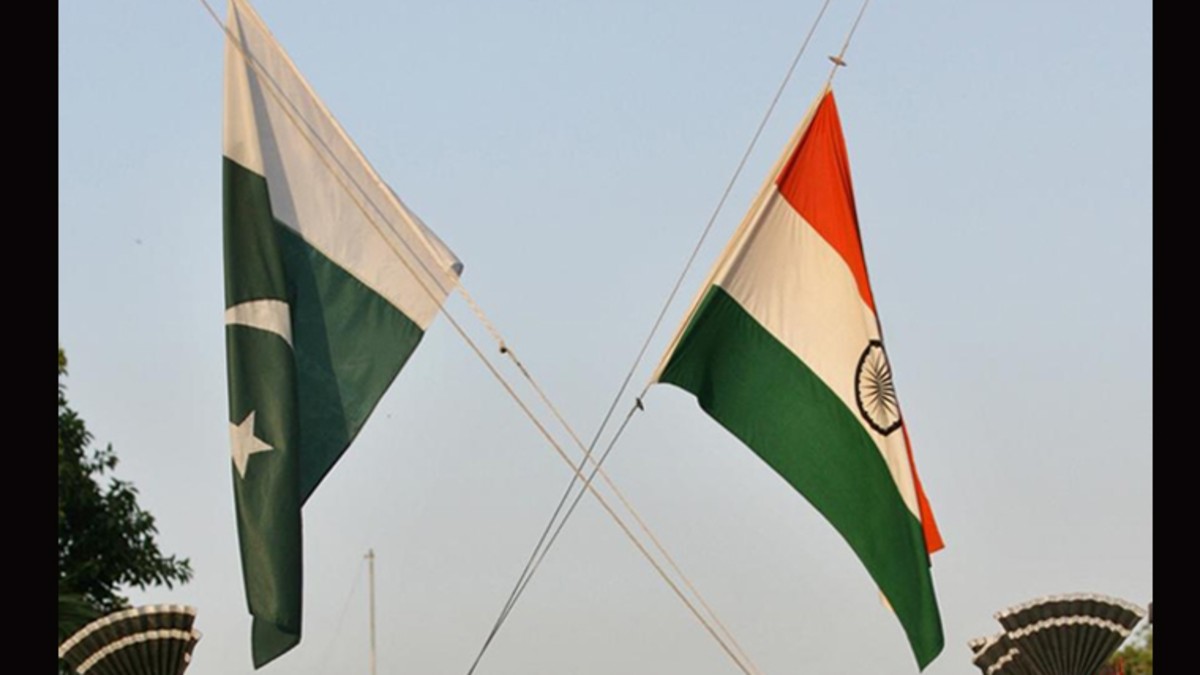
 "Goodwill meets deception: India's Pakistan conundrum")
It has been argued in this publication that “Bharat has become a victim of its own innate dharmic nature … and, of course, democratic laws.”
This is a historical fact.
The Simla Agreement of 1972, repudiated by Pakistan after Delhi denounced the Indus Water Treaty of 1960, provided for the return of Pakistani prisoners of war. Unfortunately, India’s ‘dharmic’ genes accepted to release more than 90,000 Pakistani prisoners of war, against very little compensation. The Indian leadership probably thought that it was unethical (or adharmic) to keep so many Pakistani nationals in custody.
There are many more examples of the ‘dharmic’ nature of the Indian leadership. We shall mention three here; if India had listened to saner elements, the situation would have been different on the borders today. It can, of course, be argued that it was plain stupidity, not ‘dharma’, which guided the Delhi establishment at that time.
Take Lahore
Lt Gen Nathu Singh Rathore was one of the most remarkable officers of the Indian Army post-independence. When offered the post of first Indian Commander-in-Chief of the Indian Army, he refused and told the defence minister that Gen KM Cariappa would do a better job than him.
But Gen Nathu always spoke frankly, sometimes too frankly for the politicians in Delhi. At the end of 1947, he thought of taking Lahore to force the raiders and their Pakistani supporters to leave Kashmir and return to their bases. The general decided to speak to Nehru; his biographer wrote: “When he reached the prime minister’s house, he found him sitting on the lawn, talking to some ministers and civilian officials. Presently, Nehru got up and went inside. The others present there asked Nathu Singh for his views on the best way to deal with the crisis in Kashmir. Nathu Singh replied that if he had his way, he would use the minimum troops to hold the passes and, with maximum force, attack and capture Lahore. This would force Pakistan to withdraw and vacate all occupied territory in Jammu and Kashmir.”
The biographer continues: “The civilians were impressed by the logic of this argument, and when Nehru returned, they told him that the general had a good plan to throw out the invaders. When Nehru asked him to repeat what he had said, Nathu Singh demurred, saying that he would rather not, since he knew it would not find favour. But Nehru insisted, and Nathu repeated what he had told the others.”
Impact Shorts
More ShortsBut Nehru was horrified and became angry: “How can a responsible senior officer think of such a foolhardy scheme? It could cause an international crisis.”
Incidentally, in 1965, a similar plan was approved by Lal Bahadur Shastri, then Prime Minister, and the threat to Lahore probably saved Kashmir.
After the Pahalgam massacre, it is worth remembering this. Had the Indian Army advanced on Lahore in 1947, there would be no Kashmir issue today. But would the British have allowed it? This is another question.
Occupy Chumbi Valley
In October 1950, after the Chinese had captured Chamdo, the capital of Eastern Tibet, and were ready to advance towards Lhasa, Harishwar Dayal, an extremely bright ICS officer posted as Political Officer (PO) in Sikkim (looking after Tibet, Sikkim and Bhutan), wrote to the Ministry of External Affairs in Delhi about the Chinese advances on the Tibetan plateau.
Dayal quoted from a letter from Hugh Richardson, the Indian Head of the Mission in Lhasa dated June 15, 1949, who had then suggested that India might consider occupying Chumbi Valley up to Phari ‘in an extreme emergency’ (meaning if China threatened to invade Tibet).
More than a year later, Dayal brought back the idea: “This suggestion was NOT favoured by the Government of India at the time. It was, however, proposed as a purely defensive measure and with NO aggressive intention. An attack on Sikkim or Bhutan would call for defensive military operations by the Government of India.”
China’s PLA planners today call this ‘active defence’.
Dayal explained his reasoning: “In such a situation, occupation of the Chumbi Valley might be a vital factor in defence. In former times it formed part of the territories of the rulers of Sikkim, from whom it was wrested by the Tibetans by force. It is now a thin wedge between Sikkim and Bhutan, and through it lie important routes to both these territories. Control of this region means control of both the Jelep La and Nathu La routes between Sikkim and Tibet as well as of the easiest routes into Western Bhutan, both from our side and from the Tibetan side.”
Dayal expressed his strategic views further: “It is a trough with high mountains to both east and west and thus offers good defensive possibilities. I would therefore suggest that the possibility of occupying the Chumbi Valley be included in any defensive military plans, though this step would NOT, of course, be taken unless we became involved in military operations in defence of our borders.”
Dayal had probably not realised that China was ‘friend’ (or ‘brother’) of the leadership in Delhi; a few days earlier, the prime minister had already severely reprimanded the PO and Sumul Sinha, who had replaced Richardson in Lhasa, for not understanding that China was India’s friend.
What prompted Dayal to write this letter was probably his meeting with some of the members of the Himmat Singhji Committee, who would have asked him to put his views in writing in order to bring some pressure on the pacifists in South Block, who could only see the ‘wider perspectives’.
One can only wishfully dream of the implications an Indian advance in Chumbi would have had (no Siliguri Corridor, etc).
1971: Why not take Baltistan?
Another case: in August 1971, as the clouds were gathering over the Indo-Pakistan border, a young Ladakhi officer , Chewang Rinchen, joined again his old regiment, the Ladakh Scouts; he was asked to report with Colonel Udai Singh, his commanding officer, to his beloved Nubra Valley. Rinchen had already been awarded a Maha Vir Chakra in 1947 at the age of 17.
Rinchen confidently told his GOC that the Ladakhi Scouts and the Nubra Guards (known as the Nunnus were later integrated into the Scouts) would do the ‘job’ and repel the Pakistani forces.
The army base for the sector was located at Partapur in the Valley, and since 1960 an airfield had been opened at Thoise (still today the base camp for the operations on the Siachen Glacier).
The Nunnu was a good tactician; he always sought the cooperation of the local people, whether they were Buddhist, Muslim or Christian. He knew that most of the time, the troops had to depend upon local vegetables, meat and other supplies to survive.
While most of the commanders favoured a riverbed-side approach, Rinchen decided to cross over the mountains with his Dhal Force and follow the ridge. He argued that the enemy must be waiting with mines and machine gun nests near the river; he chose to capture Pt 18,402, the highest Pakistan-occupied post, and then roll down to Chulunkha, the Pakistani base.
Soon after, on December 8, from the top of Pt 18,402, Rinchen could see the entire valley from Turtok and Chulunkha in the East to the Indian Army headquarters at Partapur and the airfield at Thoise in the west. Rinchen’s tactics had paid off. He told his men, ‘Enjoy the Pakistani blankets and food.’
On December 9, advancing along the ridges, Rinchen and his men descended towards the Chulunkha defence complex, trying not to be seen by the enemy. Soon, Rinchen got a wireless message from Maj Thapa informing him that Thapa’s team had managed to enter the enemy bunkers and a few Pakistani soldiers had been killed and a JCO captured.
On December 14 morning, soon after shelling started to destroy the roadblocks near the Turtok axis, the Dhal Force began its advance again.
At 10 pm, shelling was stopped, and the troops entered the Turtok village. Surprisingly, the village was absolutely silent.
The next phase of the operations was Tyakshi village, 6 km from Turtok. It was concluded on December 14 in the evening. A few Pakistani soldiers were captured with arms and ammunition.
On December 17, Rinchen ordered his troops to get ready to launch an attack against Prahnu and Piun in Baltistan (Khapalu, the first large town in Baltistan, is located 28 miles away); it was never to happen.
In the afternoon, the Pakistani government agreed to a ceasefire. The Dhal Force was ordered to cease fire, greatly disappointing Chewang Rinchen’s men; they knew that in a few days they could liberate the entire Baltistan. Rinchen could not disobey orders from Delhi.
Had this been done, Pakistan would have lost its base for the Siachen Glacier operations, which were to start 13 years later.
Many such stories could be recounted, but history can’t be rewritten; but one should perhaps learn from history.
The writer is Distinguished Fellow, Centre of Excellence for Himalayan Studies, Shiv Nadar Institution of Eminence (Delhi). Views expressed in the above piece are personal and solely those of the writer. They do not necessarily reflect Firstpost’s views.

 "Russian drones over Poland: Trump’s tepid reaction a wake-up call for Nato?")
 "As Russia pushes east, Ukraine faces mounting pressure to defend its heartland")
 "Why Mossad was not on board with Israel’s strike on Hamas in Qatar")
 "Turkey: Erdogan's police arrest opposition mayor Hasan Mutlu, dozens officials in corruption probe")
 "Russian drones over Poland: Trump’s tepid reaction a wake-up call for Nato?")
 "As Russia pushes east, Ukraine faces mounting pressure to defend its heartland")
 "Why Mossad was not on board with Israel’s strike on Hamas in Qatar")
 "Turkey: Erdogan's police arrest opposition mayor Hasan Mutlu, dozens officials in corruption probe")



