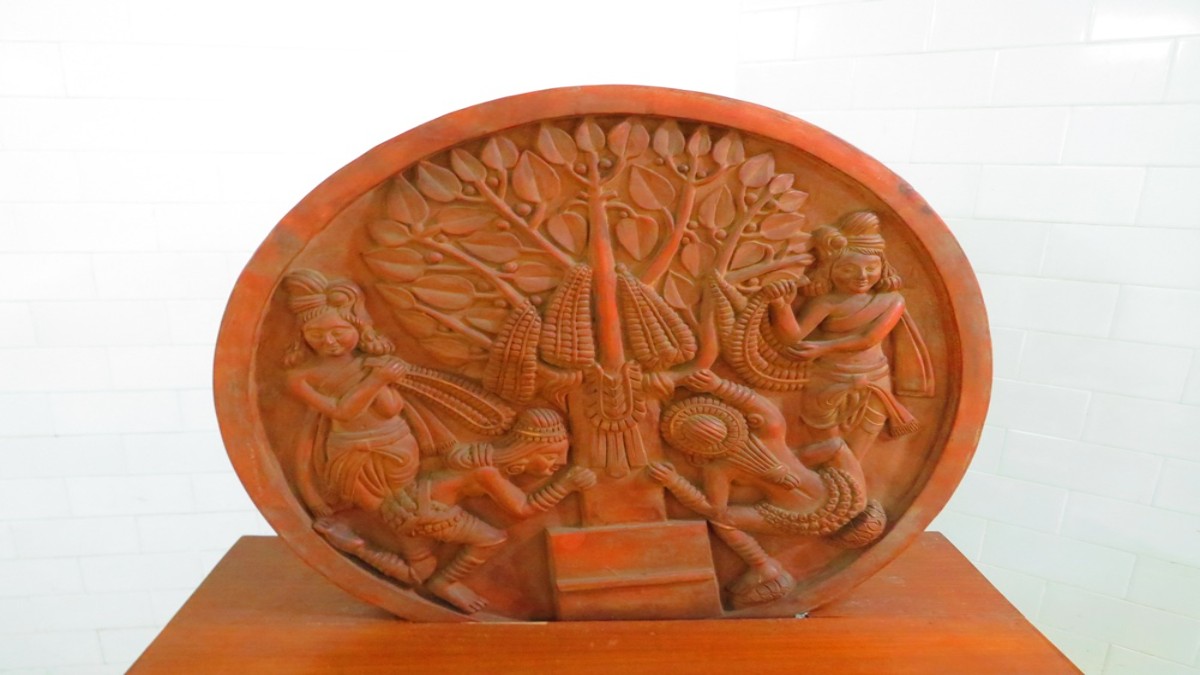
 "A terracotta plate at the Kapilavastu Museum")
Recent days have seen a high degree of excitement around the Rai Pithora Cultural Complex in South Delhi. A Grand International Exposition inaugurated by the Prime Minister himself has been drawing in visitors in significant numbers – a phenomenon quite unusual given that the show is about an aspect of ancient Indian history. Perhaps it is the publicity blitz about the antiquity of the objects as well as the manner of their return that has sparked the buzz.
On display is a set of 349 gems that were buried in a stupa along with bone fragments of the Buddha himself after his death – an event whose timeline is traditionally estimated to be 483 BCE. To understand the exposition theme in the proper context, one needs to travel to the place they came from – the Piprahwa stupa, located close to the Indo-Nepal border in the Siddharthnagar district of Uttar Pradesh.
In a contradiction that is perhaps symptomatic of all such heritage destinations of India, while thousands visit the exposition of the sacred relics, the site of the Piprahwa stupa itself remains quiet. Strangely, none of the ‘Insta-grammers’ giving deep insights about the exposition in Delhi have much to say about this site. It is entirely possible that most of them will be unable to trace the site on a map sans GPS. Sadly, this also means they will never know how tranquil the site is. Perhaps that is a good thing.
The stupa is part of a region that formed the Buddha’s land of birth, the kingdom of the Shakyas. The story goes that after the Buddha had been cremated, a dispute arose about how to honour his remains, which were considered sacred relics. Ultimately, these were divided, and each of the eight kingdoms in the Buddha’s circle of immediate impact received a part, including the Shakyas. Most of these relics were placed in caskets and stupas built over them. Along with the relics went precious stones and gems.
Quick Reads
View AllThe Piprahwa stupa was one such structure. Gradually, with the decline of Buddhism, the stupas became footnotes of history, covered by grass and vegetation. A ‘rediscovery’ of Buddhism began happening under the guidance of British Indophiles through the 19th century. The stupa at Piprahwa was one of the last beneficiaries of this rediscovery process, and that too by default rather than intent.
In 1897, the land on which the stupa stood was owned by William Claxton Peppé, a British engineer and landowner. To give work to tenant farmers rendered unemployed by famine, Peppé led an unofficial excavation of the mound on his land, which was believed to be an ancient stupa. After getting through nearly twenty feet of stone, they hit pay dirt. In the form of a stone case containing five vases. On opening those, they discovered about 1,800 gems and semi-precious stones, along with ash and bone remains considered of immense religious value. In terms of sheer numbers, this was the highest quantity of precious offerings ever found in a single deposit. On one vase was a Brahmi inscription clearly saying that these were relics of the Buddha himself. The importance of the site and the relics skyrocketed. Further excavations and study of the objects found have drawn scholars for decades.
The bone fragments and ashes were gifted by the British to the ruler of Buddhist Siam (Thailand). Of the gems and precious stones found, while the bulk went to what is now the Indian Museum in Kolkata, 349 were retained by Peppé, continuing the imperial tradition of looting the heritage of occupied lands. These included amethysts, coral, garnets, pearls, rock crystals, shells and gold objects. The objects remained with the Peppé family till last year, when they were put up for auction via Sotheby’s in Hong Kong. This crass commercialisation of sacred relics was strongly protested by India and some Buddhist countries. Resultantly, the auction was called off, and in a rare public-private partnership, the house of Godrej made a secret deal to purchase the gems and worked with the Indian government to bring the gems back to India. And this set is what is on display at Delhi’s Rai Pithora Cultural Complex.
The excavated site of Piprahwa is a serene place with the restored stupa as its focal point. The Archaeological Survey of India has painstakingly maintained the site, which includes remains of cells where monks may have prayed for centuries before the site was gradually abandoned. On one side is a lovely lotus pond, of the kind that is described in places where the Buddha himself delivered sermons. Only a short drive away is a somewhat chaotic border crossing with Nepal, but that feels a world away from the peace here.
While Piprahwa was the spiritual hub, the nearby site of Ganwaria formed the residential area. Excavations done in the 1970s here have revealed four stages of continuous occupation, the earliest of which predates the Buddha. Apart from residential structures, the place had monasteries, votive stupas and, according to some scholars, even a palace-complex-like structure. A vast quantity of terracotta objects was unearthed from here, some of which are at a nearby museum.
The museum is named after ‘Kapilavastu’ – the old name of this area, which encompassed the entire region, including both Piprahwa and Ganwaria. It gives an overview of not just the history of the area but also details out the manner and timelines of archaeological exploration here. On display are pictures of the stone container in which the vases were found, replicas of the vases themselves, iron objects going back to the 6th century BCE, copper bangles, numerous terracotta objects and tools made of bones in the 2nd century BCE. It is a comprehensive understanding of a zone’s past. One hopes that some of those who are enthused at seeing the gems at the Exposition in Delhi will take time to come to the actual stupa site and relive its history at this museum.
(The author is a heritage explorer with a penchant for seeking obscure sites. A brand consultant by profession, he tweets @HiddenHeritage. Views expressed in the above piece are personal and solely those of the author. They do not necessarily reflect Firstpost’s views.)