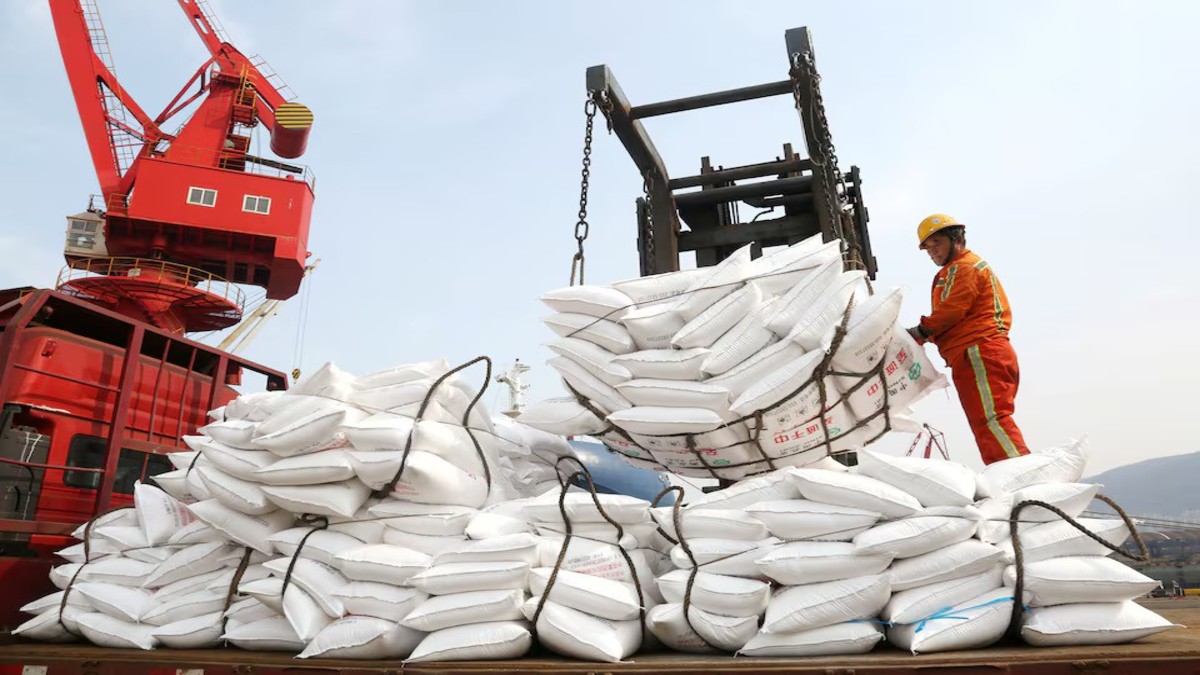
 "When domestic logic becomes global shock, what looks like a domestic stabilisation measure in China behaves like a supply shock everywhere else. Representational image: Reuters")
There is always a headline commodity. Right now, it is oil and the nervous geography of the Strait of Hormuz. Tankers, insurance premiums, naval posturing. It is visible, televisual, and urgent. And then there is fertiliser. It does not trend. It does not command primetime panels. But it determines whether food exists six months from now. And quietly, without spectacle, the fertiliser market is tightening again. The molecule that doesn’t make news but makes food.
Nitrogen fertilisers, especially urea, are foundational to modern agriculture. Estimates widely suggest that 40–50 per cent of global crop yields depend on synthetic fertilisers. Which is why supply disruptions here are never local. They are always delayed, distributed, and deeply political.
The world’s largest producer of urea is China, accounting for roughly a third of global output. And Beijing has form. When domestic prices rise or planting seasons approach, it restricts exports to protect its own agricultural base. This is not conjecture. It happened in 2021, with phosphate export curbs, then again in 2023, with tighter controls on urea shipments. These are not aberrations. They are policy. When domestic logic becomes global shock, what looks like a domestic stabilisation measure in China behaves like a supply shock everywhere else.
It is because fertiliser markets are not easily substitutable and planting windows are fixed. Agriculture does not wait for diplomacy. When a major exporter withholds supply, the result is immediate. Prices rise globally, importers scramble, farmers adjust, most often downward, and the adjustment doesn’t show up today; it shows up at harvest.
Quick Reads
View AllThis is the part most commentary misses. Fertiliser shocks are invisible right up until the moment they are not. A disruption in March affects planting decisions in April–June and eventually harvest volumes in September–October and then, of course, retail prices thereafter.
By the time the consumer notices, the cause is months old and politically untraceable. Which is precisely why fertiliser crises rarely dominate headlines when they begin. And India is very much at the centre of this storm. If China is the supply anchor, India is the demand stress test.
India is the world’s largest importer of urea, relying heavily on global markets to meet domestic demand. Historically, a significant share of imports has been sourced from China, though diversification efforts have increased in recent years.
India’s vulnerability is basically due to structural reasons. We have a large agrarian base, heavy dependence on subsidised fertiliser and a procurement system tied to global price benchmarks. When international prices rise, the government absorbs the shock through subsidies, or farmers absorb it through higher input costs. There simply is no third option.
India’s agricultural cycle sharpens the risk; the calendar is unshakeable. The kharif season, which drives a significant portion of annual output, begins with sowing in May–June. Fertiliser procurement therefore accelerates in the weeks leading up to it. This is not flexible. If fertiliser is too expensive, usage drops, and if unavailable, application is delayed or reduced. Both outcomes have an intense effect on yields. And in a country where agriculture still underpins rural livelihoods and food security, that impact is not marginal; it is systemic.
What the markets are already saying is that global fertiliser prices have shown repeated sensitivity to export restrictions, energy costs since urea production is gas intensive, and geopolitical disruptions affecting supply routes. Recent price movements in benchmark markets reflect tightening supply conditions, even when only part of the disruption is fully priced in.
Markets are forward-looking, but not soothsayers. They price what they can see. They often miss what is about to align. The current global conversation treats disruptions as distinct and separate. Oil risk in the Gulf, export controls in China, and agricultural shifts in the US, but food systems do not operate in silos. Fertiliser links energy to agriculture, while agriculture links to food inflation, and food inflation links to political stability. These are not parallel stories but are a chain.
What may happen next might not be dramatic. There will be no single breaking point. Instead, farmers will adjust input use, crop choices will shift, yields will soften at the margins, and prices will creep upward. And instead of any particular step looking like a crisis, together they will behave as one. The real risk would be a crisis that arrives without a headline. The danger is not that the world is unaware of fertiliser markets. It is that it does not treat them with the urgency reserved for oil. Because oil shocks are immediate. Fertiliser shocks are deferred. And in that gap between cause and consequence, attention moves on.
For India, the challenge is immediate and strategic. Secure diversified supply chains beyond any single exporter, manage subsidy burdens without distorting usage and ensure timely availability ahead of planting windows. Also, in the long term, reduce overdependence on urea. We already use neem-coated urea that reduces diversion and improves efficiency, but we need a serious push towards balanced fertilisation to reduce urea demand and scale alternatives without disrupting yields.
Unlike global markets, India cannot wait for prices to normalise. Its agricultural calendar will not allow it. We can only hope that it is kinder than the market, because when fertiliser tightens, the question is not whether India will cope; it always does. The question is who will pay for that coping when the bill is due.
The bottom line is no country should or need to weaponise fertiliser for it to become a geopolitical lever. All it takes is a series of rational, domestic decisions made at the same time.
China protects its farmers, energy markets tighten and importers compete. And somewhere in between all of this commotion, the cost of growing food rises quietly, steadily, and too late to reverse. By the time it shows up on a grocery bill, it will look like inflation. It will not look like the chain of decisions that caused it. That, perhaps, is why no one is watching it now.
(The author is a freelance journalist and features writer based out of Delhi. Her main areas of focus are politics, social issues, climate change and lifestyle-related topics. Views expressed in the above piece are personal and solely those of the author. They do not necessarily reflect Firstpost’s views.)