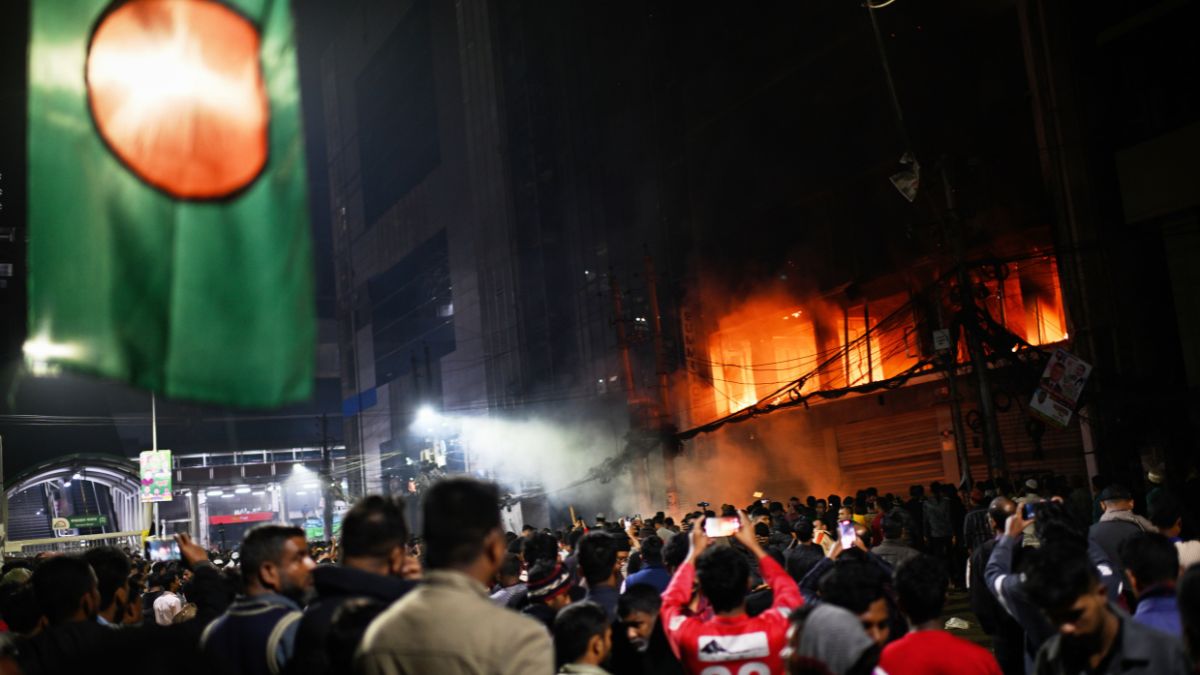
 "A crowd gathers outside the office of the daily 'Prothom Alo', which was set on fire by protesters after news arrived from Singapore of the death of prominent activist Sharif Osman Hadi, in Dhaka, Bangladesh, December 19, 2025. AP")
Bangladesh is on the streets — quite literally. Baying for the blood of its enemies, perceived or real.
Of course, Bharat remains the principal adversary. But since direct confrontation is neither feasible nor sustainable for Bangladesh, surrogate enemies are identified and attacked instead. Hindu minorities are the easiest targets. Yet even they no longer suffice to satiate a mob intoxicated by hatred. And so, newer enemies are discovered.
In the process, the Islamist mob has declared war not merely on sections of society, but on the country itself — destroying state buildings, institutions, archives, and even history and legacy. This is not a simple law-and-order breakdown. It is the culmination of a long ideological confrontation, compounded by religious frenzy, historical amnesia, and inflamed by Pakistani-American geostrategic manipulation.
One cannot examine the fall of Sheikh Hasina and the subsequent installation of Muhammad Yunus without acknowledging the unmistakable fingerprints of Western intervention, particularly that of the United States. Washington’s longstanding discomfort with the Hasina government stemmed from her strategic choices of keeping the Americans at bay while maintaining close ties with Delhi and simultaneously deepening economic engagement with Beijing. For a United States increasingly obsessed with containing China, Hasina’s Bangladesh became a problem waiting to be fixed.
The rhetoric deployed was familiar: calls for “free and fair elections”, the establishment of “credible democratic institutions”, and the “restoration of democratic norms”. Such language has often served as a prelude to regime change across Asia, Africa and Latin America. The irony, however, is that this supposed defence of democracy frequently ends up empowering the most anti-democratic forces on the ground.
Bangladesh is no exception. The American push for democracy in Dhaka has seen US officials openly engaging with Jamaat-e-Islami leaders—an organisation that advocates Islamisation, Shari’ah rule, and the erasure of minority rights, if not minorities themselves. The notion that democracy can be midwifed through alliances with Islamist forces may appear bizarre, but history suggests it is anything but unprecedented.
Quick Reads
View AllYet, responsibility does not lie solely with Western actors. Sheikh Hasina’s own miscalculations contributed significantly to her downfall. Her approach to Islamism was selective — decisive in some instances, hesitant and even dubious in others. While she prosecuted several collaborators and war criminals, many more were left untouched in the hope they could be “managed”.
As Deep Halder, Jaideep Mazumdar and Sahidul Hasan Khokon write in Inshallah Bangladesh, quoting Rezwana Karim Snigdha of Dhaka’s Jahangirnagar University: “One of the things Hasina had promised us was laws for the empowerment of the women of Bangladesh. Instead, she negotiated with the radical Hefazat-e-Islam Bangladesh and pushed the country back into the hands of the very fundamentalists she had vowed to fight.”
“Comprising mainly Sunni clerics heading a network of 19,199 Quami madrassas and their students,” Snigdha adds, “Hefazat, with Hasina’s backing, tore apart bit by bit not just the secular fabric of Bangladesh.” Before 2008, there weren’t many madrasas in Dhaka. “Now every lane has a madrasa — and all credit goes to Hasina.”
This was a fatal misreading. Islamism possesses a long historical memory and a deep sense of grievance. Hasina was wrong to believe it could be managed, if not neutralised, through accommodation. Jamaat-e-Islami was never dismantled — only driven underground, where it steadily infiltrated state institutions, including the bureaucracy and the army. When the opportunity arose, betrayal — whether by individuals or by the system itself — was inevitable.
This does not absolve Bharat of its own errors. Its policymakers have consistently failed to assess Bangladesh dispassionately, often looking at it through ideological-moralistic prisms. In the process, they have ignored that Bangladesh shares fundamental ideological traits with Pakistan; neither can be considered “normal” states. In fact, the roots of political Islam in Bangladesh run deeper than in Pakistan — a reality insufficiently acknowledged within Bharat’s politico-academic establishment.
It is no coincidence that the Muslim League was founded in Dhaka in 1906. Nor that some of the most brutal pre-Partition violence occurred in Bengal. Nor even that the 1946 Great Calcutta Killings were deliberately timed (August 16) to coincide with the anniversary of the Battle of Badr — a foundational Islamic victory symbolising triumph against numerical odds.
These ideological undercurrents did not disappear after 1971. Just two years after leading a bloody struggle for liberation, Sheikh Mujibur Rahman found no hesitation in realigning with Islamabad. In 1974, he went to the extent of according Pakistani Prime Minister Zulfiqar Ali Bhutto a state welcome that eclipsed the reception given to the then President of Bharat, VV Giri, only days earlier.
This was no accident. It reflected an ideological shift. Mujib’s Bengali nationalism steadily gave way to pan-Islamic overtones. His post-liberation rhetoric increasingly emphasised Muslim identity. The man who once said, “I am a human being first, then a Bengali, and then a Muslim,” had reversed the order, signalling a redefinition of the nation’s soul.
The most tragic victims of this transformation have been Bangladesh’s Hindus. Their predicament is uniquely devastating. Unlike Muslims or Christians, Hindus have only one civilisational refuge — Bharat. Yet that refuge has largely remained indifferent to their suffering.
The most damning truth is that persecution has not been confined to Islamist regimes. Even so-called liberal governments presided over dispossession, discrimination, and demographic erosion. For Hindu and Bharatiya interests alike, the Hasina and Yunus regimes differ only in method, not outcome — one providing halal-like death, slow but excruciating; the other promising a faster, dramatic but macabre jhatka-like death. No wonder, under Hasina’s ‘secular’ regime, a study by a Dhaka University professor warned that if current trends continued, no Hindus would remain in Bangladesh within 30 years.
For Delhi, this crisis must serve as a strategic wake-up call. Romantic idealism about good-neighbourly relations with Bangladesh should be buried for good. Goodwill, economic concessions and restraint have not translated into security or minority protection.
The plight of minorities under Yunus’s Bangladesh is unsettling. But this does not demand reckless adventurism. It demands clarity. Delhi must abandon the illusion that Dhaka’s contradictions can be resolved through diplomacy and economic concessions alone. Strengthening borders, fortifying defences, applying calibrated pressure, and preparing for prolonged instability are acts of prudence, not hostility.
Perhaps it is time to go beyond the current limits of the Citizenship Amendment Act (CAA). As Kanchan Gupta suggests to the authors of Inshallah Bangladesh, the country must consider a law — akin to Israel’s Law of Return — that enables any Hindu “to legally return” to Bharat “as its citizens, with some checks and balances”. This would reaffirm Bharat’s civilisational identity, long suppressed under Nehruvian secularism.
More importantly, the country must confront the unfulfilled promise of Partition. While minorities in Bharat have prospered, those in Pakistan and Bangladesh have faced existential decline. The time has come to consider the idea of a separate homeland for Hindus in Bangladesh — for both minority protection and Bharat’s national security. History reminds us that Chittagong’s people wanted to join Bharat. That opportunity was squandered by the country’s political leadership then, leaving the Northeast landlocked and vulnerable.
Today, as Bangladesh descends into chaos, Bharat must be prepared to take a maximalist position—and history offers precedent. In the early 1950s, Syama Prasad Mookerjee, echoing a proposal Sardar Vallabhbhai Patel had made a year and a half earlier, argued that by the logic of Partition, India should demand one-third of East Pakistan’s territory: “We must tell them: if you turn out one-third of the population from Eastern Bengal… give us one-third of your territory.”
That logic remains relevant.
Yunus’s Bangladesh is imploding under unresolved ideological contradictions. Bharat should neither attempt to rescue it nor feign surprise. History warned us. Opportunities for correction were offered. We chose not to listen.
To ignore these warnings now — when Bharat already faces a 2.5-front challenge — would be catastrophic. The country cannot afford to sit idle while the enemy plans to turn it into a 3.5-front war.
(Views expressed in the above piece are personal and solely those of the author. They do not necessarily reflect Firstpost’s views.)
The author is Opinion Editor, Firstpost and News18. He can be reached at: utpal.kumar@nw18.com