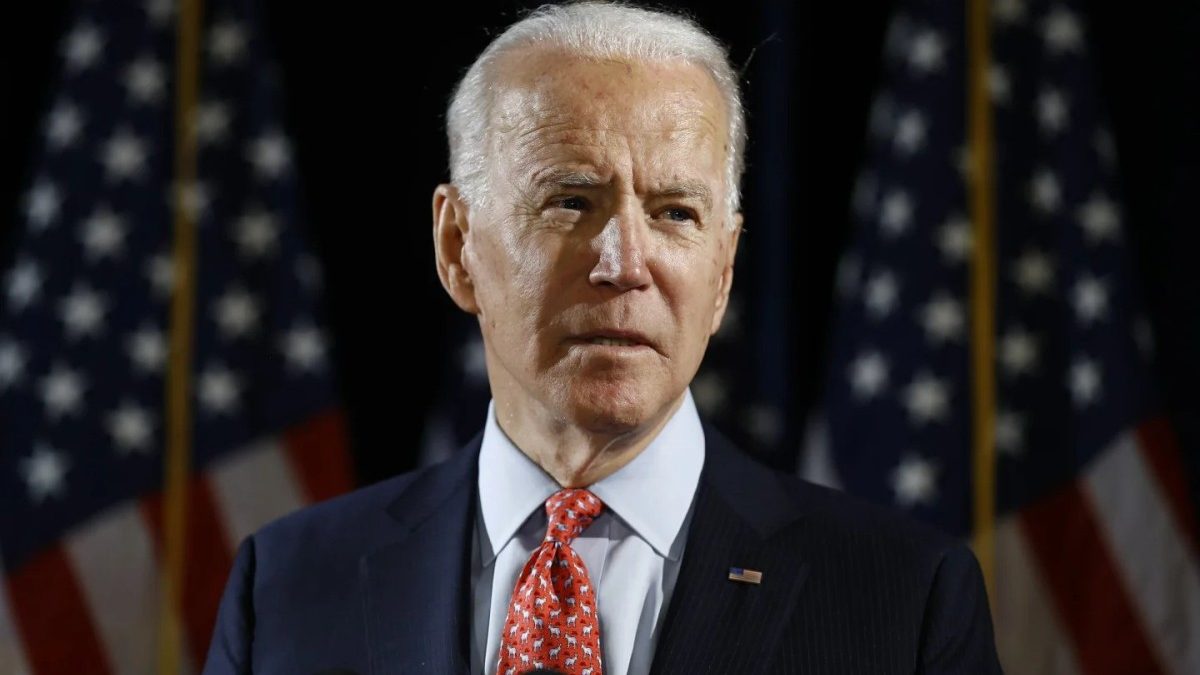
 "Biden’s recent comments made at a fundraiser event in Washington DC, where he accused India of xenophobia, seemed to lump the democratic nation, currently undergoing exhaustive general elections, with autocracies that America identifies as adversarial nations. Image: AP")
There are so many serious questions associated with Joe Biden’s cognitive abilities that it is difficult to gauge when the 81-year-old’s tongue is slipping ahead of his brain or when he is making a considered statement. The thumb rule is to take the president of the United States for his word.
It is therefore concerning to note Biden’s recent comments made at an off-camera fundraiser event in Washington DC where he accused India of xenophobia and seemed to lump the democratic nation, currently undergoing exhaustive general elections, with autocracies that America identifies as adversarial nations. It also didn’t help that subsequent ‘explanations’ from the White House muddled the water even more than clarifying it.
Biden, facing a revolt from his Arab-American base over Gaza, beset with economic pessimism, voter anger over his immigration policies and trailing Donald Trump in six of the seven ‘swing states’ was speaking last Wednesday to a group of Asian-Americans when he claimed , rather outlandishly, that American “economy is growing” because “we welcome immigrants… Why is China stalling so badly economically? Why is Japan having trouble? Why is Russia? Why is India? Because they’re xenophobic. They don’t want immigrants.”
To accuse India of suffering economic headwinds when it is the fastest growing major economy in the world is strange, it is stranger still to charge one of the most welcoming societies in the world through millennia of chauvinistic impulses, and it is even more strange to attempt a causal relationship between the two in the planet’s most populous nation that boasts of a young demography.
Leaving India aside, the comments also left America’s staunchest ally Japan nonplussed. The Japanese prime minister, Fumio Kishida, was recently on a state visit to Washington when Biden called their alliance “unbreakable”. Tokyo certainly didn’t enjoy being clubbed together with China and Russia, and in an official statement said it is “unfortunate that comments not based on an accurate understanding of Japan’s policy were made…”
Impact Shorts
More ShortsBiden was off the mark even with Russia whose militarized economy, according to the IMF, is expected to grow faster than all advanced economies this year.
The motivations behind Biden’s rhetoric aren’t hard to fathom. The US presidential elections are still a few months away, but Biden’s woes are mounting. His government is facing sustained blowback from voters on illegal immigration. Trump has made the issue his trump card, and his narrative of border crisis is resonating with even a section of Biden’s Democratic Party.
According to The Economist, “there were nearly 250,000 attempts to cross the southern border in November alone. Most of the newcomers will have sought asylum and been released into America to wait years for their claims to be adjudicated. Since Biden became president, over 3.1m border-crossers have been admitted. That is more than the population of Chicago. At least a further 1.7m have come in undetected or overstayed their visas.”
A recent Gallup poll , conducted between April 1-22 and results published on April 30, 2024, found that illegal immigration tops the list of voter concern for Americans for the third straight month, which is the “longest stretch for this particular issue in the past 24 years”.
As Trump ramps up the rhetoric on detention camps, troops on the street and the biggest mass deportations of undocumented migrants in history, the Biden team is scrambling for a response. The trouble for Biden is that illegal immigration, apart from being a polarizing issue, also spills over onto other domains such as economy, national security and crime.
A Wall Street Journal survey , conducted in February this year, found that 65 per cent of voters disapprove of Biden’s handling of border security, and 71 per cent said developments in immigration and border security are headed in the wrong direction.
This ought to give us a sense of the panic that has gripped the Biden administration which may have resulted in the gaffe-prone US president overstepping while talking up the benefits of immigration. Similarly, on economy too Biden’s barb at America’s allies and adversaries may have more to do with his domestic compulsions.
The American economy grew in the last quarter at its slowest pace in the last two years at 1.6 per cent compared to the 4.9 per cent and 3.4 per cent growth, respectively, registered in the last two quarters of 2023, and the slowdown is accompanied by higher inflation. “More Americans”, as professor of economics at Stanford University Michael Boskin writes in Project Syndicate, “still believe that they were better off under Biden’s predecessor, Donald Trump, and that Biden’s policies have hurt, not helped.”
That Biden would club India among economic laggards is surprising. India’s economy grew by a six-quarter high of 8.4 per cent in the October-December quarter of fiscal 2024, beating all estimates, and the government now expects the real GDP to grow at 7.6 per cent in 2024, up from the 7.3 per cent projected in January. India’s growth forecasts range between 6.6 per cent to 7 per cent this fiscal despite some uncertainties in an election year.
India is a civilizational nation-state as well as a young and expanding nation. It is an incredible melting pot of myriad religious, linguistic, ethnic, and cultural identities. Bharatvarsh through millennia has offered refuge to people from all corners of the world. As external affairs minister S Jaishankar, speaking to reporters on Biden’s remarks about India, said, “We are the most open society. To date, I have never seen such an open society, such a pluralistic society, such a diverse society…
“We are not just not xenophobic, we are the most open, most pluralistic and in many ways, the most understanding society in the world,” said the foreign minister. This isn’t mere rhetoric.
A survey by American think tank Pew Research Center, the findings of which were published in 2017, revealed that India was not just the top source of international migrants, but the nation “is also one of the world’s top destinations for international migrants. About 5.2 million immigrants live in India, making it the 12th-largest immigrant population in the world (till 2015). The overwhelming majority of India’s immigrants are from neighboring countries such as Bangladesh (3.2 million), Pakistan (1.1 million), Nepal (540,000) and Sri Lanka (160,000).”
It is evident that Biden’s remarks were unrehearsed, unresearched, uncalled for and made under the misconception of confidentiality. His ‘open border’ approach has created such a crisis that the US president now has to conjure up data to justify his policy blunder.
There’s one more aspect to the controversy that is increasingly evident. The president of the United States may not be guilty of it, but elements within the Biden administration and an ideologically slanted international media, influenced by American discourse power, have made it their mission to spread disinformation about India on an industrial scale – more so at a time when 900 million Indian voters are casting their ballots to choose their next government at the Centre, and prime minister Narendra Modi is widely expected to earn an extension of mandate.
India recently accused the US Commission on International Religious Freedom (USCIRF), which in its latest annual report had criticized India for its alleged violations of “religious freedom”, as a political actor trying to interfere with India’s general elections with an insidious agenda.
The external affairs ministry in an unusually sharp retort called the USCIRF “a biased organization with a political agenda” that continues “to publish propaganda on India masquerading as part of an annual report. We really have no expectation that USCIRF will even seek to understand India’s diverse, pluralistic and democratic ethos.”
At a forum in Hyderabad Tuesday, Jaishankar decried the role being played by western media in trying to influence elections in India. “I get a lot of these noises from the Western press and if they criticize our democracy, it’s not because they lack information. It is because they think they are also political players in our election.”
The minister’s words were an understatement, considering the number of influence operations being launched by western media seeking to add to, and even shape the discourse around the polls. I have already pointed out in a previous piece how Washington Post has sought to insert itself into the election campaign through its hit job against India on the Pannun controversy by leaking confidential details on an ongoing case, acting as a cat’s paw for Anglosphere’s intelligence networks.
This may sound like a conspiracy theory until one considers the multiplicity of such reports, timed to perfection. We have Canada’s Globe and Mail publish an outrageous rant , claiming that prime minister Modi’s campaign rhetoric on taking out terrorists in their den (referring to cross-border strikes inside Pakistan) were actually a ‘threat to kill Canadians in their homes!’
Or, consider the fact that one of Britain’s oldest ‘scientific journals’, that publishes peer-reviewed research papers, Nature, has waded into Indian elections with an insidious column that claims “doing science in India is difficult today”, without mentioning the fact that the author, as the daughter of a prominent Opposition politician and a marked critic of Modi and his government, has an obvious conflict of interest in presenting a skewed view of reality, and lacks the relevant qualification or credentials to make such a sweeping assumption.
Not to speak of the fact that the author had until recently been the head of a think tank that fell foul of India’s tax laws and lost its licence to receive foreign funding. If this isn’t conflict of interest, what is?
There’s hardly a need for me to press the point any further, but in the interest of fairness, le me point out that India ranks fourth globally as a research hub after China, the US, and the UK, the country’s research output surged by 54 per cent from 2017 to 2022, placing the nation on ninth spot for ‘research impact’, the country is delegating more funds under the Modi government for R&D than ever (GERD, Gross Expenditure on Research and Development , rose from ₹6,01,968 million in 2010-11 to ₹12,73,810 million in 2020-21), and India’s patent applications has jumped by 31.6 per cent in 2022, according to a study by World Intellectual Property Organisation (WIPO), ahead of some rich countries.
Indeed, as the opinion piece in Nature claims, “the future of Indian science is on the ballot”, but for quite the opposite reason than what the author suggests. These attacks will continue to rise on India as the country, too big, proud, influential and seasoned, to fall prey to the West’s subversive games, and too independent-minded to become the vassal to any power bloc.
The author is Deputy Executive Editor, Firstpost. He tweets: @sreemoytalukdar. The views expressed in the above piece are personal and solely those of the author. They do not necessarily reflect Firstpost’s views.