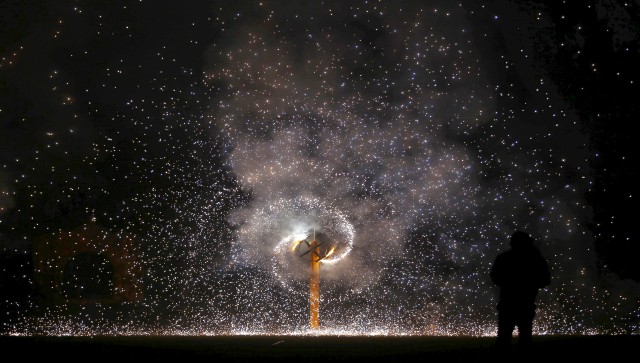
 "Bharat's ancient achievement: How India played a pivotal role in the origins of gunpowder")
When and where gunpowder first appeared is not quite known, and its history is a subject of ongoing research and debate. There is evidence to suggest that substances resembling gunpowder were known and used in India by the 4th century BC, while clearer accounts emerge around the 4th century CE, it being important to note that historical records from that period are often limited or not well-preserved.
Legend has it that gunpowder was developed in China around the Tang and Song dynasties (9th to 11th century CE). Again, there is an absence of facts to this end. Gunpowder appeared in European chronicles a few centuries later and again tradition has it that the knowledge for producing this explosive went from China to Europe through the Silk Route.
Gunpowder is a 15:3:2 mixture of three solids, potassium nitrate (or nitre), charcoal and sulfur. Whosoever developed gunpowder must have had access and a working knowledge of their chemistry. China did not have two of the three material prerequisites for this discovery—sulfur and potassium nitrate—whereas India did. Notably, nitre, the major constituent, was available in the river plains of Bengal. Till recently this substance has even been referred to as Bengal nitre. As for sulfur, it should be noted that it is the only element in the Periodic Table whose name is derived from a Sanskrit word sulvere which means enemy of copper. In summary it is clear that there was adequate scientific knowledge in India to develop chemical agents for warfare.
Western scholars have held that a “gunpowder-like substance” was developed in India in the pre-Christian era while gunpowder as a specific explosive and propellant was developed in China thousand years later. This distinction appears completely specious. What is the difference between a “gunpowder-like substance” and “gunpowder”? We are speaking here of a mixture of three simple solids all of which were freely available in ancient India 2000 years ago. What use could there have been for a “gunpowder-like substance” that was not gunpowder in ancient India if it was not as an explosive and pyrophore?
Our ancient texts paint a vivid picture of India’s chemical prowess. The Dhanurveda contains military knowledge dating back to the Vedic period, providing insights into early warfare tactics. The term mantra, as described in the Dhanurveda, suggested that it signified scientific processes rather than being just a mere incantation. The concept of guarding scientific knowledge with supernatural connotations, has echoes in the Franciscan English monk Roger Bacon, who in the 13th century CE, described gunpowder, its constitution, and its connection with alchemy with overtones more spiritual than scientific.
Quick Reads
View AllKautilya mentions gunpowder in his Arthashastra (2nd century BC). The evidence for early gunpowder use in India is based on historical texts, such as the “Rasaratnakara ’’ by Bhoja in 9th century CE and other ancient Indian manuscripts, which describe the use of explosive mixtures. Testimonies from eminent scholars such as Thomas Holland and R. Gustav Oppert provide further support of India’s priority in this field. Holland’s research affirmed India’s knowledge of sulfur, while Oppert highlighted India’s role in the development of firearms and gunpowder. As far back as the 13th century CE, a Mongol ambassador to India was greeted with 3,000 celebratory fireworks reminiscent of Indian firework celebrations during Deepavali and Kartika Purnima.
China has no definite evidence of using either fire weapons or chemical warfare weapons earlier than the 4th or 5th century CE. No authentic work of an earlier date claims or even hints at weapons for chemical warfare. Coupled with this fact it should be noted that from around the 2nd century BC up to the 10th century A.D, there was considerable travel exchange between China and India. This hints that whatever knowledge of firearms, pyrotechny, and chemical warfare the Chinese had in the post-Christian period might have been obtained from India.
It is also apparent that the Arabs acquired knowledge of gunpowder by the 10th century CE or so. Western scholars seem to presume that they got this knowledge from China and three explanations are given for this, namely that they got it from merchants who travelled along the Silk Roads, by observing (unspecified) military encounters in the Eurasian landmass or through cultural exchanges.
A simpler explanation as to how Arabs got the knowledge of gunpowder is that they acquired it directly from India. During the Islamic Golden Age, which spanned the 8th to the 13th century CE, there was a flourishing of intellectual and scientific activity in the Islamic world. Many Greek, Persian, and Indian texts (not Chinese texts) were translated into Arabic, and these translations often contained knowledge of various subjects, including alchemical and chemical processes. It’s possible that the concept of gunpowder and its components was introduced to the Arab world through these translated texts. According to a paper written in 1798 by M Langlès, it is stated that “Even Arabs mention that they got gunpowder from India.” Alchemists like the famous Abu Sina were commissioned by Mohammed Ghori (10th century CE) to translate Indian scientific texts and it is reported that the former complained that the Hindus were notoriously averse to sharing their knowledge with him!
In any event, the widespread prevalence of the use of gunpowder in West Asia and Europe is confirmed by the exertions of Sultan Mehmet II who captured Constantinople in 1453 CE. It is well documented that this successful capture of what was thought to be an impregnable fortress at the crossroads of Asia and Europe, was made possible in large measure by the use of huge cannons made in Hungary. These weapons had a hoary history during the medieval period and were known for their quality and effectiveness in warfare. The famous example used by Mehmet was the Dardanelles Gun, cast in the 15th century, made of bronze and weighing around 16.8 tons, making it one of the largest cannons of its time. Since then gunpowder was an essential explosive used for the firing of guns and cannons in all manner of small and large arms in European warfare right up till World War I which saw the use of huge German guns, the so-called Paris Gun or Big Bertha.
A final example is provided from the US when a resourceful emigre entrepreneur from France named Éleuthère Irénée du Pont started a small company in Wilmington, Delaware and sold gunpowder to both sides in the American Civil War in the mid-19th century. Notably, Wilmington was located at the border of the Unionist States and the Confederacy and the logistics of his clever operation must have been uncomplicated. The Du Pont Company went on to become a major chemical manufacturing company in the world and has given us products such as nylon, neoprene, mylar and teflon right down till the mid 20th century.
The fascinating narrative of India’s ancient achievements in chemical warfare remains a compelling testament to the subcontinent’s rich heritage. The evidence strongly suggests that India played a pivotal role in the origins of gunpowder and its applications in early military science. In doing so, it adds another layer to the grand tapestry of Bharat’s remarkable contributions to the world’s knowledge and civilization.
The author is in the Indian Institute of Science and has authored a book Bharat: India 2.0. Views expressed here are personal and solely those of the author. They do not necessarily reflect Firstpost’s views.

 "Pentagon no longer views China as top threat, offers 'more limited' support to US allies")
 "'Governor Carney sorely mistaken': Trump threatens 100% tariff on Canada over its potential China trade deal")
 "Bangladesh out of 2026 T20 World Cup, announces ICC; Scotland named replacement team")
 "Monster winter storm cancels nearly 10,000 US flights, leaves millions bracing for ice and outages")
 "Pentagon no longer views China as top threat, offers 'more limited' support to US allies")
 "'Governor Carney sorely mistaken': Trump threatens 100% tariff on Canada over its potential China trade deal")
 "Bangladesh out of 2026 T20 World Cup, announces ICC; Scotland named replacement team")
 "Monster winter storm cancels nearly 10,000 US flights, leaves millions bracing for ice and outages")