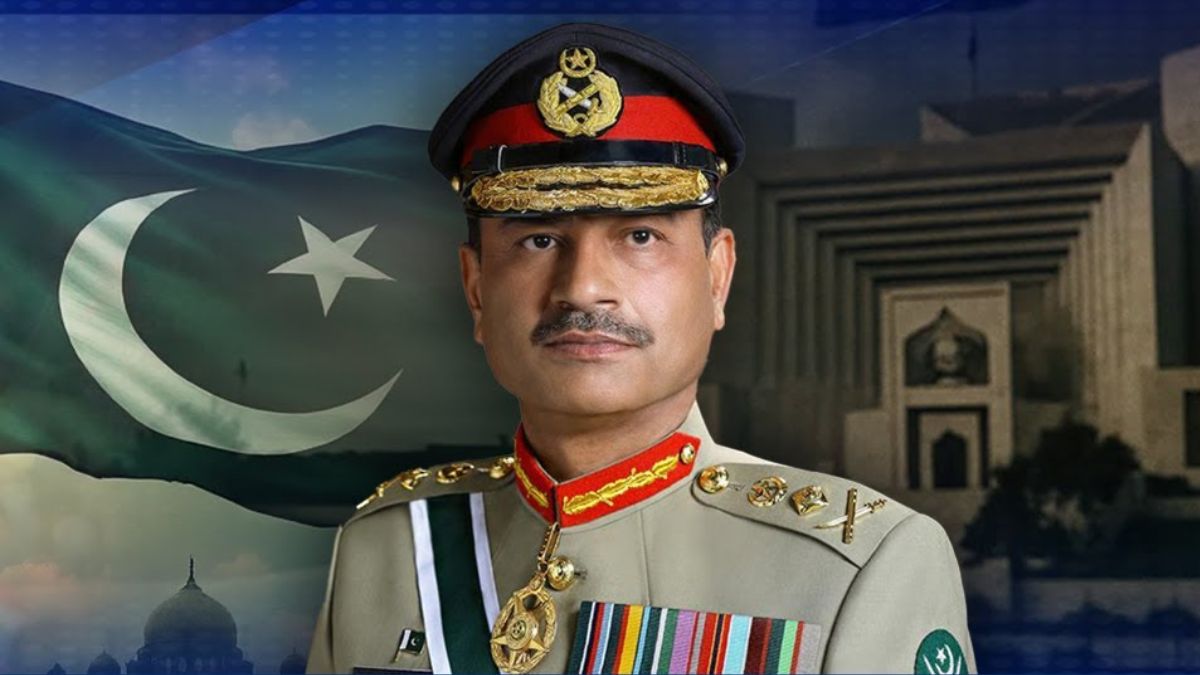
 "Pakistan: After silencing civilian government and judiciary, Gen Munir is now after journalists")
Field Marshal Asim Munir is unrelenting in his animus towards former Prime Minister Imran Khan and his supporters. The latest demonstration of his sentiment is the Anti-Terrorism Court’s decision against seven Pakistanis—journalists, YouTubers who are former army officers, and a well-known analyst—for fanning anti-army sentiment in the May 9, 2023 protests.
Judge Tahir Abbas Sipra sentenced all seven to life imprisonment on January 2 this year for engaging in digital terrorism. All seven are abroad. The trial was conducted in absentia. The judge ordered that they be taken into custody should they return to Pakistan.
The Pakistani judiciary, effectively always under the army’s thumb, has been more so in present times. It is not prepared to give objective decisions in cases relating to anti-army positions taken by anyone. This was also shown in December last year in the anti-corruption court sentencing Khan and his wife, Bushra Bibi, to seventeen years in prison in the second Toshakhana case.
The hand of the army showed not so much in the guilty convictions but in the length of the sentences. It would therefore not be wrong to conclude that Sipra’s decision has been taken in the army’s shadow. Sipra would have been aware that Munir would not accept any decision other than guilty and any sentence other than life imprisonment imposed on the seven accused.
Among the seven there are four eminent journalists. The four are:
— Shaheen Sehbai, a journalist of almost fifty years’ standing. He lives in the US. He achieved distinction as the editor of The News International. Shaheen has been critical of the establishment. He holds that the current lot of Pakistani generals do not have the intellect or the vision of their predecessors. He believes that the establishment is in control and has put puppets in front. He obviously has a high opinion of Imran Khan.
Quick Reads
View AllNaturally, anyone with such views is unacceptable to the generals. Despite his age, an example had to be made of him. That would lead other journalists to feel that if such a sentence could be given to Sehbai, they would need to refrain from causing any discomfort to the army.
— Wajahat Saeed Khan, who has spent many years as an investigative journalist with a special interest in security issues. He has worked for many leading Pakistani TV channels and for foreign news agencies too. After the sentence, he reportedly told the media that no summons was served on him, that he was not notified of any proceedings against him, and that he was never contacted by the court. This only confirms that Sipra did not act independently. Khan currently lives in the US.
— Sabir Shakir has lived in Britain since 2022, when he resigned from ARY News, where he hosted TV programmes. He has spent around thirty-five years in journalism. Media reports claim that he was threatened by former army chief General Qamar Bajwa for his reportage.
— Moeed Peerzada presently lives in the US. He left Pakistan in 2022. He is an analyst. He earned the special ire of the Pakistan defence forces when he reportedly quoted the US media on his video channel that Indian missiles had hit their targets in Pakistan during Operation Sindoor. He writes on geo-strategic issues and is objective. His house in the US mysteriously got burnt on January 4. While he has not voiced suspicions, many Pakistanis are mentioning that the houses of Munir’s critics abroad are being subjected to break-ins or arson.
— Adil Raja, Haider Raza Mehdi and Akbar Hussain also live abroad. They are all former Pakistani army officers who have been active on YouTube and have exposed the wrongdoings of the army. They have all been court-martialled and stripped of their army rank and given fourteen-year sentences of imprisonment. The conviction of life imprisonment by the ATC was after the court martial sentences.
Munir is not willing to spare anyone who shows a positive inclination for Imran Khan. In this context how should moves seemingly being taken at Prime Minister Shehbaz Sharif’s instance to initiate a dialogue with the opposition be interpreted? Why is Munir allowing Sharif to go ahead with this approach, and how far can it be taken?
In the wake of the sentence imposed on Imran Khan and his wife last month, there were comments both by the opposition and Shehbaz Sharif on the need for a dialogue on the issues that divide them. According to media reports, Sharif went so far as to say that harmonious relations between political parties were necessary for Pakistan’s growth and prosperity.
On its part, the opposition has said that dialogue is needed, but its focus should be on the independence of the judiciary and the election commission and the release of opposition party members. The aim of the PTI is naturally on Imran Khan and Bushra Bibi’s convictions and imprisonment. It also wants regular access to him.
There is no doubt that Munir would be closely following these developments. However, he has no need to be concerned because they have not reached a serious stage. In any event, it is inconceivable that Sharif and other parties in the ruling coalition would reach out to the opposition at the risk of annoying Munir.
The ruling political parties would also be aware that Munir would never allow the release of Imran Khan. At the same time, if a real dialogue were to take place between the government and the opposition, the latter would raise the issue of Khan’s release. Hence, on that point, the talks would break.
Some progress has been made in the direction of the government agreeing to the appointment of a Leader of the Opposition in the National Assembly. The Speaker has received papers from the opposition recommending that Mehmood Khan Achakzai, head of the Pakhtun Milli Awami Party, be appointed to the post. He has been chosen by Imran Khan.
This shows that though Khan is in jail, he continues to maintain his hold over the PTI and has influence with other opposition parties. This is because Khan continues to be popular in Khyber Pakhtunkhwa province but, more importantly, in sections of Punjab. This popularity has remained despite all that Munir and the government have thrown at Khan. Unlike other politicians, Khan has not preferred to go into exile. That has contributed to his continuing appeal.
Thus, the real contest in Pakistan continues to be between Munir and Imran Khan. For the time being Munir holds all the cards, but Khan has shown spirit and resilience.
(The writer is a former Indian diplomat who served as India’s Ambassador to Afghanistan and Myanmar, and as secretary, the Ministry of External Affairs. Views expressed in the above piece are personal and solely those of the author. They do not necessarily reflect Firstpost’s views.)

 "Trump announces 25% tariff on Iran’s trading partners. How India may be affected")
 "India, US to resume BTA talks after 5 months as Gor pushes for trade deal with 'real friends'")
 "ICC sources rubbish Bangladesh sports adviser’s sensational claim of BCB being asked to drop Mustafizur")
 "Jerome Powell: The 'Fed chair with a spine' taking on Trump")
 "Trump announces 25% tariff on Iran’s trading partners. How India may be affected")
 "India, US to resume BTA talks after 5 months as Gor pushes for trade deal with 'real friends'")
 "ICC sources rubbish Bangladesh sports adviser’s sensational claim of BCB being asked to drop Mustafizur")
 "Jerome Powell: The 'Fed chair with a spine' taking on Trump")