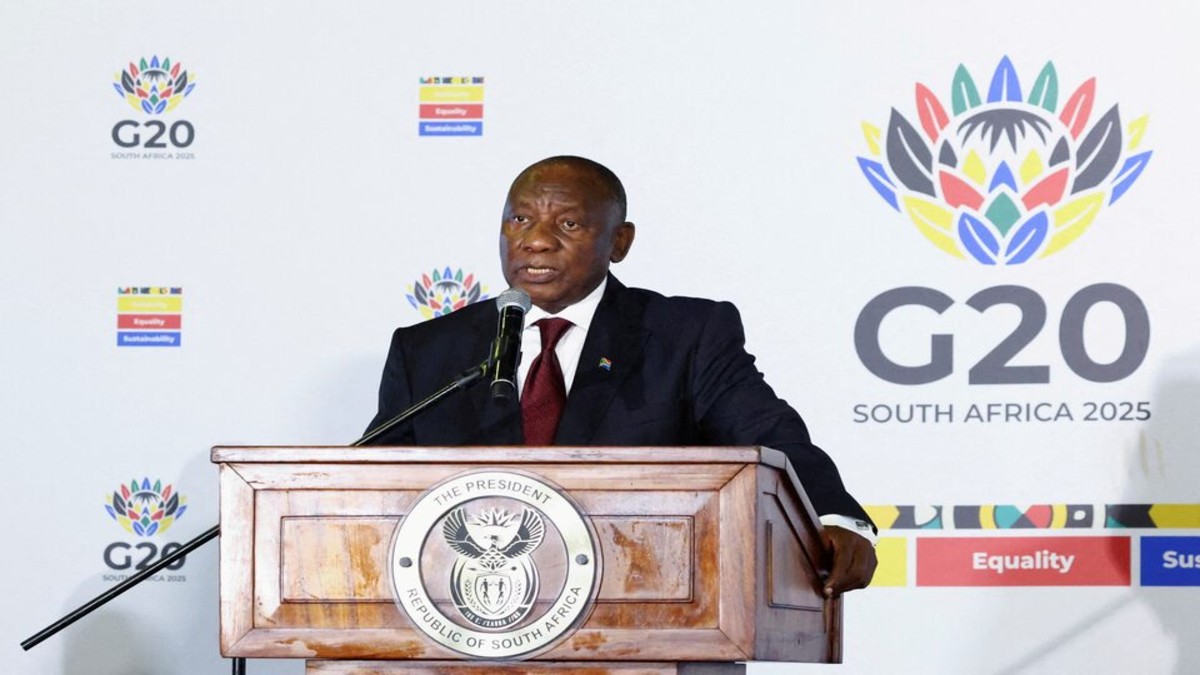
 "South African President Cyril Ramaphosa speaks to members of the media on the sidelines of the meeting of the G20 foreign ministers, which is hosted by South Africa under the theme \"Solidarity, Equality and Sustainability\", at the NASREC conference centre in Johannesburg, South Africa, February 20, 2025. Reuters/Siphiwe Sibeko")
A holistic assessment of developments in Africa in 2025 must begin by noting that the continent receives the least attention from audiences in India. This may be partly due to the absence of regular reporting on Africa by Indian media, which, unlike in the past, lacks a permanent, on-the-ground presence in any African capital. As a result, Indian readers and viewers learn about Africa from foreign media organisations that have their own priorities and perspectives.
Overview
Generally, 2025 has not been kind to Africa, as it marked the end of a half-decade of the Polycrisis, which began with the Covid-19 pandemic in 2020. This was followed by the outbreak of the Russia-Ukraine war in February 2022, the onset of the Hamas-Israel conflict in October 2023, which escalated into several other conflicts in West Asia, and other significant developments in Asia and the Indo-Pacific. Consequently, media and diplomatic attention, as well as financial resources, were diverted to other regions, leaving Africa with insufficient attention.
Two African stories that made international headlines are worth mentioning here. One was born at the White House summit of leaders from West Africa in July, when President Donald Trump asked Joseph Boakai, President of the English-speaking Republic of Liberia, where he learnt his beautiful English. Though delivered in a complimentary manner, this comment was widely interpreted as a condescending snub. Second, the year ended with US-South Africa relations at a new low, as explained at the end of this article.
Peace and Security
The foundation of governance – peace, security, and stability – seemed shaken in several parts of Africa, exposing a sizable portion of its 1.4 billion population to death, danger, and untold hardships. Protracted crises in Sudan, Somalia, the Sahel, and the Democratic Republic of the Congo continued to dominate international attention, largely for their escalating humanitarian and security consequences.
Quick Reads
View AllThe conflict between the Sudanese Armed Forces (SAF) and the paramilitary group named the Rapid Support Forces (RSF) exacted a heavy toll, leading to the fragmentation of Africa’s third-largest country. According to the Africa Centre for Strategic Studies, this resulted in “the world’s largest humanitarian crisis”, with an estimated 400,000 people dying and the number of forcibly displaced people reaching 12.8 million. More than 600,000 people may have been exposed to famine-like conditions. The Democratic Republic of Congo (DRC) continued to be ‘the sick man of Africa’, with all kinds of violence in eastern Congo wrecking its stability. As the year ended, the DRC and Rwanda signed a peace agreement brokered by the US and Qatar, but prospects for its durability seemed uncertain.
Militant Islamic violence was the dominant theme in Somalia, resulting in 6,224 fatalities linked to al-Shabaab, a doubling of the figure recorded in 2022. Somalia also served as the base of the Islamic State located in the northeastern state of Puntland. Islamist violent activities had a devastating effect on states such as Niger, Mali, and Burkina Faso, where military juntas overthrew civilian governments. This, in turn, created a crisis for the regional economic community, Ecowas, which initially adopted a firm stance and then adopted a policy of appeasement toward the three military regimes.
In Nigeria, the world witnessed a rare kind of foreign interference as the US launched multiple Tomahawk missile strikes on Christmas Day on the ISIS insurgents in the northwestern Sokoto state, with the concurrence of the Nigerian government. The reason: the ISIS jihadists were slaughtering Christians, as the US president asserted.
Democracy
The cause of democracy in Africa suffered in 2025 in two ways. First, only three of the ten elections held were rated free and fair. In an established democracy, such as Tanzania, elections were marked by unprecedented violence. Second, more military coups occurred (in Guinea-Bissau and Madagascar), or the previous seizures of power were consolidated systematically (in Gabon and Guinea).
In effect, the military had seized power in nine African countries since 2020. From another angle, 20 of Africa’s 54 national leaders came to power through military coups or other non-democratic means, thereby undermining the foundations of democratic governance.
Economy and Social Domain
The African economy showed considerable promise in the first decade of the century, growing at 5.1 per cent during 2000–2010, but the growth rate declined to 3.3 per cent in the previous decade, 2010–19. Yet as a group of experts at the McKinsey Global Institute assessed, there is no ‘one Africa’, and the continent’s recent slowdown “masks divergences across countries”. Many countries, sectors, and companies have performed much better than others.
Another noteworthy point is that African economies have been shifting rapidly from agriculture and extraction to services. Yet increases in productivity and connectivity will be of immense value as Africa plans for its emergence as a massive market of 2.5 billion people by 2050. A premium is placed on rapid progress in implementing the African Continental Free Trade Agreement (AfCFTA), accompanied by the building of interconnected infrastructure. Intra-regional imports and exports, currently at 10 per cent and 17 per cent, respectively, need to grow rapidly.
In 2025, Africa had at least 345 companies with revenues exceeding $1 billion. Roughly 40 per cent of them were headquartered in South Africa. Other major hosts were Egypt, Nigeria, Algeria, and Angola.
The year saw continued rapid urbanisation in Africa. Nearly half of the African population – 700 million – lives in urban areas. This will double to about 1.4 billion in 2050. Infrastructure cannot keep pace with this rate. Urbanisation has been accompanied by several Gen Z protests in 2025, with protesters seeking greater accountability, job opportunities, and democratic governance. Morocco, Madagascar, and Tanzania were especially affected by such protests.
International Cooperation
Prior to Covid-19, intense competition among multiple external actors was evident, with all seeking to expand political and economic cooperation with various African states. The past half-decade, 2020–25, brought some changes in this international competition. The enthusiasm of the EU and the US appeared to be on the decline, as their attention was focused on the war in Ukraine, and President Trump adopted a restrictive policy toward foreign aid.
On the other hand, China’s drive to expand its economic and geopolitical footprint continued. Russia also achieved new successes, particularly in the military domain in the Sahel region and Libya. Besides, the engagement of the UAE, Saudi Arabia, and Türkiye in eastern Africa, in both the economic and security domains, appeared to be increasing.
While the China-Africa, Japan-Africa, and EU-Africa summits were held in September 2024, April 2025, and November 2025, respectively, the India-Africa Summit did not take place in 2025. The expectation was that it might be held in 2026.
Conclusion
As the year ended, issues related to the G20 highlighted both Africa’s potential and its vulnerability. On the one hand, South Africa successfully hosted the first-ever African G20 summit. It produced a substantive Johannesburg Declaration that reflected the perspectives of Africa and the Global South. On the other hand, bilateral differences between South Africa and the US, including on G20-related matters, exacerbated tensions between the two nations. Consequently, the US decided to bar South Africa from participating in the next G20 summit, to be hosted by the US in 2026.
As the first meeting of G20 Sherpas took place in Washington in mid-December, all member countries and regional entities, including the African Union, were represented, except South Africa. What this signified for African solidarity and the resurgence of the Global South were the issues best left for experts to decipher.
(Rajiv Bhatia is a Distinguished Fellow at Gateway House, with extensive diplomatic experience in regional and global groupings, and the author of three books on Indian foreign policy. Views expressed in the above piece are personal and solely those of the author. They do not necessarily reflect Firstpost’s views.)