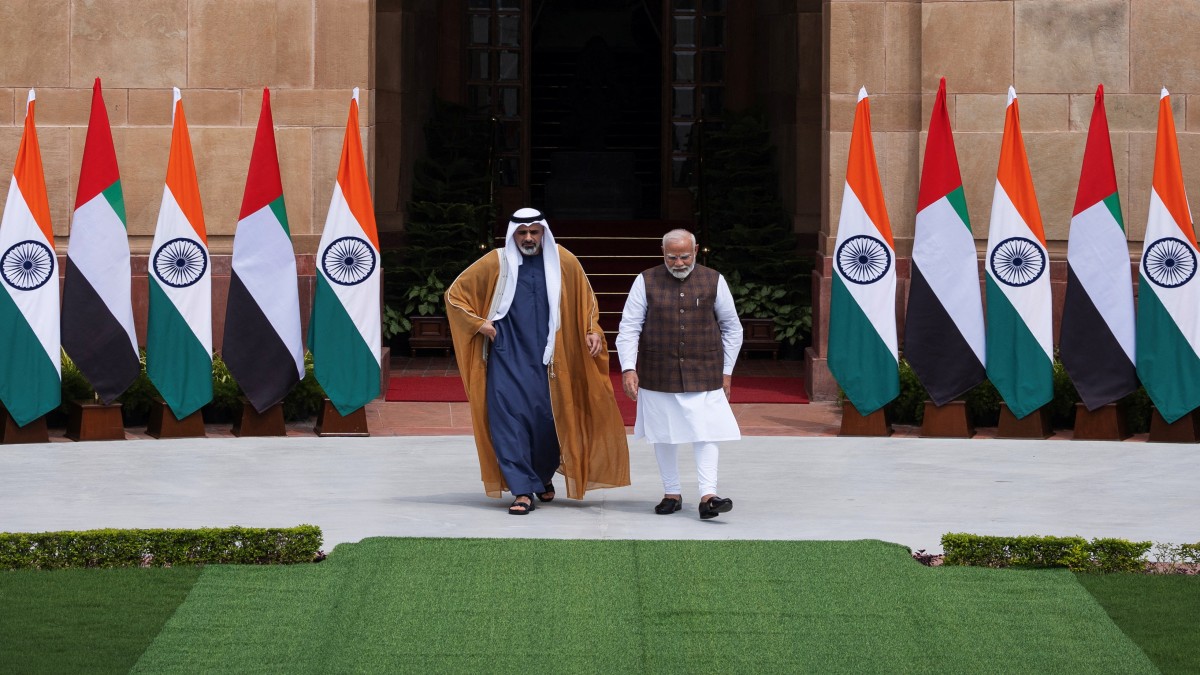
 "Crown Prince of Abu Dhabi Sheikh Khaled bin Mohamed bin Zayed Al Nahyan walks with India's Prime Minister Narendra Modi before their meeting at the Hyderabad House in New Delhi, India. Reuters")
The Crown Prince of Abu Dhabi, His Highness Sheikh Khaled bin Mohamed bin Zayed Al Nahyan, visited India on 9-10 September 2024 for a two-day visit. This visit is crucial against the background of troubled South Asia and conflict-prone West Asia. Increasing volatility in these regions requires joint efforts from the countries that seek peace, cooperation and conflict minimisation. Therefore, India and the UAE are vital in restoring stability in the fluid regions of Asia. The bilateral meeting between the Crown Prince of Abu Dhabi and Prime Minister Narendra Modi is important. Bilateral cooperation is the main focus of this eventful meeting.
The Crown Prince of Abu Dhabi and business leaders from both India and UAE participated in the India-UAE Business Forum in Mumbai to steer the trajectory of the Indo-UAE partnership to new heights. India and UAE signed four agreements in the energy sector and one agreement in the food sector. A Memorandum of Understanding (MoU) was signed on the operations and maintenance of Barakah Nuclear Power Plant (BNPP), Al Dhafra, between Emirates Nuclear Energy Company (ENEC) and Nuclear Power Corporation of India Limited (NPCIL).
Other MoUs comprise a long-term supply of one million metric tons of liquified natural gas (LNG) to India between Abu Dhabi National Oil Company (ADNOC) and Indian Oil Corporation Limited (IOCL), crude storage in India between ADNOC and India Strategic Petroleum Reserve Limited (ISPRL), production concession of Abu Dhabi Onshore Block-1 between Urja Bharat, Bharat Petro Resources Ltd and ADNOC, and food park development in India between the government of Gujarat and Abu Dhabi Developmental Holding Company PJSC (ADQ).
The nature of the four agreements indicates a roadmap for energy security. It spells out an uninterrupted energy supply to thwart any unwarranted situation or emerging imbroglio in the West Asian region. The fifth agreement is a gainful proposition for the UAE. GCC countries were dependent upon Ukraine for food imports. The prolonged Russia-Ukraine war has led to global supply chain disruption. The GCC countries are afflicted with food shortages. Creating the India-UAE/India-Middle East food corridor could be an effective alternative to the rising agro demands, paving the way for sustained food security in the region.
Impact Shorts
More ShortsThe Comprehensive Economic Partnership Agreement (CEPA) and the Bilateral Investment Treaty (BIT) were the itineraries of the discussion as well. The above domains have been designed to strengthen economic and commercial collaborations. CEPA, which came into force in May 2022, intended to set up a ‘clear, transparent, and predictable legal framework’; reinforce ‘economic and trade relations through trade liberalisation in goods and services’; boost ‘investment facilitation and cooperation’; facilitate ‘transfer of technology;’ ease the ‘creation of new employment opportunities and increase ‘living standards and the general welfare of their populations’; establish ‘free trade area’ and enable ‘trade by promoting efficient and transparent customs’; and augment ‘greater regional economic integration’.
The Ministry of Commerce and Industry also observed that CEPA tremendously impacted India’s bilateral trade with the UAE. The statistics published in the Press Information Bureau (May 2023) stated that bilateral trade has augmented from $72.9 billion in 2021-2022 to $84.5 billion in 2022-2023, showing an increase of 16 per cent. UAE has eliminated 97.4 of its tariffs, which has spread over 99 per cent of imports from India. In all practicability, the CEPA has helped expand India’s export basket in automobiles, gems and jewellery, essential oils, perfumes, cosmetics, textiles, electrical and other machinery, chemical items, seafood, agro-horti products, sugar, spices, tea, coffee, fruits and allied labour-intensive industries. Its import basket included petroleum, petroleum products, minerals, precious metals, stones, chemicals, etc. This burgeoning trade relationship has undoubtedly made UAE India’s third-largest trade partner.
India-UAE Bilateral Investment Treaty (February 2024) has deterritorialised economic space. The treaty envisioned wooing investors’ confidence and attracting Overseas Direct Investment (ODI). UAE is the fourth-largest investor in India. The prominent among the investors are DP World (cargo shipping & port operations), Sharaf Group (shipping & finance), Emaar (real estate) and Lulu Group(retail). Conversely, the UAE’s pro-investment culture and political stability have lured India’s Public sectors/corporate houses like the Oil & Natural Gas Commission (ONGC), Larsen & Turbo (L&T), and Oberoi Group for investment in the UAE.
Moreover, India’s digital payment structure (UPI) will enhance the smooth flow of ODI. It is pertinent to mention that India has emerged as a global leader in instant payment systems, followed by Brazil and China. Hence, in the light of proactive political regimes and enabling economic environments, India’s UPI, which is linked to the UAE’s instant payment system, AANI, will ease the culture of investment and aid cross-border transactions.
The historicity of the bilateral relationship between India and the UAE since 2014 has seen several watershed moments. The Memorandum of Understanding (MoU) signed since Narendra Modi became the Prime Minister of India seems endless and exhaustive. This indicates the mutual dependencies of both. It also undergirds trust in bilateralism. The scale of engagement between the two nations is phenomenal. The Rupee-Dirham participation decouples dollar hegemony and ensures the de-dollarisation of their economy. The US’s ire is, therefore, quite manifest.
This meeting also establishes India’s importance in the global scheme of things. The important takeaways of this meeting are robust partnerships in the new, emerging and cutting-edge areas in the age of artificial intelligence (AI) and technology-reliant progress. Beyond this, the Indo-UAE partnership covers connectivity, energy security, climate change, education & skill development, diaspora, cultural synergy, counter-terrorism, space, critical minerals, green hydrogen, etc.
The fragile West Asia in the wake of the Israel-Palestine conflict and Iran-Israel antagonism requires strong partners. Hamas, Houthi, Hezbollah and their affiliates are the antithesis of peace in West Asia. The initiatives under the Abraham Accord to stabilise West Asia seem to have made no substantial progress. Some actors inside and outside West Asia engage forces to orchestrate perpetual conflict. On the other hand, South Asia is simmering under convoluted geopolitical pressure. The geopolitics is quite complex. There are forces, both regional and international, to encourage conflict. The crisis in Bangladesh, Myanmar, Maldives and Pakistan disturbs peace in South Asia. Sino-American interventions in India’s neighbourhood increase the weight of Indian Ocean geopolitics. They create their Frankenstein to unsettle India and its aspirations of emerging as a civilisational nation guiding the world in the mantra of dharmic existence for global peace.
The big game between China and the US in the Indo-Pacific drags India into the fray—Indian adherence to the time-tested diplomatic position of non-alignment increases the ire of the US and China. Chinese hegemony is unacceptable for India. The prolonged ambiguity around the US’ relationship with India does not arrive at a specific ground. The US is neither a friend nor an enemy of India. The diplomatic liminality characterises the India-US relationship.
The growing resentment and deficit of trust in China and its loss of face globally in the wake of Covid 19 pandemic, BRI’s debt-trap diplomacy and its territorial expansionism and brinkmanship generate a vacuum in the supply chain and manufacturing sectors. In the whirlpool of things, India’s role has become important in securing stability in the world. Its civilisational virtues and democratic values are its extraordinary merits.
The manufacturing and supply chain needs to be robust and resilient to ease the burden of global inflation. Therefore, India needs trusted partners, such as the UAE. Thus, this meeting is crucial at an equally important time. Security, inflation, manufacturing, supply chain, AI, technology, information-sharing, counter-terrorism, regional and global stability and, more importantly, strong partnership are some of the notable emerging areas that feature in the discussions between the leaders of the two states.
India’s leadership in the global south is irrefutable. It inspires trust among the countries in the global south. Its growth dynamics, shared success, and cooperation ideas have attracted countries to express and extend partnerships. India invited the UAE to participate as a guest country while hosting the G20 in 2023. India-UAE partnership makes collaborative efforts in solar energy, climate change and counter-terrorism. Increasing carbon dioxide footprints have developed a climate crisis. It has become a global crisis.
Decoupling fossil fuel dependencies is the only way to get respite from climate fury. In this direction, India and the UAE are working in tandem to explore alternative means, namely solar energy, green hydrogen, etc. On counter-terrorism and piracy, they express much coordination to curb this growing menace.
Therefore, the growing partnership between India and UAE envisages a great ray of hope and robust optimism against the background of an increasingly complex and conflict-stressed global geopolitics. The 3.5 million Indian diasporas, constituting 30 per cent of the UAE population, largely determine the strength of this relationship. It develops a bridge of connectivity between the two important countries in Asia.
Dr. Jajati K Pattnaik is an Associate Professor at the Centre for West Asian Studies, School of International Studies, Jawaharlal Nehru University, New Delhi. Dr. Chandan K Panda is an Assistant Professor at Rajiv Gandhi University (A Central University), Itanagar. Views expressed in the above piece are personal and solely those of the author. They do not necessarily reflect Firstpost’s views.