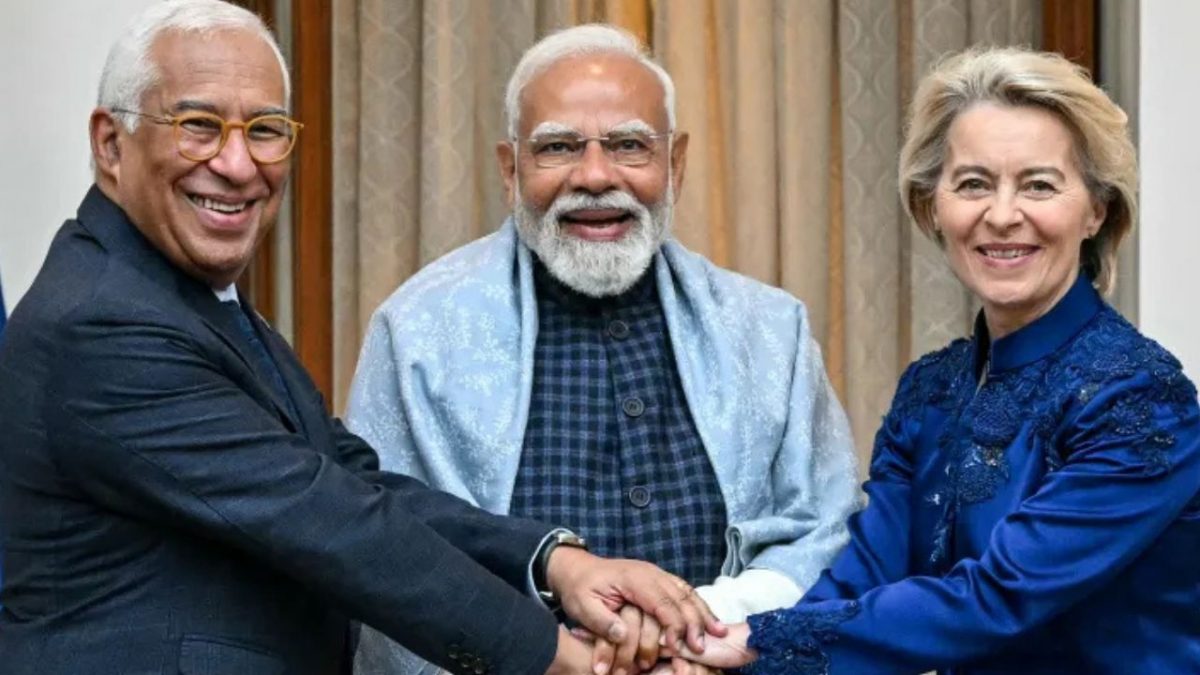
 "A strategic confluence: Why the India-EU trade deal matters")
Indian holy texts describe a sangam as the confluence of two rivers — sometimes visible, sometimes subterranean — whose mingling is believed to multiply their force. The newly concluded India-European Union free-trade agreement has something of that quality. After 18 years of on-again, off-again talks, two very different economic streams have finally found a channel wide enough to flow together and deep enough to be bountiful. What emerges is a grand bargain shaped by geopolitics, stagnation in Europe and momentum in India.
At its core, the deal is disarmingly simple. Europe gets a big slice of India’s fast-growing top-end luxury market. Think BMW and Bordeaux — this is a market that has long been sheltered by punitive tariffs. In return, India’s employment-heavy sectors — textiles, leather, chemicals, jewellery and seafood — secure deeper entry into the world’s largest single market. Luxury for jobs; brands for livelihoods. Trade economists dream of such symmetry. Politicians rarely deliver it.
That symmetry explains the unusually grand language surrounding the pact. It is India’s largest free-trade agreement yet, both in economic size and regulatory scope, granting preferential access to all 27 EU countries under a single framework. Agriculture and dairy, politically radioactive on both sides, have been prudently excluded.
The timing is no accident. Global trade is fragmenting under the pressure of Trump’s tariffs, Chinese overcapacity and weaponised supply chains. The EU, bruised by energy shocks and anaemic growth, is searching for diversification beyond China. India, wary of dependence on any one bloc and facing a hostile neighbourhood, wants scale, weapons, technology and markets. The pact promises all four.
Consider the numbers. Goods and services trade between India and the EU already hovers around $200 billion a year. The agreement is explicitly designed to push that higher. India is set to regain market access and tariff relief for labour-intensive exports, while opening fresh opportunities in services — especially digital, where New Delhi has been pressing for recognition as a data-secure country under Europe’s GDPR regime. Autos, wine and spirits — long the sticking points — will be handled through phased tariff cuts or quota-based compromises. The result is neither capitulation nor stalemate, but managed liberalisation aimed at incremental, assured growth.
Quick Reads
View AllThe sectoral effects will be uneven, but substantial. India’s top exports to the EU already include mineral fuels and oils (about $15 billion), textiles and apparel ($7.6 billion), telecom instruments ($7.5 billion), iron and steel articles ($4.8 billion) and pharmaceuticals. Lower tariffs and clearer rules should accelerate shipments of garments, leather goods, chemicals and jewellery—sectors that employ millions and matter politically. On the import side, Europe will ship more industrial machinery, medical and scientific instruments, aircraft and aircraft parts, and high-end electrical equipment. Pearls, stones and jewellery flow both ways; so, increasingly, will capital.
Europe’s motives go beyond trade balances. The continent’s big economies are stagnating, trapped between ageing populations, fiscal constraints and a loss of industrial dynamism. Germany, once the locomotive of Europe, is flirting with recession. France is muddling through. Italy barely grows. China and America remain far larger economies than India, but size is not the secret sauce here—growth is. India’s GDP is expanding at roughly 7 per cent a year. If sustained, that pace alone could turn India into a powerful growth engine for European firms starved of demand at home. For exporters in Milan, Munich or Marseille, India offers something increasingly rare: volume growth without geopolitical hostility.
India, for its part, brings confidence to the table. Its macroeconomic story is sturdier than in previous negotiating rounds. Public investment in infrastructure has been relentless; domestic demand is resilient. The rupee has weakened, though not collapsed. That will not make Indian exports instantly cheap — supply chains, compliance costs and logistics still matter — but over time a softer currency will help competitiveness, especially in price-sensitive sectors such as textiles and footwear. Europe’s consumers may not notice the shift immediately; Europe’s importers will.
Differences remain, but progress is assured
Non-tariff barriers remain the thorniest issues. Europe’s green measures — carbon border adjustment mechanisms and deforestation regulations — sit uneasily with India’s development priorities. Brussels frets about India’s quality-control orders; Delhi bristles at Europe’s traceability rules for textiles, standards for chemicals under REACH and norms for electric-vehicle batteries. None of these disputes has vanished. The difference now is institutionalised dialogue rather than megaphone diplomacy.
There is also an unspoken political bargain. Europe has long enjoyed lecturing India on human rights while, in Delhi’s view, indulging Pakistan diplomatically and strategically. That posture is becoming harder to sustain as defence cooperation deepens. The trade deal opens a golden opportunity to build a defence-industrial ecosystem that goes well beyond buyer-seller transactions. The Airbus-Tata aircraft manufacturing partnership offers a template: European technology, Indian scale and shared production.
India is in the market for more advanced Rafale fighters from France and air-independent-propulsion submarines from Germany. It is also rapidly building capacity in drones, sensors and electronic warfare. Europe, eager to reduce its own dependence on US defence suppliers, has every incentive to partner India as a co-producer rather than a customer. Doing so would anchor the trade pact in hard power as well as commerce — and require Europe to treat India less as a moral classroom and more as a strategic equal.
The geopolitical dividend may prove larger than the commercial one. The pact helps India partly absorb the shock of US tariffs and hedge against Chinese coercion, while buying precious negotiating time with Trump. For Europe, it offers supply-chain diversification beyond China at a moment when Russia’s invasion of Ukraine has exposed the risks of economic naïveté. India is not China: its bureaucracy is messier, its economy smaller, its politics noisier. But it is open, young and growing — three attributes Europe lacks.
There will be domestic losers. Indian carmakers will complain about German competition; European farmers will worry about future concessions. Regulators on both sides will argue over standards and safeguards. Such friction is the price of integration. The alternative — drifting apart in a world of blocs — is costlier.
In the end, the India-EU trade deal is less about romance than realism. Like the sangam, it brings together two currents that need each other more than they admit. Europe supplies capital, technology and brands; India supplies growth, labour and scale. If managed well, their confluence could deepen into something sturdier than a treaty: a habit of cooperation. In an age of fractured globalisation, that alone makes the bargain worth striking.
(The writer is a senior journalist with expertise in defence. Views expressed are personal and do not necessarily reflect those of Firstpost.)

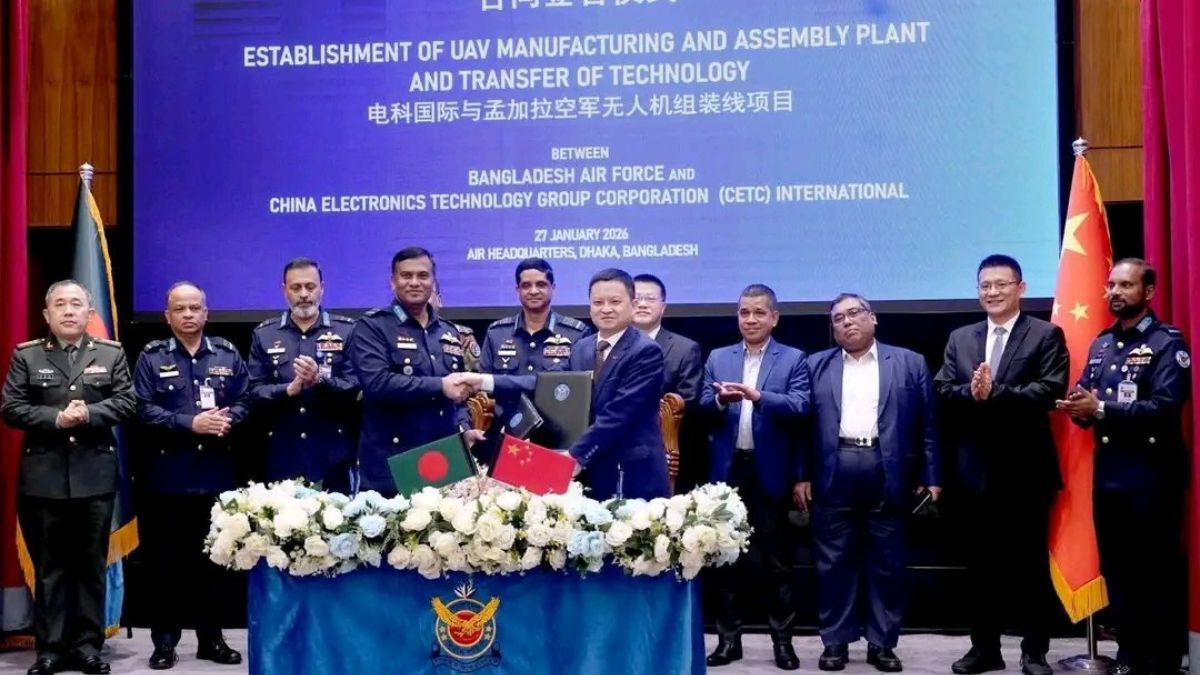 "Why Bangladesh’s China-backed drone factory is raising alarm bells in India")
 "Starmer heads to China, doesn't want UK to 'blow hot and cold' but…")
 "The Learjet 45, the plane that crashed with Ajit Pawar on board in Baramati")
 "Gold hits fresh record above $5,200 as dollar weakens; Deutsche Bank eyes $6,000")
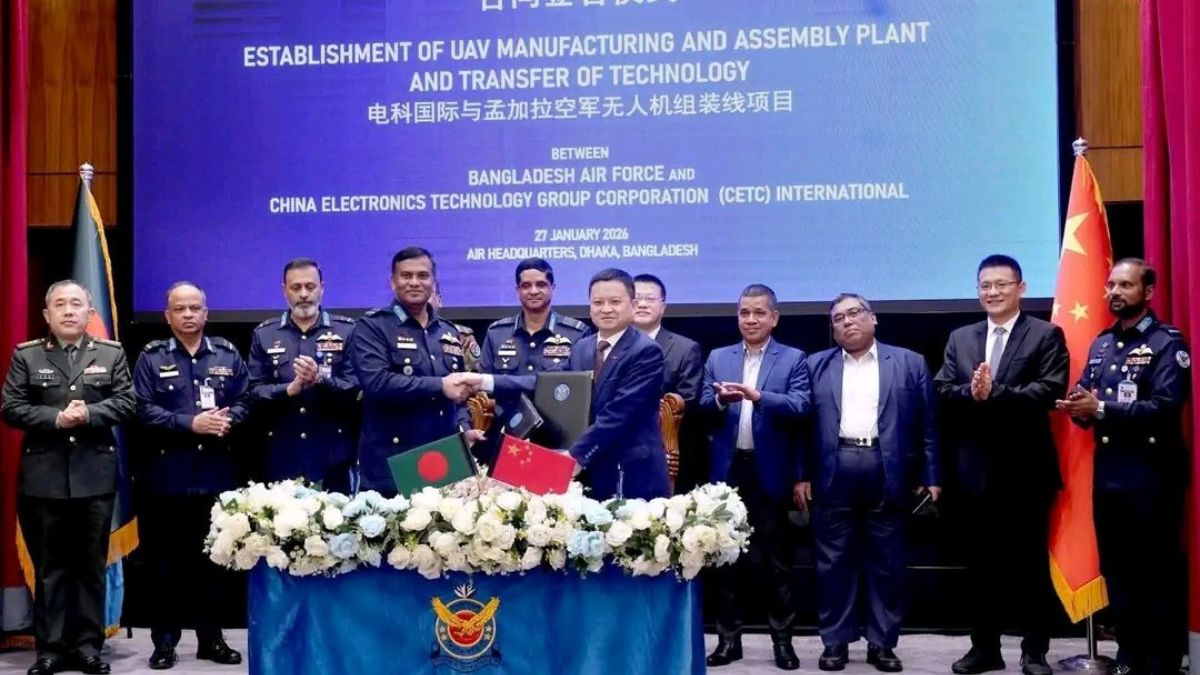 "Why Bangladesh’s China-backed drone factory is raising alarm bells in India")
 "Starmer heads to China, doesn't want UK to 'blow hot and cold' but…")
 "The Learjet 45, the plane that crashed with Ajit Pawar on board in Baramati")
 "Gold hits fresh record above $5,200 as dollar weakens; Deutsche Bank eyes $6,000")