

 "The things he left us: The inheritance of Chinua Achebe")
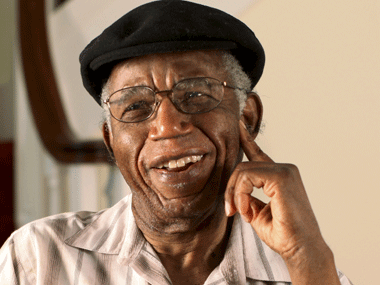
by Vijay Prashad Chinua Achebe (1930-2013) planted the flag of African literature on the planet. It was his Things Fall Apart (1958), coming two years before Nigerian independence, which suggested the liberated African consciousness. In Achebe’s novel, the protagonist Okonkwo heroically flails against colonialism: his village is not with him, he murders a white man, and then commits suicide. But Achebe himself writes without that kind of defeat – his is a solemn reminder of the detritus of colonialism, a part of the new literature of combat to redeem the historical dynamic of his country and his continent. The novel came the year before Franz Fanon gave his celebrated speech at the Congress of Black African Writers. A national culture under colonialism, Fanon said, is “condemned to secrecy.” The colonized culture-makers, the intellectuals, develop a “clandestine culture,” which, because it is reproduced in the shadows, becomes “more and more shriveled up, inert and empty.” It was the task of the post-colonial intellectual to induce a “new humanity” through the creation of “a literature of combat” – it will address its own people and not the colonial masters, and it will fling before it “new and boundless horizons.” [caption id=“attachment_677307” align=“alignleft” width=“380”]  Chinua Achebe. AP.[/caption] Achebe’s writing was both combative and elegiac. His books needed to be in the hands of a population on the march against their pasts. Things Fall Apart had entered those hands, whether through the curricula of the new states or by being passed from hand to hand. The Kenyan cabinet detested Kenyan writer Ngugi wa Thiong’o but he was allowed to teach Achebe’s book. It was the only African book sanctioned by the state because as Kenyan writer Simon Gikandi writes “in spite of their hankering for the colonial days, they wanted students to have a dignified sense of African culture.” It was this requirement for dignity that turned Achebe off of the monotonous celebration of Joseph Conrad’s Heart of Darkness (1899). In a lecture delivered in 1975 in Amherst, Massachusetts, Achebe went into the heart of Conrad’s book and emerged with the judgment, “Conrad was a bloody racist.” The diagnosis is easy to produce because the book, however well written, trucks in stereotypes that dehumanize Africans. Could this be a great work, Achebe asks, and he answers, “No, it cannot.” Occasionally Conrad’s Marlow comes up with liberal sentiments, bemoaning the “black shadows of disease and starvation, lying confusedly in the greenish gloom.” This kind of “bleeding heart liberalism,” Achebe notes, “almost always managed to sidestep the ultimate question of equality between white people and black people.” There was a tendency by the 1970s in the historical record to sidestep the racist heritage of colonialism. “Colonialism and imperialism have not paid their score,” Fanon wrote fifty years ago, “when they removed their flags and police from our territories.” They now refuse to pay up. Ten years later after that lecture in Amherst, Achebe would pass similar summary judgment on V. S. Naipaul, “I do admire Mr. Naipaul, but I am rather sorry for him. He is too distant from a viable moral centre; he withholds his humanity; he seems to place himself under a self-denying ordinance, as it were, suppressing his genuine compassion for humanity. His style is all too perfect, steel-bright, metallic, and so forth.” Naipaul, Achebe pointed out, “is the case of a brilliant writer who sold himself to the West.” Naipaul’s A House for Mr. Biswas (1961) paralleled the post-colonial brilliance of Achebe’s Things Fall Apart. But whereas Achebe would deepen his commitment to “a literature of combat” in the 1970s, Naipaul would slither into the slime of neo-colonial letters with his two “Africa novels,” In a Free State (1971) and A Bend in the River (1979). Now the honesty of Achebe has given way to cynicism and irony. Achebe’s essay on Conrad inaugurated a frontal assault on les lettres racistes. The Kenyan writer Binyavanga Wainaina’s hilarious “How to Write About Africa” (Granta, no. 92, Winter 2005), on the other hand, snuffled into the heart of the contemporary pabulum that passes as writing on Africa:
Never have a picture of a well-adjusted African on the cover of your book, or in it, unless that African has won the Nobel Prize. An AK-47, prominent ribs, naked breasts: use these. If you must include an African, make sure you get one in Masai or Zulu or Dogon dress.
All the old stereotypes are to be invoked, Binyavanga notes, but criticism of the imperialist present must be on mute, “Blame the West for Africa’s situation. But do not be too specific.” There have been history books with precise evidence of mass slaughter (Adam Hochschild’s King Leopold’s Ghost, 1998, argues that the Belgians killed ten million Congolese in a decade). They tell us of the harsh response by the colonial officials against the freedom movement (Caroline Elkins’ Imperial Reckoning, 2005, shows how the British slaughtered up to 300,000 people in the Mau Mau uprising and interned 1.5 million Kikuyu in what she calls the Kenyan Gulag). These books, these revelations, are not capable of changing the general perception of Africa in popular culture as a poor continent in need of charity, largely because its people are not capable of taking their own lives in hand. Racism of the Conrad variety dominates the planet’s approach to Africa on television and in magazine cover stories. The literary critic is not able to see things from the standpoint of African humanity; they like to come at Africa through the eyes of North Atlantic liberalism. It is time now, with the passing of Achebe, to move back from irony to honesty – to point the finger of blame where it belongs. It is time too to see Africa as “quite simply a continent of people – not angels, but not rudimentary souls either – just people, often highly gifted people and often strikingly successful in their enterprise with life and society.” One of those people was Achebe: now gone. But his inheritance, his full anti-colonial inheritance remains. Vijay Prashad is the author of Uncle Swami: South Asians in America Today(Harper Collins, 2013) and The Poorer Nations: A Possible History of the Global South(LeftWord, 2013).

 "Russian drones over Poland: Trump’s tepid reaction a wake-up call for Nato?")
 "As Russia pushes east, Ukraine faces mounting pressure to defend its heartland")
 "Why Mossad was not on board with Israel’s strike on Hamas in Qatar")
 "Turkey: Erdogan's police arrest opposition mayor Hasan Mutlu, dozens officials in corruption probe")
 "Russian drones over Poland: Trump’s tepid reaction a wake-up call for Nato?")
 "As Russia pushes east, Ukraine faces mounting pressure to defend its heartland")
 "Why Mossad was not on board with Israel’s strike on Hamas in Qatar")
 "Turkey: Erdogan's police arrest opposition mayor Hasan Mutlu, dozens officials in corruption probe")



