There are two kinds of Bengalis. One, that leaves Kolkata at the first whiff of Durga Puja. The other, who would not dream of spending Durga Puja anywhere else. Actually there is another kind of Bengali. That’s the Bengali who grows up outside Bengal – the probashis. Like Chirodeep Chaudhuri, who grew up in Chembur, Mumbai. So he has seen the pickled-in-nostalgia variety of Durga Puja. “It’s the probashi Bengalis having a blast in the name of Durga Puja,” he says. “Everything they miss about Calcutta, they would have a little bit of it. So you would have stalls selling chicken cutlet and screenings of Uttam Kumar and Suchitra Sen films.” And of course, Rabindrasangeet playing around. [caption id=“attachment_496732” align=“alignleft” width=“380”]
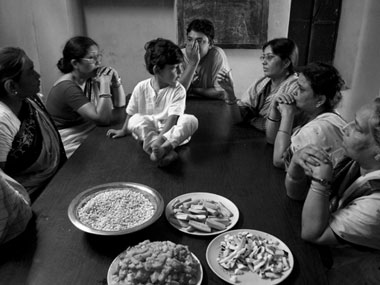
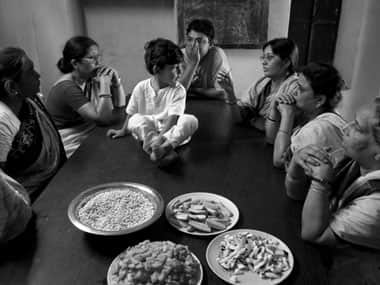 A photograph published in Chirodeep Chaudhuri’s A Village in Bengal – Photographs and an Essay. Image courtesy: Picador India.[/caption] But the first time he went to Kolkata for its five day Durga puja extravaganza he was frustrated. “There were some wonderful pandals,” he remembers. “As a photographer I was very keen to photograph them. But it was difficult to photograph them because of all the advertising hoardings plastered all over the place.” Chaudhuri now has a book of photographs about Durga Puja out. But A Village in Bengal – Photographs and an Essay is about a very different kind of Durga Puja. It’s the one that has been happening at Chaudhuri’s ancestral home in the village of Amadpur for almost 200 years and which he has painstakingly documented over a dozen years. This is almost the anti-Puja. No corporate house is sponsoring the best pandal competition. No goddesses made out of nails, pots and pans or looking like Aishwarya Rai. In fact, if you look at the black and white images what jumps out is the quiet. A group of men sit in front of a placid pond worshipping the banana plant, the kola bou. A man brings a basket of fluttering chickens to sell while an old widow in a white sari looks on. A little boy sits on a table surrounded by the women of the house. They seem to be resting, their arms folded, not in the throes of any festive euphoria. This could be out of Pather Panchali. Change, Chaudhuri says comes slowly in these parts. Perhaps a few dish antennas, some Being Human t-shirts or the local cigarette shop stocking Milds and Lights – these are the subtle signs of change. But the Durga Puja itself is removed from even those markers of change. This is quite a contrast to our usual orgiastic vision of Durga Puja – teeming crowds, blaring loudspeakers, frenzied pandal hopping. But it’s worth remembering that the ritual, whether in Amadpur or Kolkata, is still pretty much the same. Chaudhuri is trying to capture the quiet heart of that Puja as opposed to a nostalgic ode to remembrances of Pujas lost. “It was important to convey that, rather than revisit those popular notions of Durga Puja we keep seeing in the movies,” he says. “Photographically it’s very easy to dramatize something like Durga Puja. There is grandeur about it. I was very aware of that little trap I could fall into.” He writes about the other little rituals of a successful Puja. Something as minor as a burst bolster-pillow takes on great significance in post-lunch conversation. The case of a missing string from somebody’s pyjama might become a subject that is brought up every day to tease the owner whenever he is spotted. Overeating and afternoon siestas become the norm. Usually from the second day of celebrations, Shaptami, the terms Isabgol, Digene, Dependal and Metrogyl pop up in conversation as often as a choonka, macher jhol, macher jhal and macher tok. But Chaudhuri is also very aware of the fact that this Puja he has been photographing for over twelve years now lives on shaky ground. Though 60-65 members of the extended family descend on Amadpur every year, no one lives in the ancestral home anymore. He sees another home Puja in the village at the Singha-bari, the family home of the Mukherjees. “It’s completely opposite of the ambience of our family,” he says. “That’s the puja it feels like the family has forgotten. The tall columns are crumbling. The plaster is peeling. There’s a general air of decay but the puja continues though very few people come.” But he knows that might easily happen to his family puja. He’s not sure if his nephews and nieces will have an attachment to the place. “If they don’t return that’s the end of it. I would be really surprised if it continues after my generation. Who knows? Maybe there will be a trust running this one as well. It’s a bit of a scary thought.” For now, he pushes aside these thoughts. This puja he has a new mission – to learn to wear a dhoti. “I was always afraid it would come off. But I have taken it up as a challenge to move around Amadpur in a dhoti. I don’t have to go around the village taking pictures this time. So I have nothing to fear,” he says with a laugh. Chirodeep Chaudhuri’s A Village in Bengal – Photographs and an Essay is published by Picador India. The photographs appear courtesy of the publisher. The book will be launched at the Calmfest in Shillong on November 1 and the Times Literary Festival in Mumbai on December 7. You can check out an exhibition of the photographs at Gallerie 88 in Kolkata (November 2 -22) and India Habitat Centre in New Delhi (December 18 -23).
The quiet heart of Durga Puja: A photographer’s 12-year-journey
Sandip Roy
• October 20, 2012, 10:28:28 IST
Chirodeep Chaudhuri’s A Village in Begal – Photographs and an Essay is a collection of photographs from the Durga Puja organised in his ancestral village in West Bengal.
Advertisement
 "The quiet heart of Durga Puja: A photographer’s 12-year-journey")
End of Article