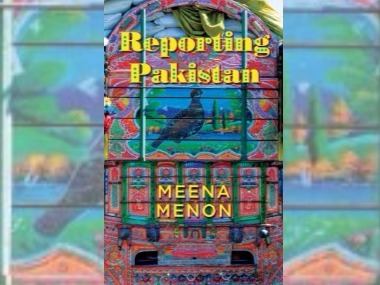
 "Reporting Pakistan: Meena Menon's book busts stereotypes and explores unseen side of India's 'enemy'")
When Meena Menon of The Hindu visited Pakistan for the first time in 2011, she was in for some surprises: a press club which holds yearly elections, in a country where democracy has had a stop-start track record, a Keralite Muslim who runs a labour research institute, and a vibrant English-language media. Two years after her maiden visit, Menon was chosen to be the Pakistan correspondent of The Hindu. It was her nine-month stay between August 2013 and May 2014 (when she was expelled by Pakistani authorities for unknown reasons), that forms the crux of her book, Reporting Pakistan. [caption id=“attachment_4022705” align=“alignleft” width=“380”]
 Meena Menon’s Reporting Pakistan[/caption] Pakistan evokes mostly negative feelings among Indians. The bloody Partition, four wars, cross-border terrorism and the Kashmir dispute are the reasons behind the long-standing acrimony. For an average Indian, Pakistan is the antithesis of India. Over time, it has also emerged as the one-stop destination for Indian ’nationalists’ to pack off ‘anti-nationals’. But beyond our stereotypes about Pakistan, how well do we know the country? The answer would in most cases not be very encouraging. During a recent book discussion moderated by Sameer Patil of Mumbai-based think tank Gateway House, Menon told Firstpost, “I felt like writing the book as not many have read this side of Pakistan. When it comes to Pakistan, many are ’experts’ even without understanding the country. I wanted to write about my experience in the country.” Indeed her book is a treasure trove of stories which would not find place in the usual narrative surrounding the country. While reading the book, one gets the glimpse of a country which is nowhere close to the one that grabs the headlines in India. The stories that find a mention in Menon’s book highlight a Pakistan which is quite similar to India: economically-weaker sections of the society struggling for fuel supplies, frequent power cuts in middle-class localities and a country riddled with rising socio-economic inequality. Owing to visa restrictions, however, Menon was confined to Islamabad, the federal capital. “American journalists did not have such restrictions. While my other journalist friends from India visited Lahore and Karachi during an exchange programme, they laughed at me for not being able to do so,” Menon said during the discussion. In her own words, Islamabad, looked like an “unreal city”, with its wide roads and lush gardens, flanked by the Margalla Hills. And unlike Hyderabad (Sindh) and Karachi, which are considered cultural centres, Menon quotes her Pakistani friends as calling the planned capital city “cold and soulless”. An interesting trivia one would come across is how the planned city was named. Apparently, it was Piloo Mody, the legendary Indian politician, who suggested the name to Field Marshal Ayub Khan during a social gathering. The book also narrates the amusing instances of two supposed ISI men trailing her wherever she went. But apart from the two men from the state apparatus who might have followed her suspecting her to be an “Indian agent”, Menon said most of her experience was good. “Most of the experience was positive, especially the way we were treated there. On the face of it, everybody seemed charming and polite till the push comes (refering to the deep State). Most of the people were helpful. When my phone fell into the water, they repaired it free of cost. Everyone made me feel at home. They never really made me feel that I am an Indian in Pakistan,” the author said. Menon, however, did notice the dicotomy between the people and the State in her book. While on one hand, the book gives numerous instances of Pakistan’s little-known gentler side, on the other hand, the Pakistani state discriminates against Ahmadiyyas, terming them non-Muslims. While Menon noted there is sizeable positive sentiment towards India despite the ongoing Kashmir standoff, the propaganda machinery of the deep State does not further the cause of peace. Reporting Pakistan has numerous stories which are worth reading. Some are shocking — like the plight of Afghan refugees and Christians, who live in shanties on the ouskirts of Islamabad, after fleeing fundamentalists. Some may come as a pleasant surprise to many Indians: Murree Brewery, which is one of the oldest breweries in South Asia, is run by a Parsi, who claims his beer is better than Kingfisher’s. Reading through the pages, one can find out about stranded Malayalis in Pakistan, the surprisingly well-functioning Parliament, a Pakistani’s contribution to poverty alleviation in India, among many other stories, which are not really heard of, from this part of South Asia. Reporting Pakistan is one of those rare books which introduces us to the unseen side of Pakistan. The stories have a personal touch to them, devoid of strategic and statistical mumbo jumbo, which is usually the case with books on the subject of Pakistan. While Menon told Firstpost that the book was written in a subjective manner and not really to dispel misconceptions, the former The Hindu scribe does agree that her book may play a role in re-imaging Pakistan. “One of the reasons for these stereotypes is because we have had very little interaction. But there is a long history for why the stereotypes still exist. People anyway have diverse experiences about Pakistan. However, we are not like the erstwhile Soviet Union and the US. At least the people there had expertise on each other. But in India as well as Pakistan, we get to know of each other through retired army officers and journalists. This won’t help. And our conversations regarding Pakistan revolve around terrorism. That’s it. We certainly need more literature to break stereotypes,” Menon said. A dovish Atal Bihari Vajpayee once said, “We can change our friends, but not our neighbours.” Despite being neighbours for seven decades, Indians have very poor understanding of Pakistanis. While Menon says that one book can’t help change our perspective about a country, her book can certainly help usher in a change that is long due.
The author follows Indian politics and foreign policy. Find him on Twitter: @aprameyatweets