

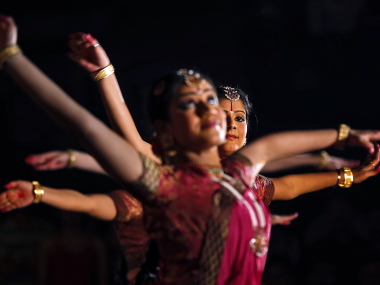
 "On Indian media's role in depoliticising discourse around classical dance, and the need for change")
When was the last time you saw a classical dancer make a headline? Probably never. Although headlines are often dedicated to state politics, there are moments when other professions like cinema and sports bask in the glory of the front page. Is dance, more so classical dance, so peripheral to the mainstream society that it can never spill out of its bracketed space of the supplementary sheets? Media, especially print media has played a historically significant role in shaping the public discourse on classical dance in pre-independent as well as post-independent India. From being in the eye of public debate (of whether or not Devadasi system should be abolished) in the mid 20th century to becoming an “Art/Entertainment supplement”, the public discourse on classical dance was systematically depoliticised in a span of less than half a century. The relationship between dance and print media was initially forged during the 19th-century social reform movement in India. Public intellectuals involved in writing and running newspapers were often also heralding the movement to put an end to the Devadasi system (Devadasis were a community of women who would perform in public spaces such as temples and secular social gatherings). As early as in 1893, Subramania Iyer, (the then chief editor of The Hindu and head of Madras Hindu Social Reform Association), sent in a memo from his association to the Governor of Madras requesting that “the government discourage the devadasi system, for that would “strengthen the hands of those trying to purify the social life of the community.”” (Soneji. 2011)* [caption id=“attachment_7060861” align=“alignnone” width=“825”]  Representational image. Reuters[/caption] Since legacy newspapers such as The Hindu and vernacular newspapers participated with a reformist interest in this debate, the views they carried did not represent the dissenting voices of Devadasis, to say the least. The protests led by the Devadasis against the abolition of their profession were described by some English newspapers in words such as “extremely revolting” and “ignorant opposition engineered by disinterested parties”. However, though one-sided, these reports also point us to the enormous resistance put up by the traditional dancing communities against the abolition of the Devadasi system. They fought for their rights, wrote official letters and used their best tools to remain empowered as citizens of the rapidly modernising India. Though unsuccessful in preventing the abolition, their attempts remind us of the position they took with respect to the people and government in power. Finally, the abolition marginalised the Devadasis by criminalising their profession and alienating them from their own practice of dance. Print media played a crucial role not just in furthering the views of those in favour of delegitimising the Devadasi system but was also instrumental in shaping the idea of who a legitimate dancer is. Appropriated into the wealthy and educated pockets of upper caste, dance made a second appearance in the public sphere refurbished in a whole new avatar as a “virtuous pursuit” with a new tag of being “classical”. The print media of the new Independent India was flooded with visuals of costumed upper-caste dancers in state-endorsed tourism brochures, or of dancers dancing in new proscenium settings. If one could identify the keywords (or hash tags) of this discourse it would be: preservation of ancient tradition, Indian culture, national heritage, temple sculptures. As classical dance took to new spaces of halls and auditorium, print media took on to the review culture. A new pool public intellectuals who were meant to operate as of “cultural critics” emerged. Unfortunately, classical dance reviews were often either reportage or took on a corrective tone, merely pointing “mistakes” in the performance. Until today, review culture in print hasn’t been able to evolve into a practice beyond praising or putting the dancer down (with a negligible number of exceptions). We continue to have reviews where critics have objectified dancers and their dance with adjectives like “over-smiling” and “sloppy aramandis”. Describing children’s performances one of the senior critics of the country writes “one in purple costume had too much attitude while one in brown very little stamina. Were they even under 13?”. Few reviews contextualise a performance politically, historically or socially or help the artist see her own performance from a different perspective. The world of classical dance is entrenched in the politics of nation-state and internal power games which is rendered invisible to the public eye. Critical studies of classical dance from the perspective of politics, gender, caste and religion are carried out by academics but they barely percolate into the practice and the public understanding of classical dance. Media is not solely responsible for how the public perceives classical dance but has the privilege of influencing it. By rehashing the state rhetoric that dancers are keepers of “Indian culture”, it has contributed to narrowing the role of a classical dancer in her own society — keeping her from perceiving and bridging many other vital links with the reality around her. Enabled by digital media, the #MeToo movement was probably a rare moment in decades of classical dance history where few dancers felt empowered to reflect on their own field, recognise and express systemic problems in the disorganised sector of dance – sexual exploitation, gatekeeping of knowledge and opportunities, lack of agency in performances and festivals. Dancers like Swarnamalya Ganesh (who also led #MeToo classical dance from Chennai) have now taken to the public sphere through digital media to render the obfuscated politics of the field visible. With an interest in generating accessible writings that makes the connection between the larger social and political landscape of the country and its performing arts more evident, this monthly column in Firstpost is an attempt to un-bracket the dance discourse from its contained category of “Arts for Art’s sake”. *Soneji, Davesh. Unfinished gestures: devadasis, memory, and modernity in South India. University of Chicago Press, 2011.
Media, especially print media has played a historically significant role in shaping the public discourse on classical dance in pre-independent as well as post-independent India.
Advertisement
End of Article

 "Israel targets top Hamas leaders in Doha; Qatar, Iran condemn strike as violation of sovereignty")
 "Nepal: Oli to continue until new PM is sworn in, nation on edge as all branches of govt torched")
 "Who is CP Radhakrishnan, India's next vice-president?")
 "Israel informed US ahead of strikes on Hamas leaders in Doha, says White House")
 "Israel targets top Hamas leaders in Doha; Qatar, Iran condemn strike as violation of sovereignty")
 "Nepal: Oli to continue until new PM is sworn in, nation on edge as all branches of govt torched")
 "Who is CP Radhakrishnan, India's next vice-president?")
 "Israel informed US ahead of strikes on Hamas leaders in Doha, says White House")



](https://images.firstpost.com/wp-content/uploads/2019/07/cd825.jpg)