

 "Celebrate, not Decry Desi Domination of Spellings")
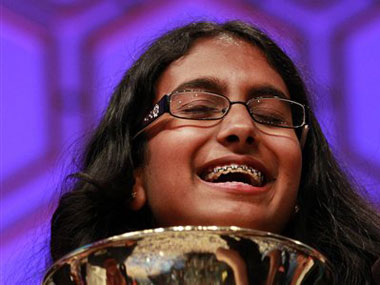
Washington: It seems some have a slight problem with desi kids dominating the American spelling bees. They are busy finding convoluted reasons to explain why Indian American kids won the celebrated Scripps Spelling Bee five years in a row. Ancient oral traditions, Indian methods of rote learning, subliminal parental memories of endless General Knowledge factoids about longest rivers and highest mountains are being invoked to illustrate why desis win. There is a hunt to pin success on anything other than hard work and grit. Instead of celebrating the success of 14-year-old Snigdha Nandipati, who won the latest spelling bee, this band of pop psychologists is busy finding holes and deconstructing a happy phenomenon into cynical bits. It’s like there must be a “dark” side to every success. Usually I hunt for the “dark” side too but not this time around when young motivated teenagers are excelling in a fair competition. [caption id=“attachment_331775” align=“alignleft” width=“380” caption=“People are busy finding convoluted reasons to explain why Indian American kids won the celebrated Scripps Spelling Bee five years in a row.”]  [/caption] Firstly, the spelling champions are second and third generation Indian Americans, born and brought up in the United States, quite far from the rote learning environment of India. They go to American schools, learn from American teachers and hang out with American friends. They do better in all subjects, not just English and spelling bees. Desi kids don’t t just correctly spell “guetapens,” (ambush or trap) or “cymotrichous” (having wavy hair) but also excel in math and science Olympiads. They win competitions devised by Intel and Google. Surely not all success can be attributed to rote learning and “ratta-fication.” Besides, winning the spelling bee is not just a question of memorising words but developing a feel for them. The young kids need an understanding of etymology, pronunciation, phonetics and word association to spell correctly. It is a complex process, which needs a solid intellectual base. A “ratta” master can’t win the competition. Sociological and cultural reasons more worthy than an ability to memorise could account for the special performance of desi kids in “intellectual sports.” A majority of Indian Americans come from highly-educated upper middle class backgrounds. It is a truism that they put a premium on education and learning. More importantly, they coddle their children less and generally do a better job of supervising homework. Even in the much-celebrated US public school system, parental involvement and oversight are extremely necessary. The enormous success of desi kids in American schools may have something to do with the blending of the best of both cultures. Imaginative teaching methods, openness, a spirit of inquiry, encouragement and innovation meet the good old values of hard work, regular study hours, completing projects before partying and respect for parental authority. This is a winning combination. A word of caution for those who think of the US school system as a panacea for all ills and the Indian system as the root of all evil. Having been through Indian schools and colleges myself and seen two kids through American schools, I see neither as ideal. The US system is good for under performers and the overly motivated. Those in the middle can fall through the cracks and never realise their potential mainly because the teachers don’t push, punish or demand performance. The emphasis on making everyone a winner is so great that a child is never told he “needs” to do his homework on time. Of course, American teachers focus on making a child feel important, have self-esteem and generally feel wanted and rightly so — something we hardly emphasize in India to our detriment. But in the end one has to ask why Bill Gates has been bemoaning the deficiencies of American public school system and asking for tougher standards and harder testing procedures. India puts all the emphasis on tests and none on imaginative teaching or learning. In short a medley of the two could be the answer. The Indian American community is in the best position to create it. It can enforce a strict regimen at home and set the kids “free” at school with great teachers and an interesting environment. The result is generally a well-balanced child who doesn’t crack under pressure. Be it a spelling bee or the pressure cooker of Wall Street. Forgive me for my own bit of pop psychology and pop sociology.
It seems some have a slight problem with desi kids dominating the American spelling bees. There is a hunt to pin success on anything other than hard work and grit.
Advertisement
End of Article
Written by Seema Sirohi
Seema Sirohi is a foreign policy analyst currently based in Washington. She has worked for The Telegraph (Calcutta), Outlook and Ananda Bazar Patrika in the past, reporting from Geneva, Rome, Bratislava, Belgrade, Paris, Islamabad and Washington on a range of issues. Author of Sita’s Curse: Stories of Dowry Victims, she has been a commentator on BBC, CNN and NPR. see more

 "Israel targets top Hamas leaders in Doha; Qatar, Iran condemn strike as violation of sovereignty")
 "Nepal: Oli to continue until new PM is sworn in, nation on edge as all branches of govt torched")
 "Who is CP Radhakrishnan, India's next vice-president?")
 "Israel informed US ahead of strikes on Hamas leaders in Doha, says White House")
 "Israel targets top Hamas leaders in Doha; Qatar, Iran condemn strike as violation of sovereignty")
 "Nepal: Oli to continue until new PM is sworn in, nation on edge as all branches of govt torched")
 "Who is CP Radhakrishnan, India's next vice-president?")
 "Israel informed US ahead of strikes on Hamas leaders in Doha, says White House")



](https://images.firstpost.com/wp-content/uploads/2012/06/spellingbee.jpg)