 "Activists, Modi govt oppose Leslee Udwin's BBC documentary on Indian rapists")
As we all know, excerpts from an interview with one of the Delhi gang-rape convicts,
Mukesh Singh, have gone viral.
The interview, which was conducted as part of a documentary by British filmmaker Leslee Udwin called India’s Daughter, has Singh saying, “A girl is far more responsible for rape than a boy. You can’t clap with one hand – it takes two hands.” Mukesh Singh said in the interview that Delhi gangrape victim shouldn’t have fought back but rather let the rape take place and then the men would have let her live. He was quoted as saying, “A decent girl won’t roam around at 9 o’clock at night. A girl is far more responsible for rape than a boy. Boy and girl are not equal. Housework and housekeeping is for girls, not roaming in discos and bars at night doing wrong things, wearing wrong clothes. About 20 percent of girls are good.” Mukesh’s interview shows that he’s highly unrepentant about the act and has naturally caused outrage and shock in India. After the reports about the interview,
Home Minister Rajnath Singh
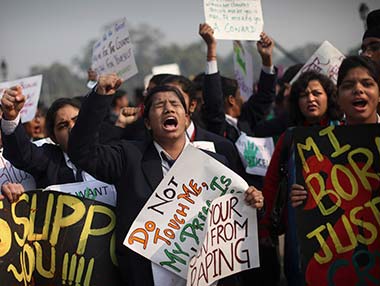
took strong exception to a British film maker interviewing 16 December gangrape convict Mukesh Singh in Tihar jail, and sought a detailed report from the jail chief on the whole issue. Taking the incident of the convict being interviewed in custody very “seriously”, the Home Minister spoke to Tihar jail Director General Alok Kumar Verma and sought a detailed report on it urgently, official sources said. [caption id=“attachment_1843525” align=“alignleft” width=“380”] Representational image. AP[/caption] Activists, however have pointed out that there are several problems with the framing of the documentary and that Udwin’s ‘white-saviour-perspective’ in the film, needs to be rejected. In a piece on DailyO
women’s right activist and Secretary at the All India Progressive Women’s Association Kavita Krishnan has argued that Udwin’s documentary seems to re-invoke patriarchal notions of how women are just daughters, mothers or sisters when it comes to leading the fight against rape, a notion that activists and women say needs to be rejected. She writes, “Hailing Indian women as ‘India’s daughters’ is something India’s patriarchs including Indian government’s and the most anti-feminist forces in India have always done. Why does a global campaign against gender violence do the same?” She also points out that based on that when it comes to discussing gender violence in India the cause is not helped by arguing that “India’s ‘backwardness’ is the problem; or that gender violence is ‘worse out there in India’”. She notes: “What we’re saying is that the global campaign saying rape is an Indian problem, is racist. Rape and rape culture are global problems; there are millions of Mukesh Singhs in every country, including India. What we’re saying is that it doesn’t help Indian women to bypass or short-cut the legal appeals process and replace it by a mob trial by media.” She adds the anti-rape and gender violence movement in India needs to move away from the narrative of how men like Mukesh Singh and his co-convicts in the Delhi rape cases are “brutes, animals, vile beasts” and focus on “more systemic rape culture and denial of autonomy to women in homes, schools, by the state machinery, by the caste system, by communal violence”. In
a separate Facebook post
, Krishnan adds that she remembers an October 2013 meeting with Udwin (nearly a year after the protests had broken out against the Delhi gangrape case) and writes that Udwin didn’t appear to have a great detail of contextual knowledge about the incident and the subsequent protests. Krishnan writes:
Representational image. AP[/caption] Activists, however have pointed out that there are several problems with the framing of the documentary and that Udwin’s ‘white-saviour-perspective’ in the film, needs to be rejected. In a piece on DailyO
women’s right activist and Secretary at the All India Progressive Women’s Association Kavita Krishnan has argued that Udwin’s documentary seems to re-invoke patriarchal notions of how women are just daughters, mothers or sisters when it comes to leading the fight against rape, a notion that activists and women say needs to be rejected. She writes, “Hailing Indian women as ‘India’s daughters’ is something India’s patriarchs including Indian government’s and the most anti-feminist forces in India have always done. Why does a global campaign against gender violence do the same?” She also points out that based on that when it comes to discussing gender violence in India the cause is not helped by arguing that “India’s ‘backwardness’ is the problem; or that gender violence is ‘worse out there in India’”. She notes: “What we’re saying is that the global campaign saying rape is an Indian problem, is racist. Rape and rape culture are global problems; there are millions of Mukesh Singhs in every country, including India. What we’re saying is that it doesn’t help Indian women to bypass or short-cut the legal appeals process and replace it by a mob trial by media.” She adds the anti-rape and gender violence movement in India needs to move away from the narrative of how men like Mukesh Singh and his co-convicts in the Delhi rape cases are “brutes, animals, vile beasts” and focus on “more systemic rape culture and denial of autonomy to women in homes, schools, by the state machinery, by the caste system, by communal violence”. In
a separate Facebook post
, Krishnan adds that she remembers an October 2013 meeting with Udwin (nearly a year after the protests had broken out against the Delhi gangrape case) and writes that Udwin didn’t appear to have a great detail of contextual knowledge about the incident and the subsequent protests. Krishnan writes:
“On meeting me, she asked ‘Have you participated in the protests?’ I did a bit of a double take: if she didn’t know I had participated in the protests, why was she interviewing me? Since she planned to interview me, should she not have done some basic homework - about my work, my views, my intervention in the movement? If these didn’t matter to her film, what was the perspective of the film? I frankly said some of this to her, suggesting that she should do some more homework on the protests, and on the women’s movement in India. “I felt - and continued to feel - unease about how the film would present my views, and how these would fit in in the overall perspective of the film. She responded warmly thanking me for the material, and also sent a warm mail thanking me for the interview, a couple of months later. I do not question her integrity or intention, as a person. But I am concerned at the sheer confidence with which a single film, made by someone with scant familiarity with the daily decisions, dilemmas and struggles of India’s activists, can claim to set the agenda for change in India. As such, I fear that a global campaign, with the disproportionate funds and power at its disposal, can possibly do great damage.” Already, the film has sent a message that due legal process can be given short shrift and junked, for the noble agenda of exposing a ‘rapist’s mind’ to the world.”
Krishnan also critiques certain remarks that Udwin made in an interview to the Guardian . Udwin had claimed that when it came to gender violence and rape, “it’s not just about a few rotten apples, it’s the barrel itself that is rotten”. Krishnan counters by saying this if the whole barrel is rotten as Udwin claims then “it might be a tad unbalanced to put a harsh spotlight on a couple of rotten apples alone?” Interestingly NDTV has said that the Delhi gangrape victim’s parents have seen the documentary and support it. While the Delhi gangrape victim’s parents might have endorsed the film, the government of India is definitely not pleased. ANI reported that Ministry of Information and Broadcasting has issued an advisory to all television channels to not broadcast Delhi gang-rape documentary. The Delhi Police also obtained a restraining order from a court against the broadcast of a documentary film and an FIR against unknown persons was also registered in the matter. Indian Express says that the order reads, “British filmmaker Leslee Udwin from BBC interviewed Mukesh Singh… in which he had made offensive and derogatory remarks against women creating an atmosphere of fear and tension with the possibility of public outcry and law and order situation. …The court has passed order prohibiting the publication/transmission of the interview till further orders.” Incidentally Udwin has claimed she had permission from both the DIG and MHA. “I wrote to DG of Tihar. The DG had to consult with MHA. The letter basically stated that it was a campaign film. I had applied for permission in May 2013 and I got the answer ‘yes’ in two weeks. Official permission of MHA had also come. Permission from the prison was also signed,” she was quoted saying by PTI . While activists are up in arms about the film, and the government is no mood to let the film be aired, the documentary has managed to get some solid publicity before its release thank to the publication of the sensational interview.