 "What a literature festival told me about reading in the age of distraction")
By Thursday morning, the first day of the Jaipur Literature Festival, Hotel Clarks Amer already had no room to spare: not for more feet, not for more bodies, not for more excitement. People spilled into every corner of the venue, tote bags brushing against linen kurtas, books clutched alongside coffee cups. If this was proof of anything, it was that people still loved to read and they were willing to show up early for it.
The crowd was a study in contrasts and continuities. Silver-haired mothers in sharply pressed clothes, walking purposefully with oversized tote bags. College students with dyed hair and jangling junk jewellery, darting between venues. Tourists soaking in the culture and performances. Avid readers planted firmly in their seats for the talks, unwilling to miss a word. Everyone seemed animated, buzzing, a little breathless.
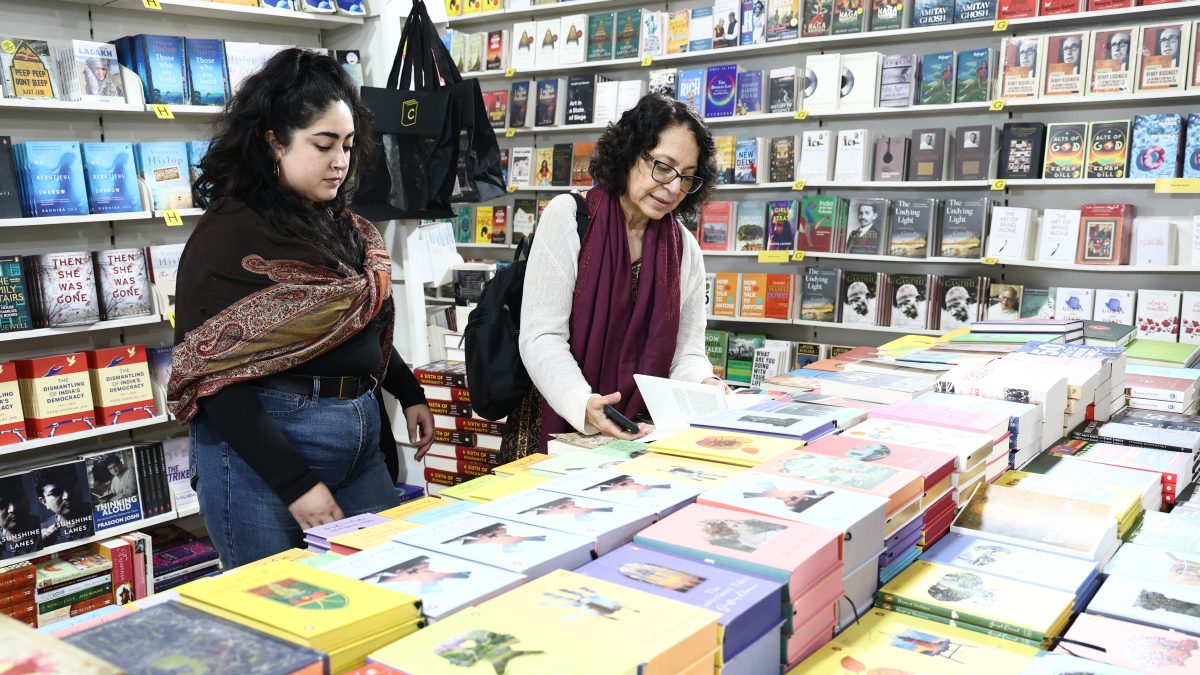
The Crossword stall was constantly crowded, people buying books faster than the volunteers could stack them. Food counters hummed too; reading, after all, requires fuel. Volunteers in mint Nehru jackets swarmed the grounds, helping, directing, answering the same questions over and over with remarkable patience. Panellists wandered around like regular attendees, pausing for conversations and coffee. On the music stages, both big and small, performers brought folk traditions alive, grounding the festival in sound as much as text.
A bubble worth examining
What struck me most was how sharply this scene clashed with the dominant online narrative about reading today. We are repeatedly told that younger generations don’t read anymore; that declining reading habits signal eroding empathy, shrinking attention spans, emotional shallowness. Standing inside the crowd, those claims felt hollow then. At the very least, they felt incomplete.
Of course, this is a bubble. A privileged one. A space populated largely by those who can afford to be here, who speak the languages of the colonisers, who have the leisure to consume literature as culture. But bubbles still reveal something. The Delhi Book Fair, too, was packed when I visited. On the journey to Jaipur, fellow passengers spoke excitedly about the festival. On the way back, a mother and her two children sat coiled into their seats for four hours, each absorbed in their own book, pausing occasionally to exchange observations from JLF. It felt like a dog-eared page from my own memory – long winter train journeys spent rereading the same novel on the way to my mother’s hometown. Reading not as productivity or self-improvement, but as companionship.
Quick Reads
View AllThe rise of the performative reader
There is also something else happening here, harder to dismiss. Books are not just being read; they are being carried, displayed, circulated. They are objects again.
The performative reader has emerged as a familiar figure; often male, tote bag slung over one shoulder, a feminist paperback visible by design. Online, this aestheticisation of reading invites mockery and “ragebait”. It can feel superficial, even cynical. But if the performance nudges someone to pick up a book, isn’t that a compromise worth making? In an attention economy driven by visibility, reading has found a new costume and a new audience. What once signified interiority now doubles as social currency. And perhaps that isn’t entirely a loss.
Access is the real story
Maybe the question isn’t whether people still love to read. Maybe it’s who gets access to books, to festivals, to time. Maybe it’s about where reading is allowed to exist; beyond curated spaces, beyond paywalls and ticketed venues. Festivals like JLF operate within structural economic, linguistic and cultural limits. The love of reading visible at such festivals does not automatically translate into widespread accessibility.
The viral narrative around “book theft” at the Delhi Book Fair also flattens what actually happened. According to some attendees, the chaos followed a few poorly managed free book giveaways on the closing day, but online, it quickly hardened into moral outrage. Stripped of context, the videos travelled faster than the explanation, raising questions about why desperation around access to books invites such swift condemnation. In a world where knowledge is routinely hoarded, monetised, and extracted by the powerful every day, it’s worth asking why we moralise some forms of taking while ignoring others.
Beyond the festival
Perhaps what JLF reveals is not that reading is back, but that it never left. It learned to survive alongside feeds and algorithms and spectacle. The challenge now is not revival, but redistribution - making reading less gatekept, less ornamental. Let’s bring back reading, truly. And this time, let’s make it accessible.