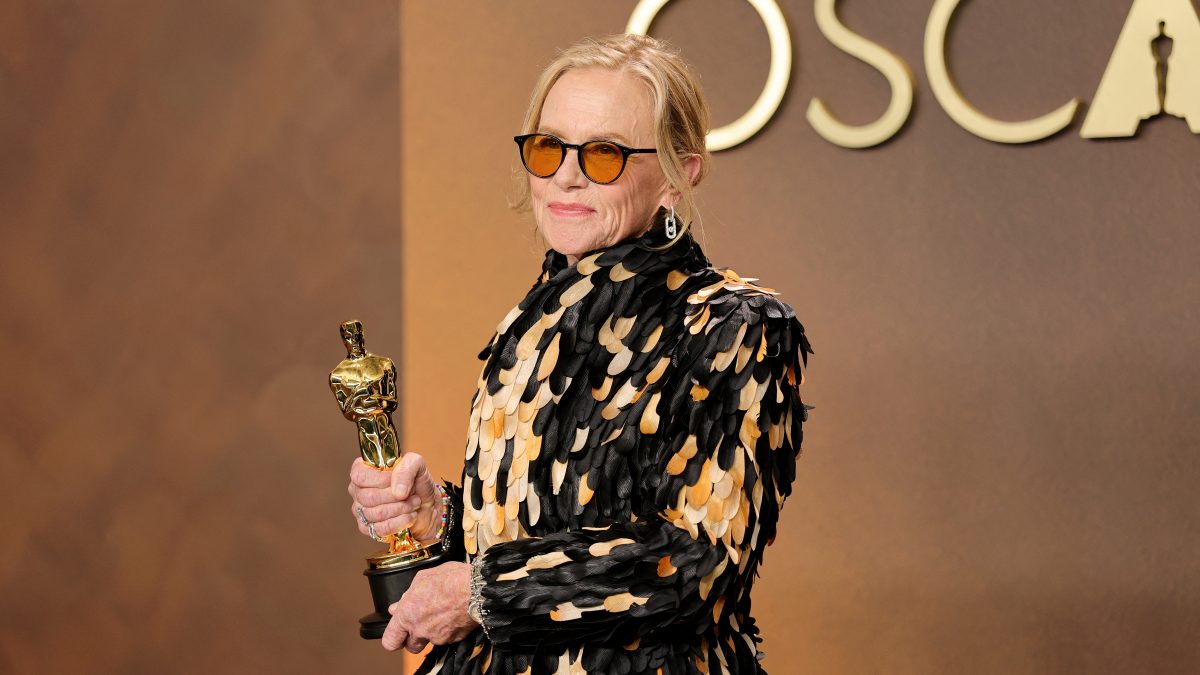
 "Amy Madigan, winner of the Best Actress in a Supporting Role award for 'Weapons', poses in the press room during the 98th Oscars. File photo/AFP")
Amy Madigan won Best Supporting Actress on Sunday night at 75. Demi Moore was nominated at 62. Jessie Buckley won Best Actress at 35. The average age of a best actress nominee at the Oscars in the 2020s is 44, up from 33 in the 1940s. On the surface, it looks like progress. The Academy, it seems, has finally discovered older women.
Hollywood has not gotten the memo. In 2025, out of the top 100 highest-grossing films in the United States, four women over the age of 45 appeared as leads or co-leads. Four. In the same year, 31 men in the same age bracket qualified for the same category. One of the four women was a voice character in an animation. None of them were women of colour.
This is not a gap. It is a wall with a door that opens once a year, on Oscar night, and then closes again.
The prestige bubble
The Oscars and the film industry are not the same thing, and conflating them is how the industry avoids accountability. When Frances McDormand wins at 63, or Demi Moore gets nominated at 62, or Amy Madigan wins at 75 — forty years after her first nomination — the assumption, as Dr Martha Lauzen of the Centre for the Study of Women in Television and Film puts it, is that ageism in Hollywood is a thing of the past.
It is not. For older women in mainstream commercial films, the numbers begin declining in their late thirties, continue falling through their forties, and by their sixties, they account for just 2% of major female characters in Hollywood’s top-grossing films. Men over 60, by comparison, account for 8%. A USC Annenberg study found that in the top 100-grossing films, out of 4,288 speaking characters with a discernible age, only 10.7% were 60 or older. Of those, just 26.4% were female, despite women comprising a larger percentage of the U.S. population.
The prestige circuit, where Oscar-nominated films live, operates by different rules. Dr Stacy L Smith of USC’s Annenberg Inclusion Initiative notes that in arthouse and awards-driven films, women do have longer career spans now. There are more roles, more female directors choosing female protagonists, and more stories being built for veteran actresses. Chloé Zhao directed Jessie Buckley in Hamnet. Zhao’s previous film Nomadland starred Frances McDormand in her sixties. Neither film would likely have been made fifty years ago. But this is the prestige bubble, and the prestige bubble is not Hollywood. It is a small, critically celebrated corner of it, the part that gets televised on Oscar night and mistaken for the whole.
The exception proves the rule
Amy Madigan’s win is instructive. At 75, she became the second-oldest winner in the Best Supporting Actress category, playing a parasitic witch in the horror film Weapons. She let out a deep, witch-like cackle on stage and joked that after 40 years, “what’s different is I’ve got this little gold guy.” The triumph was personal and powerful. It was also an outlier.
Madigan has spoken openly about how the phone stopped ringing in Hollywood for years, how she grew accustomed to being counted out. Her 40-year gap between nominations — the longest for any actress — speaks not to Hollywood’s generosity but to its scarcity. The Demi Moore nomination tells a similar story. Moore was celebrated as a revelation in The Substance at 62, and more than one piece noted, approvingly, that she “doesn’t look her age.” The compliment contains the problem. The bar for an older woman in Hollywood is not just talent, or a great performance, or the right material. It is talent plus the right material plus the right body plus the right director plus a certain kind of luck that 31 men over 45 did not need in the same year.
Quick Reads
View AllThe numbers don’t lie
Frances McDormand won Oscars in 2018 and 2021 at 60 and 63. Youn Yuh-jung won at 73. Michelle Yeoh won at 60 in 2023, using her acceptance speech to declare: “Ladies, don’t let anybody tell you you are ever past your prime.” The pattern looks like progress. The data tells a different story.
The average age of a Best Actress winner is 37.2 years. For Best Actor, it’s 44.6 years—a gap of 7.4 years. When looking at first-time winners only, actresses win at 35.2 while actors win at 43.6, an 8.4-year difference. From 2002-2013, the 120 women nominated for Best Actress or Supporting Actress averaged 40 years old; the same number of male nominees averaged 48. Out of all Best Actor winners through 2022, 39 were in their 40s at the time of winning. Only 16 Best Actress winners were in that same age bracket; most had already won younger or aged out of consideration entirely.
The 2026 UCLA Hollywood Diversity Report showed that 2025’s biggest films were less diverse than previous years, with the number of women in lead roles down 10% year-on-year. Martha Lauzen puts it plainly: “We see a handful of mature female actresses and assume that ageism has declined in Hollywood. But unless your last name happens to be Streep or McDormand, chances are you’re not working much in film.”
Visibility at the Oscars is not the same as structural change in the industry, and the danger is that one keeps getting mistaken for the other.
The Academy gives older women their due once a year. The other 364 days, the industry does what it has always done: cast four women over 45 as leads and cast 31 men. Build prestige films for a handful of A-listers and call it progress. Award Amy Madigan after four decades of silence and act as if the forty years didn’t happen.
The door opens once a year. The wall remains.
From films to music to internet trends, Preetika covers cultural moments that feel bigger than themselves, and the context that makes them matter.