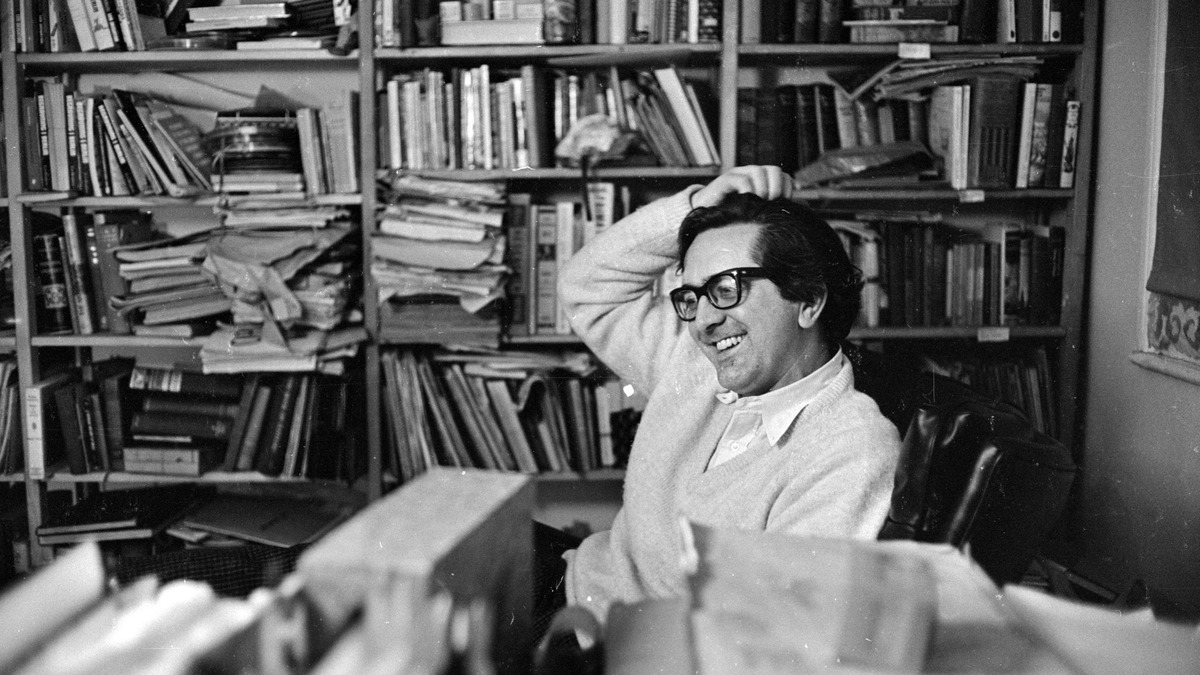
 "On Len Deighton, the Quiet Giant of espionage fiction")
It’s not without reason that Len Deighton was widely known as the “quiet giant” of spy fiction. He was quiet in his modest personal life, yet a giant in his ability to craft intelligent espionage stories.
Deighton, who passed away on March 15 at the age of 97, was a prolific writer whose work encompassed cookbooks, history, and World War Two thrillers. However, it was his command over the fictional world of spycraft that cemented his legacy.
Much like John le Carré, Deighton’s protagonists were a counterpoint to the escapism of Ian Fleming’s James Bond. Their brand of cynical realism proved to be immensely influential in redefining the genre.
Deighton’s background was the training ground for the nature of his spies. He was the son of a professional cook and chauffeur, very different from Fleming’s upper‑class upbringing and Le Carré’s middle‑class and intelligence community background.
Before he took to writing, Deighton studied at London’s Royal College of Art, later designing striking book covers. He also worked as a flight attendant, visiting some of the international locations that he would go on to describe with precision.
His first novel, The Ipcress File (1962), was a Cold War thriller in which a British intelligence officer investigates the brainwashing and kidnapping of defence scientists. The unnamed hero in these pages spent as much time obsessing over his groceries, incompetent superiors, and expense reports as with keeping the country safe.
Quick Reads
View AllThe movie version, starring Michael Caine in distinctive black glasses, was also a success, with its moody cinematography, realistic settings, and understated style. (No shaken martinis or exotic locations, sorry.)
With the subsequent Bernard Samson series, Deighton established himself as a master of this method. These were a sequence of nine novels, collectively known as the Game, Set, and Match trilogy, the Hook, Line, and Sinker trilogy, and the Faith, Hope and Charity trilogy.
Berlin Game, the first book, introduced us to Samson, an experienced, disillusioned intelligence officer caught up in the shapeshifting world of Cold War espionage, balancing loyalty with betrayal and the personal with the political.
For author Matt Lyon, “all spy fiction is really an extended metaphor for the office. No character captures that better than Bernard Samson, a middle-ranking intelligence executive, who can’t trust anyone.” Lyon’s belief: “this really is the best Cold War thriller.”
Much of Deighton’s other work remains notable. His Bomber (1970), dealt with an World War Two RAF raid over Germany from multiple perspectives. This approach effectively brought out the fear, tension, and complexities of the assault.
Then, there was SS-GB (1978), a work of alternative history that imagined a Nazi-occupied Britain. Later, quite a few other authors were to write about similar scenarios, such as Robert Harris in Fatherland (1992) and C.J. Sansom in Dominion (2012).
For many, the elevated prose style, ingeniously complicated structures and moral murkiness of Le Carre’s novels left an indelible impression. However, Deighton’s influence has also lasted, and is palpable in the work of many spy writers today.
A notable example is Mick Herron’s Slough House series, with its emphasis on office drudgery, bureaucratic resentments and flawed characters.
Others such as Charles Cumming carry forward aspects such as the psychological toll of the spying job as well as its technical details. William Boyd’s espionage novels often mirror the bureaucratic maze, and Paul Vidich claims that Deighton had an outsized influence on his recent novel, The Poet’s Game.
For British journalist Tim Shipman, a long-time Deighton devotee, his importance was two-fold. “Firstly, while Eric Ambler moved the genre from superhero secret agents to amateurs, Len made his professional spies rugged working-class men in temperamental opposition to their upper middle-class bosses, which added another dimension.”
The second great achievement, Shipman continues, “was to take us into the office and explore the kind of dynamics recognizable to anyone working in that environment”.
The “quiet giant” is no more, but his legacy lives on, and will remain anything but quiet.


 "Israel-Iran war live: Trump gives Iran 48 hours on Hormuz as Tehran launches strikes on Israel")
 "Pentagon draws up Iran ground invasion plans as Trump weighs options: Report")
 "Netanyahu had to prove he was alive 3 times. Why proof of life is ‘Word of the Week’")
 "Trump threatens to ‘obliterate’ Iran’s power plants if Strait of Hormuz not opened in 48 hours")
 "Israel-Iran war live: Trump gives Iran 48 hours on Hormuz as Tehran launches strikes on Israel")
 "Pentagon draws up Iran ground invasion plans as Trump weighs options: Report")
 "Netanyahu had to prove he was alive 3 times. Why proof of life is ‘Word of the Week’")
 "Trump threatens to ‘obliterate’ Iran’s power plants if Strait of Hormuz not opened in 48 hours")