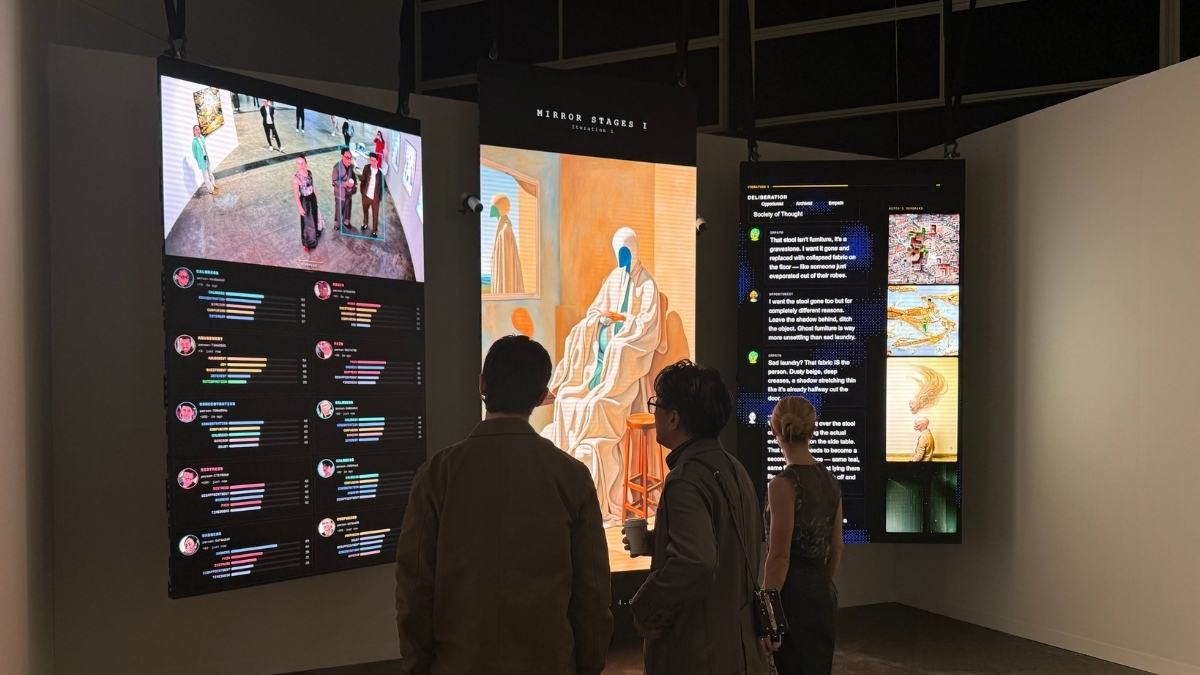
 "Meet Botto: The AI-artist who has already made millions")
This artist has recently become the talk of the town. And it is not a human being, yes, you heard that right.
Meet Botto, an AI-powered artist that has been creating and selling digital images since 2021.
In that time, it has generated more than 150 artworks and earned over $5 million through auctions, with total sales crossing $6 million. Its style has evolved as it learns what people like and adapts to their tastes.
How Botto creates and selects art
Each week, Botto produces around 350 new digital artworks based on a predetermined theme. These are presented to BottoDAO, an online community with more than 28,000 members, though around 5,000 are actively involved.
Members discuss the artworks’ aesthetic merits and vote for their favourites or downvote others using a real-time leaderboard.
The selected work is then auctioned, and the feedback helps determine what Botto creates next.
A community governed AI
Often described as an ‘autonomous artist,’ Botto is governed by thousands of human participants. Beyond voting, members of BottoDAO discuss exhibition plans, budgeting and logistics on Discord.
Even minor details, such as elements of its Art Basel Hong Kong display, have been debated and decided through collective voting.
According to its creators, human involvement is otherwise limited to copyediting auction listings for typos and punctuation.
“I’m just here to hold its virtual hand and make sure that it doesn’t offend anybody,” joked German artist Mario Klingemann, one of the project’s creators while speaking to CNN.
Tokens, voting power and ownership
The BottoDAO community is open to all, but participants must hold at least 100 $BOTTO tokens to receive any sale proceeds.
At current prices, this is less than $6. These tokens also grant voting power, with more heavily invested users holding greater influence, making the system deliberately plutocratic.
Quick Reads
View AllThe creators behind Botto
Botto was designed by software collective ElevenYellow and German artist Mario Klingemann, whose earlier AI-generated installation sold for £40,000 at Sotheby’s London. Klingemann’s work has long explored coding and neural networks, and Botto is based on a white paper he developed.
A group of stewards, including co-lead Simon Hudson, manages the project’s day-to-day operations and physical execution.
“If there’s, kind of, a purpose of Botto, it’s first to become recognized as an artist, and I think second is to become a successful artist,” said Simon Hudson in a video call with CNBC.
How Botto learned to create
Initially, Botto was given a general idea of what a prompt is, without any specific aesthetic direction. It began by combining random words, phrases and symbols to generate images, using elements like plus and minus signs to adjust emphasis.
“It started by combining random words, phrases and symbols…to produce images,” Hudson told CNBC by email.
Speaking to CNN, Klingemann was asked whether he had set any ground rules on what Botto could or could not create in such a public setting, particularly to avoid causing offense. He dismissed the concern with a laugh.
“I’m not too worried. I mean the only thing that might offend people is the idea that an AI claims to be an artist,” he said.

 "US-Israel-Iran War Live Updates: US bases in Kuwait, Qatar and Saudi Arabia hit in fresh Tehran strikes")
 "Is Trump buying time to send in troops to Iran? What’s behind the extended pause on US strikes?")
 "'We get things done': Trump hails partnership with PM Modi, says looking forward to 'stronger' tiles")
 "Putin turns to oligarchs for budget support as Ukraine war strains Russia’s finances")
 "US-Israel-Iran War Live Updates: US bases in Kuwait, Qatar and Saudi Arabia hit in fresh Tehran strikes")
 "Is Trump buying time to send in troops to Iran? What’s behind the extended pause on US strikes?")
 "'We get things done': Trump hails partnership with PM Modi, says looking forward to 'stronger' tiles")
 "Putin turns to oligarchs for budget support as Ukraine war strains Russia’s finances")