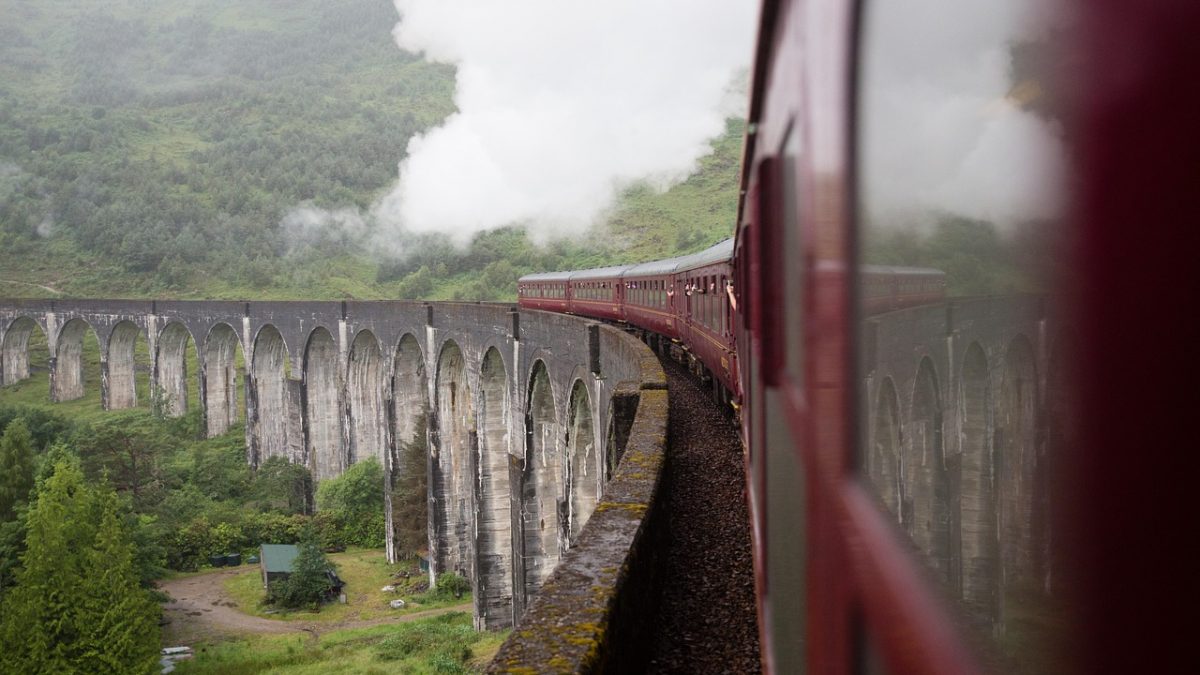
 "10 of the longest train journeys in the world you should know")
Long-distance train journeys aren’t just about the kilometres covered. They’re about what railways make visible: the world unfolding slowly, political borders dissolving into landscapes, and the rare luxury of time. In an age obsessed with speed and efficiency, these routes insist on duration.
Here are ten of the longest train routes in the world, journeys that turn travel into a way of seeing.
Trans-Siberian Railway (Russia)
Distance: 9,289 km
Conceived in the late 19th century to bind imperial Russia together, the Trans-Siberian Railway remains the longest continuous rail journey on Earth. Running from Moscow to Vladivostok, it crosses eight time zones and more than 80 cities, including Yekaterinburg, Novosibirsk, and Irkutsk. What passengers experience is not just scenery from forests, frozen rivers, to industrial towns, but the political logic of a nation built on vastness and connectivity.
Beijing–Moscow Railway (China, Russia)
Distance: Approx. 7,600 km
This transcontinental route links two former socialist capitals, passing through China, Mongolia, and Russia. Built as much for diplomacy and trade as for travel, the journey moves from Beijing’s urban density through the Gobi Desert and Mongolian steppe before entering Siberia. Beyond its sheer distance, it offers a glimpse into the contrasts of East and Central Asia, where urban sprawl yields to emptiness and political borders seem to stretch without end.
Shanghai–Lhasa Railway (China)
Distance: Approx. 4,300 km
One of the world’s highest railways, this line climbs onto the Tibetan Plateau. Travellers witness the gradual transition from the bustling Yangtze delta to stark high-altitude deserts, punctuated by towns that feel suspended between history and isolation. It is one of the world’s highest rail journeys, with oxygen-supplemented carriages and long stretches above 4,000 metres. Beyond the engineering feat, the railway is also deeply political, a reminder of how infrastructure can function as both connection and control.
The Canadian (Canada)
Distance: Approx. 4,460 km
Launched in the 1950s, The Canadian was designed to stitch together a country spread across forests, plains, and mountains. Running from Toronto to Vancouver via Winnipeg and Jasper, it offers a slow passage through Canada’s most defining landscapes: the flat prairies, dense boreal forests, and the jagged Rockies. The journey privileges observation over arrival, making the act of watching the land change the primary reward.
Indian Pacific (Australia)
Distance: Approx. 4,350 km
Named for the oceans it connects, the Indian Pacific travels from Sydney to Perth, crossing the Nullarbor Plain on the world’s longest stretch of straight railway track. Built to unify Australia’s east and west coasts, the journey reveals just how sparse the continent is. Hours pass with little visual change which leaves one with a quiet confrontation with scale and isolation.
Maharajas’ Express (Various luxury routes in India)
Distance: 3,000–4,000 km, depending on itinerary
Introduced in 2010 to position India within the global luxury rail circuit, the Maharajas’ Express reframes long-distance travel as curated heritage. Routes typically run through Delhi, Jaipur, Udaipur, Agra, and Mumbai, stitching together palaces, forts, and historic cities. It may not be the longest train on paper, but it stands out for how it turns rail into narrative: carefully composed and indulgent.
California Zephyr (United States)
Distance: Approx. 3,900 km
First introduced in 1949, the California Zephyr connects Chicago to Emeryville, skirting the Rockies and the Sierra Nevada. Often cited as the most scenic train route in the US, it passes through Denver and Salt Lake City, following rivers, canyons, and mountain passes. It’s a reminder that American geography, so often flown over, rewards slowness.
The Ghan (Australia)
Distance: Approx. 2,979 km
Originally built to service Australia’s interior, The Ghan runs from Adelaide to Darwin via Alice Springs. Its name nods to the Afghan cameleers who once navigated these routes long before rail arrived. It’s an iconic passage that cuts through the heart of the continent, passing red deserts, remote settlements, and long stretches of emptiness.
Eastern & Oriental Express (Singapore, Malaysia, Thailand)
Distance: Approx. 2,000 km
Modelled on the romance of old-world luxury trains, this route runs from Singapore to Bangkok via Kuala Lumpur. The journey passes rubber plantations, rivers, and colonial-era towns, offering a slower, more intimate way to experience Southeast Asia. More than the kilometres, it’s the mood: slow-moving vistas, ornate interiors, and a sense of timelessness reminiscent of a bygone era.
The Blue Train (South Africa)
Distance: Approx. 1,600 km
Operating since the early 20th century, The Blue Train connects Pretoria and Cape Town, traversing vineyards, mountains, and semi-arid plains. Once reserved for diplomats and heads of state, it remains one of Africa’s most iconic rail journeys. Here, comfort and history move in parallel, turning the route into a reflection on South Africa itself.


 "Trump announces 25% tariff on Iran’s trading partners. How India may be affected")
 "India, US to resume BTA talks after 5 months as Gor pushes for trade deal with 'real friends'")
 "ICC sources rubbish Bangladesh sports adviser’s sensational claim of BCB being asked to drop Mustafizur")
 "Jerome Powell: The 'Fed chair with a spine' taking on Trump")
 "Trump announces 25% tariff on Iran’s trading partners. How India may be affected")
 "India, US to resume BTA talks after 5 months as Gor pushes for trade deal with 'real friends'")
 "ICC sources rubbish Bangladesh sports adviser’s sensational claim of BCB being asked to drop Mustafizur")
 "Jerome Powell: The 'Fed chair with a spine' taking on Trump")