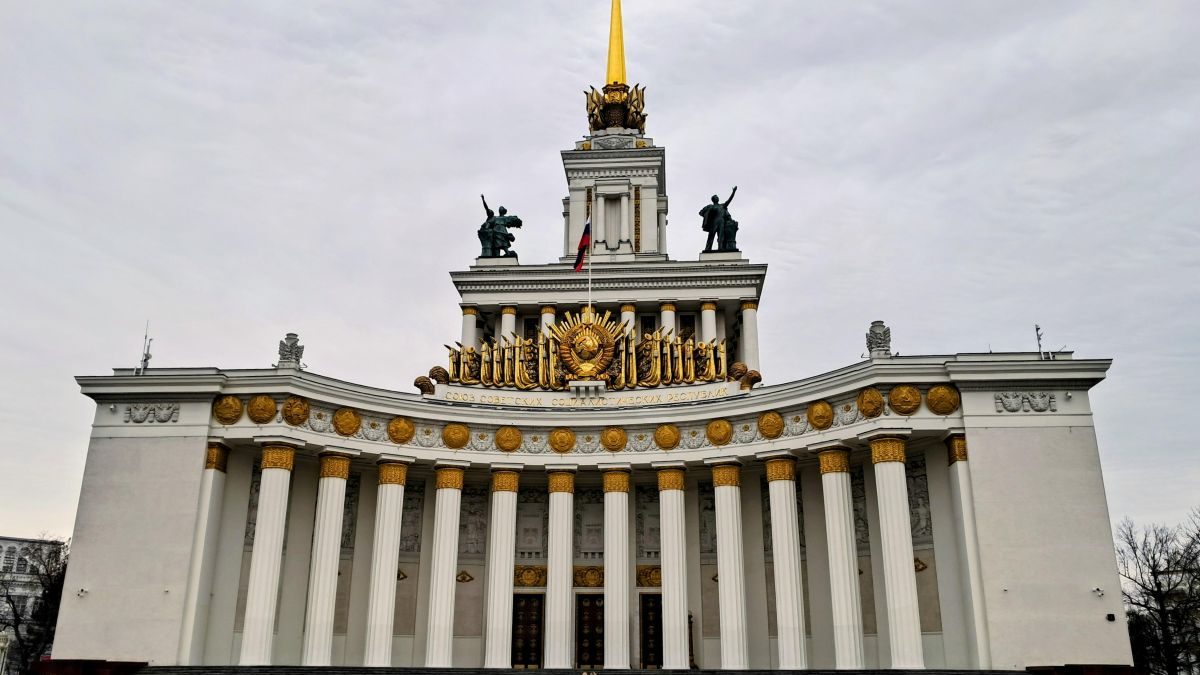
 "The Exhibition of Achievements of the National Economy, VDNH is the largest trade show, museum, and entertainment complex in the world. Credits/Arpita")
A short metro ride from my hotel brought me to the entrance of VDNKh, where crowds of locals and tourists were already gathering. Children were smiling, families were walking in, and the scale of the place slowly revealed itself.
As I stepped through the grand arch, the central pavilion rose ahead, and for a moment it felt like entering another era. There was an immediate sense of grandeur, but also a surprising liveliness.
Located in the north of Moscow, VDNKh stands for the Exhibition of Achievements of the National Economy. The largest trade show, museum, and entertainment complex in the world.
What began as a grand ideological project has today become one of the city’s most popular public spaces. Locals come here for walks, food and festivals. Visitors arrive for history, architecture and a glimpse into a carefully curated Soviet past.
A celebration of achievements
Walking further in, I sensed an interesting mix of modern life and a complex frozen in time. The space intricately holds up the achievements the Soviet Union once took pride in, even as it adapts to a very different present.
VDNKh was established in 1935 as the All-Union Agricultural Exhibition. The idea was ambitious. It was meant to present the success of the socialist system and demonstrate the strength of the Soviet economy.
The timing was significant. On the eve of the 20th anniversary of the October Revolution, the Soviet state wanted a space that would celebrate its achievements and project confidence. The exhibition also aimed to highlight agricultural abundance at a time when earlier years had seen famine in parts of the Soviet Union.
Quick Reads
View AllThe complex was designed as a “city of exhibitions” with wide avenues, public squares and themed pavilions. Each structure represented a sector of the planned economy, from textiles and grain to electricity and aerospace. It was not just about display. It was also a place for knowledge exchange, where scientists, workers and officials could meet.
During the Soviet period, VDNKh hosted hundreds of exhibitions, conferences and meetings every year. It became a central platform for sharing ideas and promoting technological progress.
A long tradition of exhibitions
The roots of VDNKh go back further than the Soviet era. Russia had a long tradition of fairs and agricultural exhibitions. Early fairs were often held near monasteries. By the 19th century, provincial exhibitions had become important for economic development.
In 1923, the new Soviet state organised a large national exhibition in Moscow. It attracted both specialists and the general public, laying the groundwork for what would later become VDNKh.
Over time, the exhibition evolved. It expanded in the post-war years and retained its importance as a national showcase. Today’s complex reflects decades of change while preserving its original purpose.
VDNH is home to more than 50 pavilions and around 200 buildings designed for leisure, education, and innovation. The park also boasts 49 cultural heritage sites, several ornate fountains, a pond system, flower gardens, and sculptures.
Fancy a trip to the stars? The museum showcases an impressive collection of aircraft from different eras, space capsules, satellites, rare documents, and archival photos and videos.
Grand architecture and Soviet symbolism
VDNH is on the UNESCO Tentative List for World Heritage status as a landmark of Soviet urban planning and cultural history.
As you enter deeper into the grounds, the architecture becomes impossible to ignore. The intricate designs and vibrant Soviet symbols offer a direct window into the past.
The architecture reflects what is often called Stalinist empire style. Columns, bas-reliefs and sculptures dominate the space. Agricultural motifs appear everywhere, from carved wheat sheaves to decorative panels.
At the main entrance, a sculpture of a tractor driver and a collective farm worker stands above the arch. They hold a bundle of grain high, symbolising prosperity and abundance. The imagery is direct and powerful. It tells the story the Soviet state wanted to project.
The fountain everyone stops for
At the heart of the complex is the famous ‘Friendship of Nations Fountain.’ It is impossible to miss.
Completed in 1954, the fountain features sixteen golden figures representing the Soviet republics. Each figure wears traditional dress and holds a crop linked to their region. The arrangement is not random. It reflects the order of republics as shown on the Soviet coat of arms.
The composition highlights two key ideas of the time. One is unity among the republics. The other is the promise of abundance and prosperity. The figures are elegant and still, creating a sense of calm grandeur.
The fountain remains a central meeting point. Visitors gather here, take photos and pause to take in the scale of the design.
Space dreams and future visions
VDNKh is not only about agriculture and industry. It also celebrates science and space exploration.
One of its most popular attractions is the space museum, dedicated to the Soviet space programme and its vision of the future. Nearby, the Space Pavilion draws visitors with its striking design. The structure resembles a temple and houses exhibits including space stations and rocket simulators.
For many visitors, these sections offer a glimpse into how the Soviet Union imagined the future. They combine real technological achievements with a sense of ambition and imagination.
A place for everyday life
Despite its grand history, VDNKh today feels lively and accessible. It is not just a historical site. It is a place where people spend their day.
Street food stalls and souvenir shops line parts of the complex. You can find snacks, local treats and goods from different regions. Families walk through the park. Children head towards amusement rides. Tourists move between pavilions and open spaces.
The site is easily accessible. It lies in the Ostankinsky district, not far from the Ostankino Tower, and is connected by metro and monorail.
Why VDNKh still matters
Covering 325 hectares, VDNKh was designed to showcase the achievements of the Soviet economy. It was also meant to connect people, share knowledge and promote progress.
Today, it continues to play an important role. It hosts exhibitions, festivals and cultural events throughout the year. More than 19 million people visit annually, making it one of Moscow’s most popular destinations.
The site is also significant for its architecture and planning. Dozens of structures here are recognised as cultural heritage sites. Together, they form a unified ensemble that reflects an important period in 20th century history.
A living symbol of the past and present
VDNKh is more than a park or an exhibition ground. It is a symbol of an era, shaped by ideology, ambition and design.
At the same time, it is a place that has adapted to the present. It offers leisure, culture and space for everyday life. Visitors can explore history, enjoy modern attractions and simply spend time outdoors.
Open daily from morning to late evening, it remains one of the most popular and engaging spaces in Moscow.
For anyone looking to understand the layers of the city, VDNKh offers a journey through time, one pavilion at a time.
The writer is visiting Moscow as part of the InteRussia Fellowship for South Asian Journalists
An aspiring globetrotter, Arpita Chowdhury is a writer, poet, and researcher with a strong grounding in human-interest storytelling. She holds an MA in Journalism and International Affairs from University College Dublin, completed in collaboration with the CNN Academy. Her reporting and commentary have appeared in several national and international dailies, spanning travel, culture, politics, and people-centric narratives. Powered by adrak chai, she is always chasing stories that connect place with people. Reach her at arpita.chowdhury2@nw18.com