 "India’s hidden Giant’s Causeway: Stunning basalt columns that look straight out of mythology")
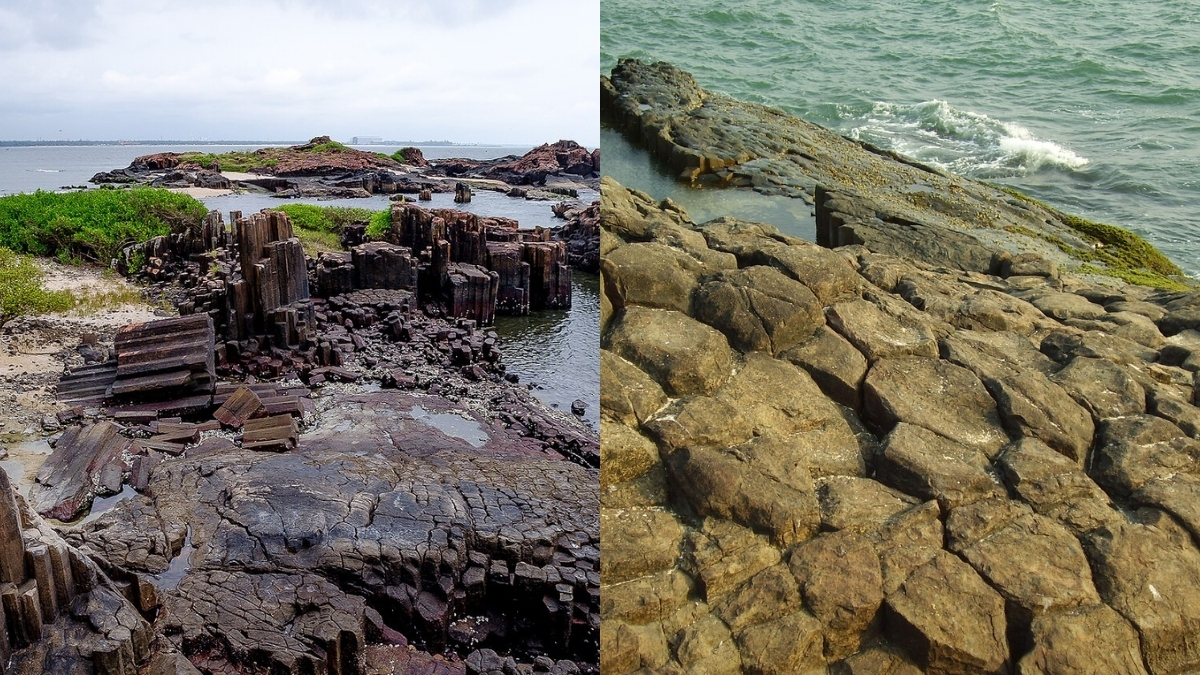
St. Mary’s Islands, also known as Thonsepar, are a group of four small islands in the Arabian Sea, located off the coast of Malpe near Udupi.
At first glance, they feel like a peaceful coastal getaway. But beneath that calm lies a dramatic geological story that goes back millions of years.
A rare natural wonder
What makes these islands special is their unusual rock formations. The hexagonal columns seen here are made of rhyolitic lava, which formed when molten rock cooled and cracked into geometric shapes.
These formations were created by sub-aerial subvolcanic activity, at a time when Madagascar was still attached to India. The landmasses separated around 88 million years ago.
These columnar formations are rare, especially because they are rhyolitic. Most similar formations around the world are basaltic.
Because of this uniqueness, the islands are recognised as one of the National Geological Monuments of India, declared by the Geological Survey of India in 2016.
They are also an important site for geo tourism.
A global comparison
A key international parallel is the Giant’s Causeway and Causeway Coast, a World Heritage Site, located along the coast of Northern Ireland, United Kingdom. This formation, comprising roughly 40,000 interlocking basalt columns, was also created by volcanic activity during the Tertiary period.
Like St. Mary’s Island, the Giant’s Causeway offers a visually dramatic display of nature’s geometric precision, with the columnar jointing pattern standing as a testament to specific thermodynamic conditions of lava cooling.
The scientific investigations at Giant’s Causeway have greatly influenced the early development of geology as a discipline, and the site is steeped in mythological and cultural traditions, most famously the legend of the giant Finn MacCool.
Similarly, St. Mary’s Island, while less mythologized in international literature, is deeply connected to regional maritime heritage and has long attracted pilgrims and naturalists alike.
However, a key distinction lies in the composition of the lava: while the Giant’s Causeway is basaltic, the St. Mary’s Island formations are rhyolitic, making them geologically and globally unique.
This compositional distinction adds to the island’s scientific uniqueness, as rhyolitic columnar jointing is far less common than basaltic varieties.
So if visiting the UK is not possible, India has its own version of it.
A place touched by history
The islands are not just about rocks and science. They are also part of India’s maritime history. In 1498, Vasco da Gama landed here after his long voyage from Portugal. He placed a cross and named one of the islands O Padrão de Santa Maria, dedicating it to St Mary, before continuing to Kozhikode.
Coconut Island and its quiet charm
Out of the four islands, Coconut Island stands out. It is the northernmost island and the only one with these hexagonal rock formations in India. Small in size, around 500 metres long and 100 metres wide, it is covered with coconut trees and has no permanent habitation.
The simplicity of the place is what draws people. There are no shops or loud activities, just the sound of waves, wind, and curious visitors exploring the rocks.
Getting there
The only way to reach the islands is by boat from Malpe. Boats run roughly every 20 minutes, depending on the number of visitors. The distance is about 6 km from Malpe fishing harbour.
The nearest major city is Mangalore, about 58 km away, which also has the closest airport. The region is well connected by the Konkan Railway, linking coastal towns like Udupi, Goa, and Mumbai.
Visiting with care
The islands are protected, and visitors are expected to follow certain rules to preserve them.
Carrying plastic is not allowed
Do not damage rocks or take stones, shells, or pebbles
No alcohol or smoking
No overnight stay
Use designated areas and follow safety instructions
Avoid entering danger zones
Respect marine life and keep the island clean
These rules are not just restrictions. They help keep the place safe and untouched for future visitors.
Best time to visit and costs
The islands are open from October to May. They remain closed during the monsoon months from June to September due to rough sea conditions.
Ferry cost
₹250 to ₹300 per person
Some operators may charge ₹300 to ₹450 depending on the season
Entry fee
₹250 per person
More than a tourist spot
St. Mary’s Islands are not just about sightseeing. They offer a mix of nature, history, and quiet reflection. Whether it is watching the waves crash against ancient rocks or walking barefoot on sandy stretches, the experience feels slow and grounding.
It is a place where science meets everyday life, and where people come not just to see, but to pause.


 "Israel-Iran war live: Trump gives Iran 48 hours on Hormuz as Tehran launches strikes on Israel")
 "Pentagon draws up Iran ground invasion plans as Trump weighs options: Report")
 "Netanyahu had to prove he was alive 3 times. Why proof of life is ‘Word of the Week’")
 "Trump threatens to ‘obliterate’ Iran’s power plants if Strait of Hormuz not opened in 48 hours")
 "Israel-Iran war live: Trump gives Iran 48 hours on Hormuz as Tehran launches strikes on Israel")
 "Pentagon draws up Iran ground invasion plans as Trump weighs options: Report")
 "Netanyahu had to prove he was alive 3 times. Why proof of life is ‘Word of the Week’")
 "Trump threatens to ‘obliterate’ Iran’s power plants if Strait of Hormuz not opened in 48 hours")