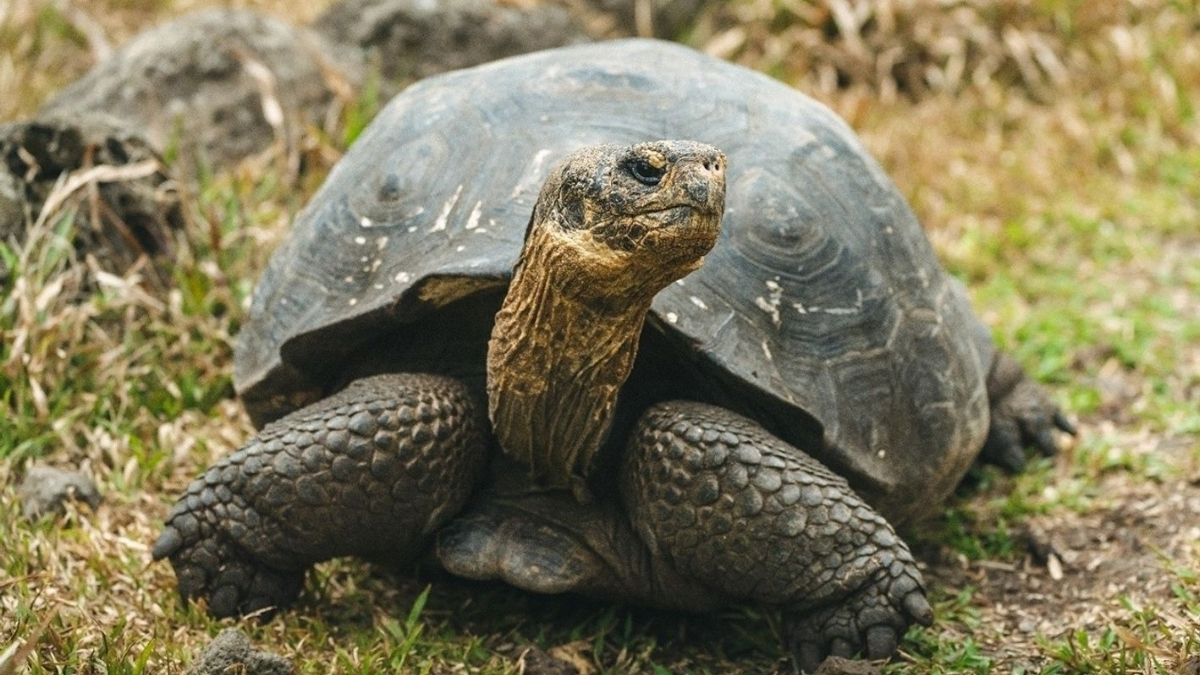
 "Giant tortoises disappeared in the mid-1800s from Floreana Island in the Galápagos.
Credits: © Galápagos Conservancy")
For the first time in more than 150 years, giant tortoises have returned to the wild on Floreana Island in the Galápagos. This was guided by NASA satellite data that helps scientists discover where the animals can find food, water, and nesting habitat.
The effort, a collaboration between the Galápagos National Park Directorate and Galápagos Conservancy, marks a key milestone in restoring tortoise populations to one of the most ecologically distinctive archipelagos on Earth.
Ecuador’s environment ministry said the tortoises were bred and raised at the Fausto Llerena captive breeding center, in Santa Cruz island, using animals with strong genetic ties to a lineage rediscovered on Wolf Volcano.
According to the ministry, the genetic research enabled the breeding program and will allow a phased return of tortoises to Floreana, based on technical criteria.
On Floreana Island, tortoises disappeared in the mid-1800s after heavy hunting by whalers and the introduction of new predators like pigs and rats, which consumed tortoise eggs and hatchlings.
Without the tortoises, the island began to change. Across the Galápagos, giant tortoises historically helped shape the landscape by grazing vegetation, opening pathways through dense plant growth, and carrying seeds across islands.
Quick Reads
View All“This is exactly the kind of project where NASA Earth observations make a difference,” said Keith Gaddis, the manager for NASA Earth Action’s Biological Diversity and Ecological Forecasting program at NASA Headquarters in Washington.
“We’re helping partners answer a practical question: Where will these animals have the best chance to survive, not just today, but decades from now?”
On February 20, the Galápagos National Park Directorate and conservation partners released 158 giant tortoises at two sites on Floreana.
“It’s a huge deal to have these tortoises back on this island. Charles Darwin was one of the last people to see them there,” said James Gibbs, the Galápagos Conservancy’s Vice President of Science and Conservation and a co-principal investigator of the project.
These released juvenile specimens, out of a total of 700 planned for Floreana, will be introduced gradually. According to Christian Sevilla, director of ecosystems of the Galapagos National Park, they carry between 40% and 80% of the genetic makeup of the Chelonoidis niger —a species that has been extinct for 150 years.
The extinction was driven by sailors who took thousands from the island for sustenance during long voyages.
Two centuries ago, Floreana was home to approximately 20,000 giant tortoises. However, whaling, a devastating fire, and relentless human exploitation eventually led to their complete extinction on the island.
“In genetic terms, reintroducing a species to that island with a significant genetic component of the original species is vital,” biologist Washington Tapia told The Associated Press.
The tortoises reintroduced to Floreana will share their territory with a diverse population of nearly 200 people alongside flamingos, iguanas, penguins, sea gulls and hawks.
However, they must also contend with introduced plant species such as blackberry and guava, as well as animals like rats, cats, pigs and donkeys.
These non-native species, introduced by human activity, represent potential threats to the island’s newest inhabitants.
The conservation project became possible after scientists discovered tortoises carrying Floreana ancestry on Wolf Volcano on Isabela island in 2008.
Researchers selected 23 hybrid tortoises with the closest genetic links to the extinct subspecies and began breeding them in captivity on Santa Cruz island.
By 2025, more than 600 hatchlings had been produced, with several hundred now large enough to survive in the wild.
The United Nations designated the Galápagos Islands as a Natural World Heritage Site in 1978. This honor recognizes the islands’ unique abundance of terrestrial and marine species found nowhere else on the planet.
With inputs from agencies
An aspiring globetrotter, Arpita Chowdhury is a writer, poet, and researcher with a strong grounding in human-interest storytelling. She holds an MA in Journalism and International Affairs from University College Dublin, completed in collaboration with the CNN Academy. Her reporting and commentary have appeared in several national and international dailies, spanning travel, culture, politics, and people-centric narratives. Powered by adrak chai, she is always chasing stories that connect place with people. Reach her at arpita.chowdhury2@nw18.com