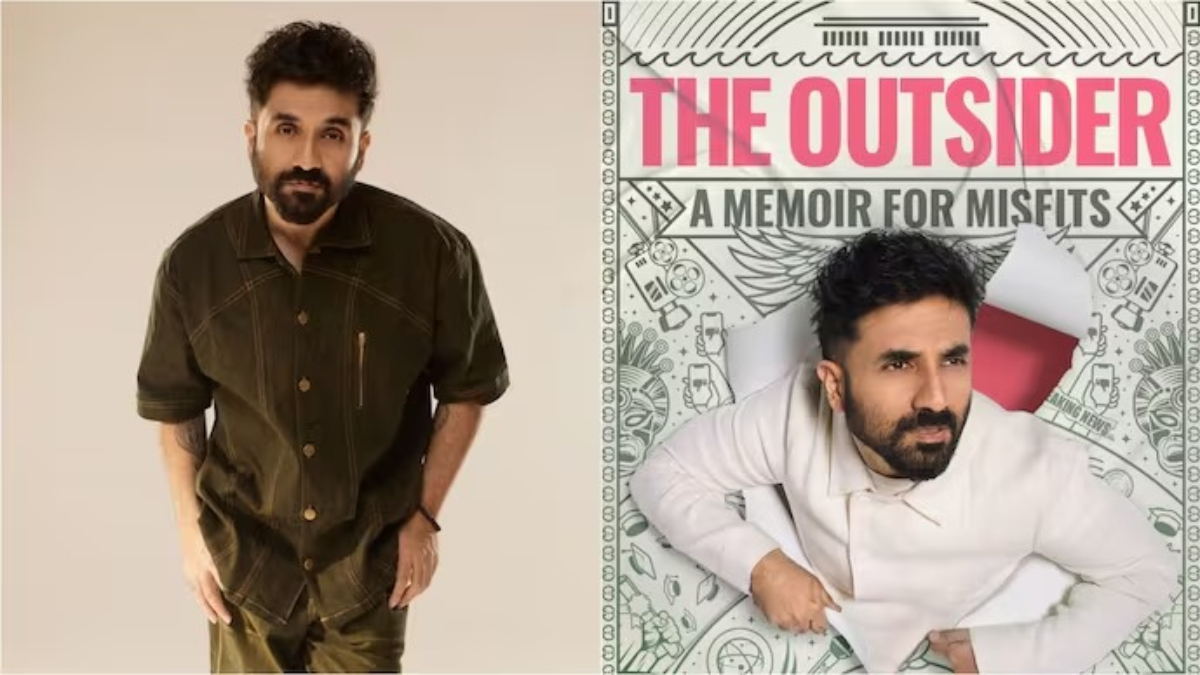
 "EXCLUSIVE | Vir Das on his book ‘The Outsider: A Memoir for Misfits’")
‘The Outsider: A Memoir for Misfits’ by Vir Das is about his world tour of heartbreak, failure, and grit, with chaotic detours through Bollywood and Hollywood–all while being a professional outsider. If you’ve ever felt lost or out of place, this book is for you. Vir Das has a style of his own and is effortlessly amusing and that’s what makes him ‘stand-out’.
In an EXCLUSIVE interview with Firstpost’s Lachmi Deb Roy, Vir Das talks about his journey and how not having a sense of belonging from any particular place means, ‘you also don’t have a sense of entitlement’ and that makes him more ‘observant’. I totally agree with this part of Das when he says, “You don’t go into places thinking you deserve them or own them.”
Vir’s story is one of cultural dissonance and a search for identity. As a child, he bounced from India to Nigeria and back again. He navigated life between worlds, never quite fitting in. In Africa, he was the kid from India, and back in India, he was the kid from Africa.
Edited excerpts from the interview:
Why do you call yourself an outsider?
I feel like I’ve kind of gate crashed the coolest parties in the world. I somehow made it into Bollywood and into the stand-up comedy scene that didn’t exist yet,
Since you consider yourself as an accidental author, just wanted to know how hard writing is for you?
It’s the hardest thing I have ever done. In fact, it’s the hardest thing anyone will ever do. I have massive respect for authors. It is harder than stand-up and even harder than directing.
You’ve been a hustler, done plays, acting in movies, stand-up, and now author, which journey do you enjoy the most, and why?
Stand-up. Stand-up, I think, is the most honest art form. It
is the most direct connection with an audience. It is just only one step away from truth.
You once mentioned that you lost your voice. How traumatic was that experience?
It was very traumatic. It’s like a painter losing the hand that he paints with. But it also kind of brought me to understand the value of silence. So, it forever changed my comedy perspective. If I was ever given a choice, I would definitely go through it again. I would rather put it this way, I would choose to go through it again.
What is your global audience like? Which age group generally are they from?
I think eighty, eighty-five percent of my audience is between the ages of sixteen and thirty years old, so they’re quite young.
Can you tell us a little bit about your childhood days, which has helped you in making the person that you are today?
I think not being from anywhere gives you an acute observation of wherever you are. Sometimes not having a sense of belonging means you also don’t have a sense of entitlement. So, you don’t go into places thinking you deserve them or own them. You go into them really watching them and grateful for them.
How is Aamir Khan as a producer and what is your character in Happy Patel like?
My character, Happy Patel, is of a bumbling spy who is new to India, so he’s an outsider himself. It is the silliest, craziest spy comedy I promise you’ve seen in a very long time!
Lachmi Deb Roy is the Entertainment Editor of Firstpost, Network18. She reviews films and series with a gender lens. She is a 'Rotten Tomatoes' certified critic. Her interviews are called 'Not Just Bollywood' because she takes a huge interest in world cinema. She has been the winner of the prestigious Laadli Media and Advertising Award for Gender Sensitivity for two consecutive years, 2020 and 2021. OTT over theatrical releases is her preference unless and until it's a King Khan film. She takes interest in fashion, food and art reviews too.