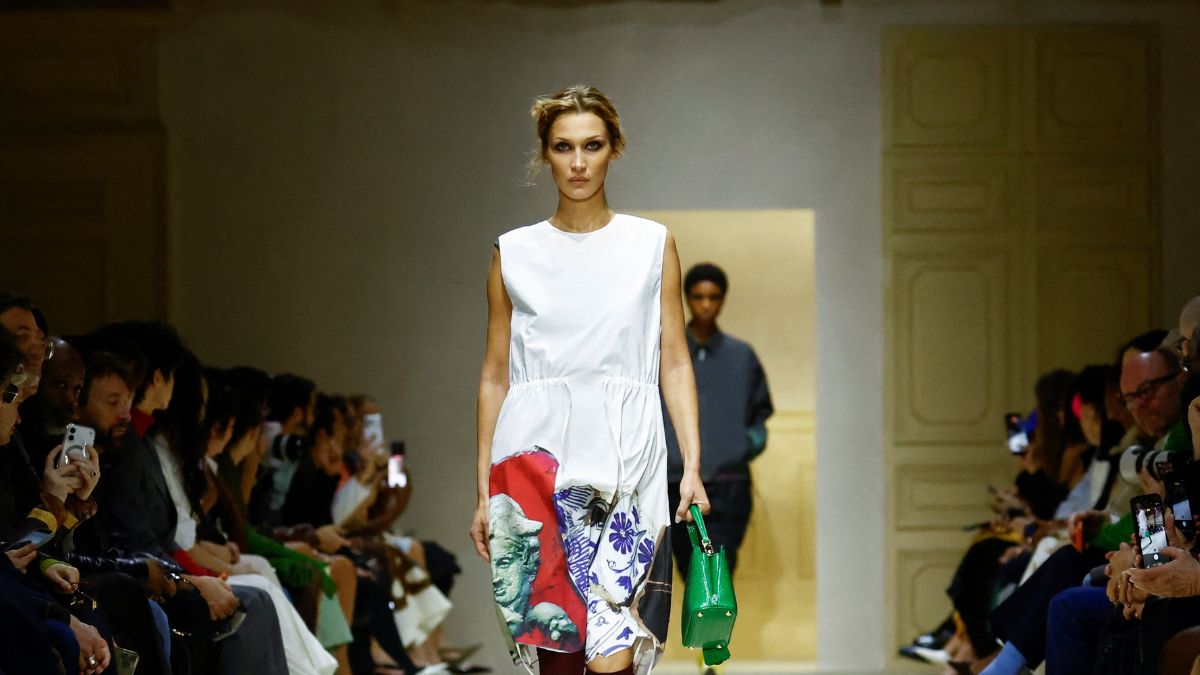
 "Model Bella Hadid walks for the Prada Fall/Winter 2026/2027 collection with a messy ponytail in Milan, February 26, 2026. File photo/REUTERS")
Messy hair feels like the character of the moment. The main character, even.
For a while, beauty was all about polish: slicked-back buns, laminated flyaways, strands disciplined under the reign of the “clean girl.” But somewhere between last year’s shows and this season’s, that gloss has mostly worn off. On the Fall/Winter 2026 runways, the evidence was impossible to ignore among the frizz, texture and free flyaways. The grit was intentional.
At Prada in Milan, hair looked slightly disturbed, as though it had been caught mid-motion before settling. Strands framed sharply tailored silhouettes without being coerced into place. Simone Rocha, long associated with intricate braids and ribbon-threaded romanticism, shifted toward long, faintly frizzy lengths that softened her dreamy femininity without polishing it to perfection. In New York, Collina Strada leaned into tousled texture across hair types, amplifying its playful codes through movement rather than control. Across cities, the absence of overworking was striking.
This wasn’t sudden. As early as the Fall 2025 shows, the brush had already begun to lose authority. Miu Miu sent out models with instinctively rumpled tresses. Prada’s ponytails looked hastily secured, as if done without a mirror. Kenzo embraced shaggy lengths; Stella McCartney showed fuzzy, lived-in waves; Alexander McQueen introduced crimped roots that disrupted smoothness at the scalp; Chloé allowed flyaways to remain visible. It felt less like neglect and more like recalibration.
Guido Palau, who created the deliberately “messed up” looks at Prada, Miu Miu and Dolce & Gabbana, described their appeal as irreverence, the attractiveness of looking like you hadn’t taken too much time. That irreverence has since evolved into something more assured. The mess no longer reads ironic; it reads intentional.
It would be easy to frame this as a revival of ’90s grunge, but the comparison only goes so far. The grunge era wore its disarray as defiance through greasy lengths, anti-glamour, a refusal of beauty’s expectations altogether. The 2026 version is not rejecting beauty but is loosening it. The texture is romantic rather than confrontational. The flyaways coexist with tailoring, and the frizz is placed within luxury.
Quick Reads
View AllAnd that may be why it translates so easily off the runway. This is not a trend that demands reinvention, only permission. Texture spray becomes an essential in makeup bags, enhancing natural hair. Curls are left slightly imperfect, separated with fingers rather than arranged into uniform spirals. Ponytails and messy buns are secured without aggressively smoothing the hairline. Even something as simple as tucking your hair into the collar of a coat and letting it crease and shift throughout the day suddenly feels aligned with fashion’s mood.
After years of hyper-curated beauty, where every strand was laid and every angle documented, this soft disorder feels almost corrective. It suggests that polish is no longer the ultimate aspiration. That effort can exist without exhibition, and beauty can look lived-in.
Fashion often exaggerates what we are already sensing, and right now, the appetite seems to be for something less rehearsed. The lived-in aesthetic acknowledges that hair does not exist in stillness. It reacts to weather, to collars, to touch, to time.
If Fall 2025 hinted at it and Fall/Winter 2026 confirmed it, then bedhead is no longer backstage. It is not a styling accident or a rushed morning. It is a recalibrated ideal, one where looking like yourself, slightly undone, feels not only acceptable, but chic.
From films to music to internet trends, Preetika covers cultural moments that feel bigger than themselves, and the context that makes them matter.